Capítulo uno: La puerta que se rompió
Lo primero que Margaret Whitmore escuchó aquella mañana fue silencio.
No es el silencio apacible de una casa en reposo.
El tipo equivocado.
La cocina de abajo estaba fría. La cafetera no estaba encendida. Los platos del desayuno permanecían intactos en el armario, y la pequeña taza de cerámica blanca que Sofía siempre colocaba junto a la medicación de Margarita no se veía por ninguna parte.
Exactamente a las 7:13 de la mañana, Margaret miró el reloj que estaba encima de la estufa.
Su nuera llegó trece minutos tarde.
Trece minutos.
Para otra mujer, podría no haber significado nada.
Para Margaret, fue otro insulto.
A sus cincuenta y ocho años, Margaret Whitmore creía que en el mundo existían dos tipos de personas: las que entendían la responsabilidad y las que esperaban que alguien más la asumiera.
Durante treinta y seis años, ella había pertenecido a la primera clase.
Había trabajado como ama de llaves en casas caras, criado a un hijo, enterrado a un marido, sobrevivido a deudas, enfermedades, humillaciones y a ese tipo de pobreza que enseña a una persona a contar cada dólar antes de gastarlo.
Ella nunca había llegado tarde al trabajo.
Nunca se quejó de dolor de cabeza.
Nunca se permitió el lujo de quedarse en la cama porque la vida se había vuelto difícil.
Y ahora Sofía, la mujer de veinticinco años que se había casado con su único hijo, ni siquiera podía bajar a preparar el desayuno.
Margaret cerró un armario de golpe.
“Increíble.”
Tomó su medicamento para la presión arterial con un vaso de agua, murmurando entre dientes.
Carlos ya se había marchado para una cita temprana. Tenía que reunirse con alguien para hablar sobre el negocio de construcción de su familia, que estaba en quiebra.
Margaret sabía perfectamente quién era el responsable de ese fracaso.
Sofía.
Desde que Carlos trajo a esa chica a casa, el dinero había empezado a desaparecer, las facturas se habían multiplicado y el futuro, antes prometedor, de su hijo se había sumido en la incertidumbre.
Faltaban treinta mil dólares.
La autorización de retirada falsificada.
Las misteriosas transferencias desde la cuenta de la empresa.
Y, más recientemente, un documento con la firma de Margaret, que autoriza la venta de la pequeña propiedad a orillas del lago que le había dejado su difunto esposo.
Sofía lo había negado todo.
Naturalmente.
Ella siempre lo negó todo.
Margaret miró hacia la escalera.
“¡Sofía!”
Sin respuesta.
Ella alzó la voz.
“¡SOFÍA!”
Todavía nada.
Una extraña irritación recorrió la columna vertebral de Margaret.
Recordó lo que había oído la noche anterior.
Sofía susurrando a alguien detrás de la puerta cerrada del dormitorio.
“No puedo decírselo todavía. No hasta que esté seguro.”
And then another sentence.
“If Margaret finds out before Carlos gets home, everything could fall apart.”
Margaret had stood in the hallway listening.
She had heard enough.
Another secret.
Another lie.
Another scheme being arranged behind her back.
Now the girl was pretending to sleep.
Margaret crossed the kitchen, picked up the wooden handle of a broken mop she had been repairing, and marched upstairs.
Her slippers struck the wooden steps with increasing speed.
She reached the bedroom door.
Locked.
Margaret tried the handle again.
“Sofia! Open this door!”
Nothing.
Her jaw tightened.
“Don’t you dare ignore me!”
Silence.
She stepped backward.
The wooden handle was clutched in her right fist.
Then, with every ounce of anger she had been carrying for months, Margaret lifted her right foot and kicked the door.
BANG!
The old latch snapped.
The door flew inward and struck the wall.
Margaret stormed into the bedroom.
“GET UP, YOU LAZY GIRL! NOW!”
Sofia lay on her side beneath the white comforter, her dark hair spilled across the pillow.
She didn’t move.
Margaret hurried toward the bed.
“Did you hear me?”
She raised the wooden stick.
“YOU DON’T GET TO SLEEP ALL DAY IN MY HOUSE!”
The stick came down hard against the thick blanket covering Sofia’s upper arm.
Once.
A sharp, ugly sound filled the room.
Sofia barely stirred.
Margaret pulled the stick back.
“Now get your lazy…”
She stopped.
Something was wrong.
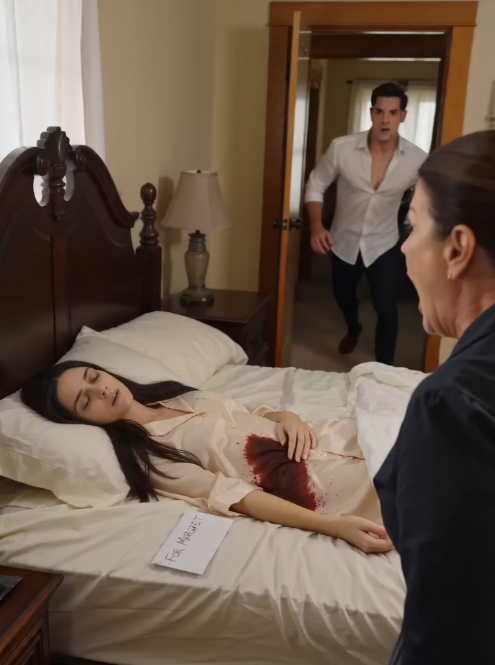
There was a dark red stain on the white bedsheet.
At first, her mind refused to understand what she was seeing.
She looked closer.
The stain spread from beneath Sofia’s body toward the edge of the mattress.
Margaret’s throat tightened.
“Sofia?”
No response.
She noticed the girl’s left hand hanging over the side of the bed.
Her fingers were motionless.
And the color of her face…
Dear God.
The color of her face.
“Sofia?”
Margaret’s voice changed.
The wooden stick slipped from her fingers.
It struck the floor with a hollow clatter.
She reached toward Sofia, but her hand stopped a few inches from the girl’s shoulder.
There was so much blood.
More than Margaret had ever seen outside a hospital.
“Sweetheart?”
For the first time in months, the word escaped her without bitterness.
Sofia’s eyelashes fluttered.
Her lips moved slightly.
Margaret leaned closer.
“What? What are you saying?”
But the girl made no sound.
Margaret stumbled backward.
Her knees nearly gave way.
Then she turned toward the broken doorway and screamed.
“CARLOS!”
The sound tore through the house.
“CARLOS! HELP!”
Footsteps thundered up the stairs.
A moment later, her son appeared.
Carlos Whitmore was thirty-two, with dark hair, tired eyes, and a white dress shirt he had buttoned incorrectly that morning.
He had been outside in the driveway, searching his car for a folder he’d forgotten.
Now he stood in the doorway, staring at the scene before him.
His wife.
The blood.
The broken door.
The wooden stick lying near his mother’s feet.
For half a second, he didn’t move.
Then he ran.
“Sofia!”
He dropped to his knees beside the bed and carefully supported her head and shoulders.
“Sofia! Can you hear me?”
Her eyes opened a fraction.
“Carlos…”
“I’m here. I’m right here.”
He reached for his phone.