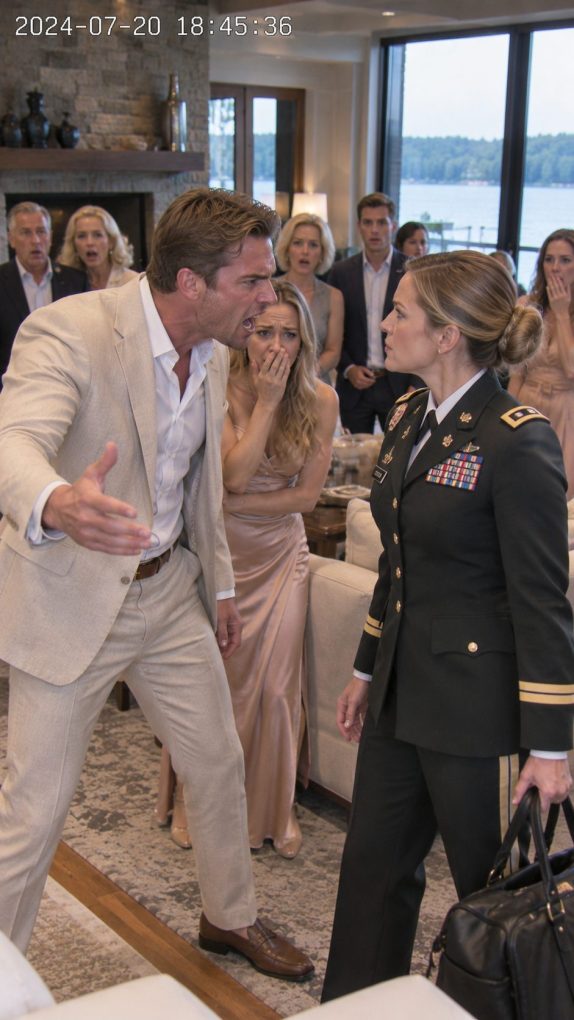
« Dégage, parasite ! » hurla mon beau-frère à quelques centimètres de mon visage pendant notre fête de famille. Il menaçait de faire expulser de force la sécurité sous le regard d’une vingtaine de proches. J’ai discrètement pris mon sac militaire et je me suis éloigné. Dix minutes plus tard, je discutais avec un officier supérieur de l’armée d’une chose que mon beau-frère voulait absolument cacher.
Je suis le colonel Emily Carter. J’ai quarante-cinq ans et je sers depuis vingt-trois ans dans l’armée américaine. Je suis rentrée en Virginie du Nord après une mission à l’étranger, espérant fêter le soixante-dixième anniversaire de mon père dans la maison au bord du lac que j’avais achetée six ans auparavant.
Ma sœur cadette, Rachel, et son mari, Ryan Mitchell, logeaient temporairement chez moi le temps de rénover leur maison. Je l’avais autorisé car Rachel faisait partie de la famille. Malheureusement, Ryan a commencé à se comporter comme si la maison lui appartenait : il organisait des fêtes, changeait les serrures et disait à nos proches que j’étais un simple soldat au chômage vivant des allocations sociales.
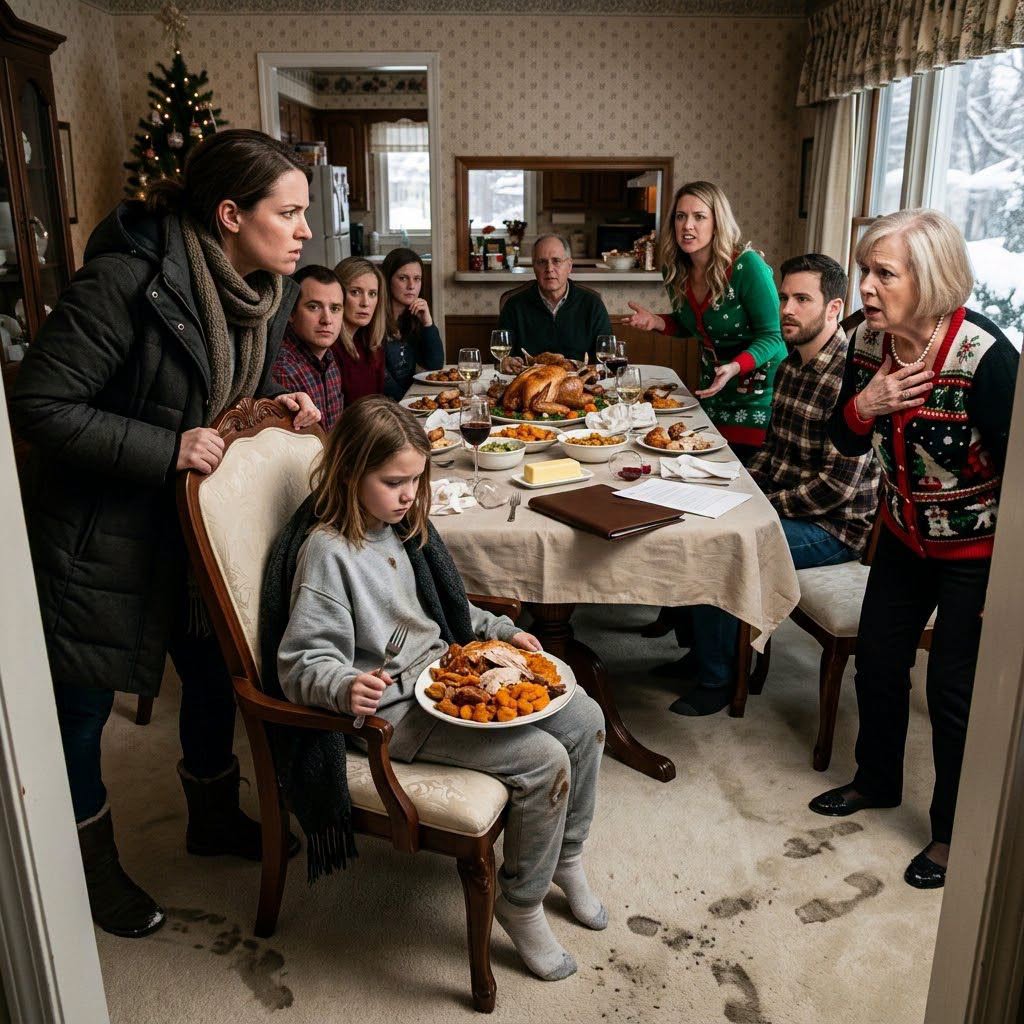
Ce samedi après-midi, je suis arrivée avec mon sac de sport militaire noir. Une vingtaine de proches étaient réunis dans la salle à manger lorsque Ryan m’a barré la route. Il a exigé de savoir pourquoi je m’étais présentée sans autorisation. Je lui ai calmement rappelé que mon nom figurait sur l’acte de propriété.
Ryan éclata de rire. Il attrapa mon sac de sport et le jeta vers la porte, éparpillant plusieurs affaires personnelles. Rachel se tenait derrière lui, évitant mon regard. Mon père tenta d’intervenir, mais Ryan frappa violemment la table à manger du poing et ordonna à tout le monde de ne pas s’en mêler.
« Tu crois que porter un uniforme te donne de l’importance ? » hurla Ryan. « Tu n’es qu’un parasite qui s’attend à ce que tout le monde te respecte ! » Il s’approcha et menaça d’appeler ses contacts pour me faire expulser. Plusieurs proches fixaient le sol tandis que d’autres filmaient nerveusement la scène.
J’ai pris mon sac sans répondre. Avant de partir, j’ai remarqué plusieurs véhicules inconnus garés près du garage. Deux hommes portant des vestes brodées du logo de Sentinel Defense Solutions déchargeaient des caisses de matériel scellées. Ryan s’est immédiatement interposé entre moi et les fenêtres lorsqu’il a remarqué où je regardais.
À l’extérieur, j’ai appelé le général de division Thomas Whitaker, un officier supérieur chargé de superviser un audit de conformité des contrats de défense concernant plusieurs installations de l’armée. Plus tôt dans la semaine, il m’avait demandé de signaler toute préoccupation crédible concernant Sentinel, un sous-traitant faisant actuellement l’objet d’une enquête sur des documents relatifs à du matériel à accès restreint.
I explained what I had witnessed, carefully separating facts from suspicions. Whitaker instructed me not to confront anyone or handle the equipment. He said he would refer the information to the appropriate investigative authorities because my brother-in-law had previously worked as a subcontractor for Sentinel.
As I ended the call, my father hurried onto the porch, looking terrified. He whispered that Ryan had been using my garage for months and had forbidden anyone from entering it. Then he handed me an envelope Ryan had accidentally left inside. Across its front were three words that made my stomach tighten: Restricted Inventory Transfer.
I opened the envelope only far enough to recognize the document heading, then stopped. I knew better than to examine materials that might belong to a sensitive investigation. I photographed the envelope’s exterior, placed it in a clean folder, and called the investigator whose contact information General Whitaker had provided.
Within an hour, a representative from the Army Criminal Investigation Division contacted me. He explained that investigators would need to establish whether the equipment had any connection to government property before taking further action. I gave him Ryan’s employment details, the vehicle descriptions, and my father’s account of the garage activity.
Meanwhile, Ryan called me repeatedly. When I finally answered, he demanded that I return immediately and apologize in front of the family. He claimed I had embarrassed him during an important business gathering. I told him the discussion was over and that he needed to remove his unauthorized equipment from my property.
Ryan’s tone changed. He suddenly offered to pay me $20,000 if I allowed him to continue using the garage for another month. When I refused, he threatened to sue me for interfering with his business. I ended the conversation and preserved the messages for investigators.
That evening, Rachel arrived at my temporary apartment crying. She confessed that Ryan had told her he was storing surplus communications equipment purchased through legitimate government auctions. But she had recently discovered invoices showing serial numbers that didn’t match the inventory descriptions. Whenever she questioned him, he became furious.
Rachel also revealed that Ryan had been using my address as the registered storage location for his subcontracting company without my permission. She had discovered the paperwork while searching for mortgage records. Worse, Ryan had instructed her to sign documents confirming that I had authorized the arrangement.
I asked whether she had signed anything. Rachel shook her head, explaining that she had refused and secretly photographed the forms. When she showed me the pictures, I saw a supposed authorization letter bearing my printed name and a signature that resembled mine. I had never signed it.
The following morning, investigators obtained the appropriate legal authorization to examine the garage. I cooperated as the property owner but remained outside while trained personnel documented the contents. They recovered equipment and records that required further verification against government inventory databases. No one suggested that my military rank gave me special authority over the investigation.