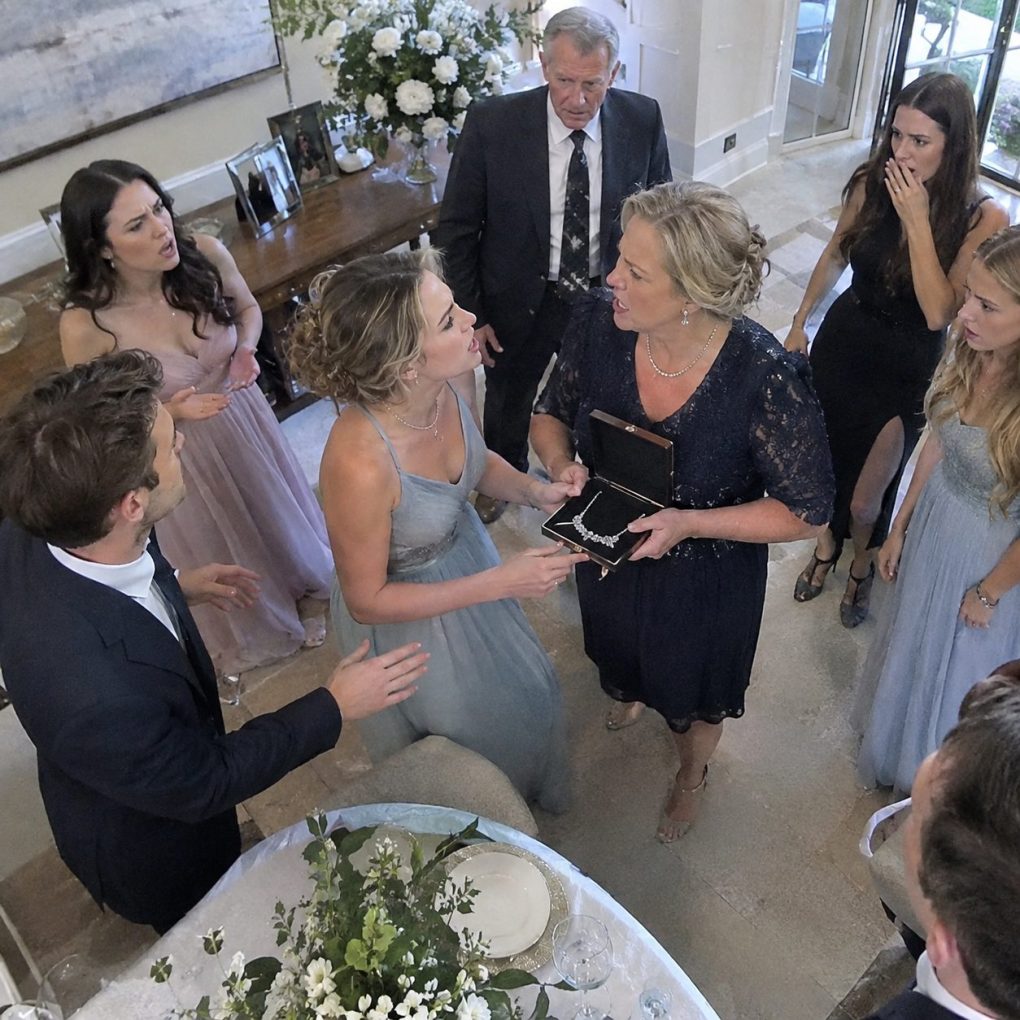
Meine Stiefmutter öffnete vor der gesamten Familie die Schmuckschatulle meiner verstorbenen Mutter, nahm die Diamantkette heraus, die ich drei Jahre lang unberührt aufbewahrt hatte, und verkündete, dass sie zur Hochzeit ihrer Tochter mitgebracht werden würde.
„Rachel braucht etwas, das ihrer Hochzeit würdig ist“, sagte Linda und hielt die Kette meiner Mutter an Rachels weißes Kleid, während alle in unangenehmem Schweigen zusahen.
Ich stand auf der anderen Seite des Wohnzimmers und spürte eine seltsame Ruhe in mir, denn Linda ahnte nicht, dass die Kette in ihrer Hand bereits eine Nachbildung war.
„Die gehörten meiner Mutter“, sagte ich und sprach so leise, dass alle aufhören mussten zu reden, um mich zu verstehen.
Linda verdrehte die Augen und antwortete: „Deine Mutter ist tot, Claire, und Schmuck in einer Schachtel nützt niemandem.“
Mein Vater schaute weg.
Das tat mehr weh als Lindas Worte.
Meine Mutter, Evelyn, hatte während ihrer Ehe eine kleine Anzahl schöner Schmuckstücke gesammelt, aber es war ihr nie wichtig gewesen, sie zur Schau zu stellen. Nach ihrem Tod gab mir mein Vater ihren Schmuck, weil er wusste, dass jedes Stück eine Erinnerung in sich trug, die mir wichtiger war als sein Marktwert.
Linda hat das nie akzeptiert.
Jahrelang schlug sie immer wieder vor, dass Rachel den Schmuck erben sollte, weil Rachel „die Tochter sei, die tatsächlich eine Zukunft habe“, während ich angeblich zu sentimental und verantwortungslos sei, um seinen Wert zu verstehen.
Sechs Monate zuvor hatte Linda versucht, den Schmuck zu stehlen, als ich meinen Vater nach seiner Operation besuchte.
Da begriff ich endgültig, dass es nicht mehr sicher war, die Originalstücke im Haus aufzubewahren.
Ich brachte alles zu einem seriösen Juwelier, ließ jedes Stück fotografieren und professionell begutachten und deponierte die Originale in einem Bankschließfach.
Anschließend kaufte ich überzeugende Repliken und legte sie, genau wie zuvor, wieder in die mit Samt ausgekleideten Schachteln zurück, wohl wissend, dass ich eines Tages beweisen müsste, dass jemand sie absichtlich entwendet hatte.
Ich hätte nie erwartet, dass dieser Moment bei einem Probeessen für eine Hochzeit kommen würde.
Linda hielt die Halskette hoch und lächelte.
„Rachel wird wunderschön aussehen in den Diamanten deiner Mutter.“
Rachel zögerte.
„Mama, bist du sicher, dass Claire damit einverstanden ist?“
Linda lachte.
„Sie wird es verkraften.“
Ich schaute Rachel an, anstatt Linda.
„Weißt du, was du da trägst?“
Rachel runzelte die Stirn.
Bevor sie antworten konnte, trat Linda zwischen uns und fuhr uns an: „Hör auf, die Hochzeit deiner Stiefschwester zu ruinieren.“
Ich holte mein Handy heraus und öffnete ein Foto meiner Mutter, auf dem sie die Originalkette Jahre zuvor getragen hatte.
Dann sah ich Linda direkt an.
„In einem Punkt hast du recht“, sagte ich. „Ich werde ihre Hochzeit nicht ruinieren.“
Linda smiled triumphantly.
I continued, “But you might want to check what you’re actually giving her.”
Her smile disappeared.
And for the first time that evening, my father finally looked at me.
Linda stared at me as though I had just insulted her, then laughed loudly enough for everyone at the table to hear.
“Claire is bluffing because she wants the attention back,” she said.
I said nothing.
Instead, I asked Rachel to look at the necklace carefully.
Rachel lifted it toward the chandelier, and Linda immediately snapped, “Don’t start examining it like some detective.”
That reaction told me more than I needed.
My mother’s original necklace had a tiny engraving inside the clasp, a detail Linda had never noticed because she had never cared about the history of the jewelry, only its value.
Rachel searched for it.
She found nothing.
Her expression changed.
“Mom,” she whispered, “there’s no engraving.”
Linda’s face hardened.
“That proves nothing.”
“It proves everything,” I answered.
My father finally stood.
“Claire, what did you do?”
“I protected what Mom left me.”
I explained that the original necklace, earrings, bracelet, and wedding ring were not in that house anymore.
They had been professionally appraised, photographed, insured, and stored securely months before.
Linda looked at Dad.
“You knew about this?”
He shook his head.
Then Linda turned on me.
“You deliberately replaced them with fakes?”
“Yes.”
“You set a trap for me?”
“No,” I said. “I removed the opportunity for you to steal from me.”
That distinction started an argument that lasted nearly twenty minutes.
Linda accused me of humiliating her, while Rachel began crying because she realized her mother had given her something she had no right to take.
Then Rachel said something that silenced everyone.
“Mom, did you tell Claire you were taking them?”
Linda avoided her eyes.
Rachel asked again.
“Did you ask her?”
“No,” Linda finally admitted.
My father sat down heavily.
Then he looked at me and said, “Why didn’t you tell me?”
I stared at him for several seconds.
“Because every time I told you Linda was taking things that belonged to Mom, you told me I was being possessive.”
He had no answer.
But Linda was not finished.
She suddenly said, “Fine. If the originals are yours, prove they exist.”
I almost laughed.
She had just given me exactly what I needed.
The next morning, I contacted the jeweler who had handled the appraisal.
He confirmed the originals were documented and still secured.
But during that conversation, he mentioned something I had completely forgotten.
There was one additional item on the original appraisal.
My mother’s wedding ring.
And according to his records, that ring had been presented to the jeweler by someone else two months earlier.
Someone using my father’s name.
I drove to the jeweler that afternoon with my father beside me, because for the first time since my mother died, he seemed genuinely frightened by what he might discover.
The jeweler pulled up the transaction record and showed us the intake photograph.
The ring was unmistakable.
It was my mother’s wedding ring, the one Dad had given me after her funeral.
Except I had never given it to anyone.
Dad stared at the photograph.
“That signature isn’t mine,” he said.