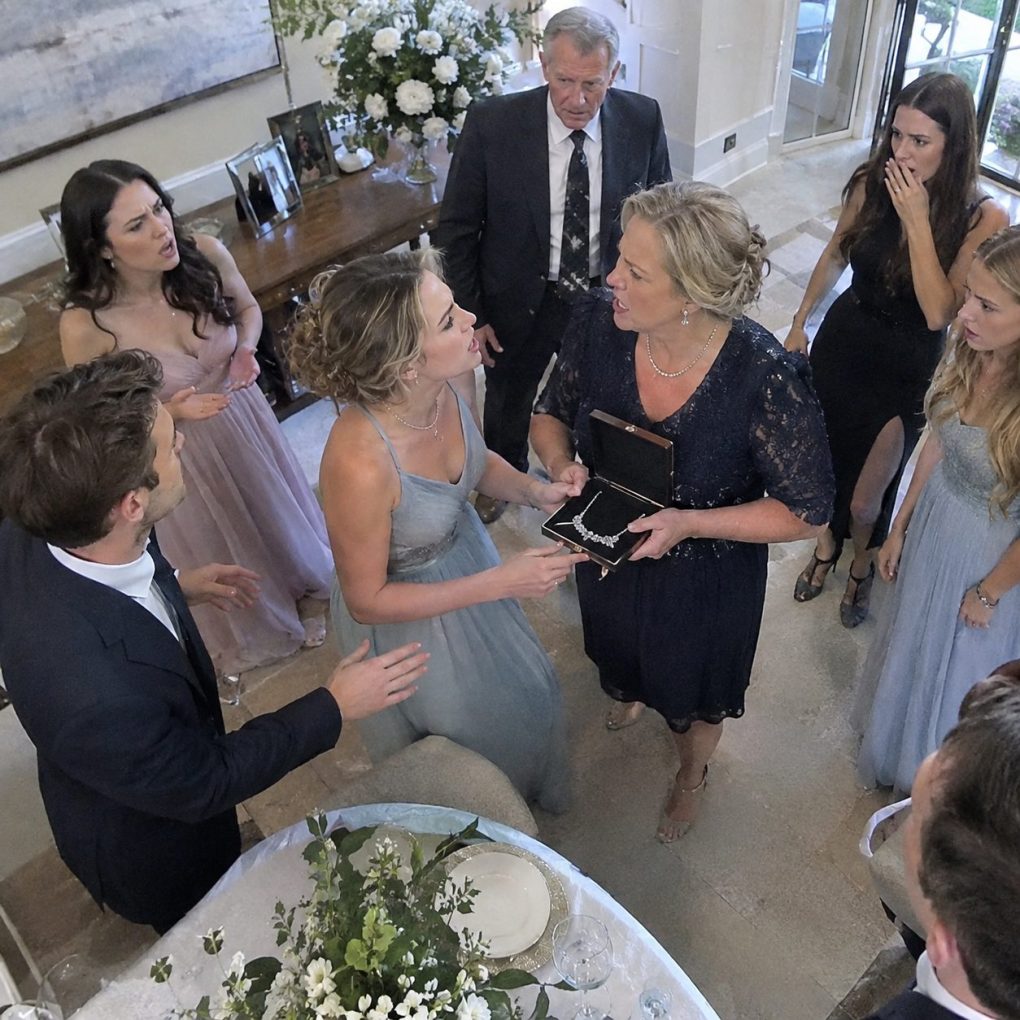
Mi madrastra abrió el joyero de mi difunta madre delante de toda la familia, sacó el collar de diamantes que yo había guardado intacto durante tres años y anunció que iría a la boda de su hija.
—Rachel necesita algo digno de su boda —dijo Linda, sosteniendo el collar de mi madre contra el vestido blanco de Rachel mientras todos observaban en un silencio incómodo.
Me quedé al otro lado de la sala y sentí una extraña calma en mi interior, porque Linda no tenía ni idea de que el collar que tenía en la mano era una réplica.
—Esas joyas pertenecían a mi madre —dije, bajando la voz lo suficiente como para que todos tuvieran que callarse para oírme.
Linda puso los ojos en blanco y respondió: —Tu madre está muerta, Claire, y las joyas guardadas en una caja no le sirven de nada a nadie.
Mi padre desvió la mirada.
Eso dolió más que las palabras de Linda.
Mi madre, Evelyn, había coleccionado algunas piezas preciosas durante su matrimonio, pero nunca le importó exhibirlas, y después de su muerte, mi padre me dio sus joyas porque sabía que cada pieza guardaba un recuerdo que era más importante para mí que su valor de mercado.
Linda nunca lo aceptó.
Durante años, ella sugirió repetidamente que Rachel debería heredar las joyas porque Rachel era “la hija que sí tenía un futuro”, mientras que yo supuestamente era demasiado sentimental e irresponsable para comprender su valor.
Seis meses antes, Linda había intentado robarme las joyas mientras yo visitaba a mi padre después de su operación.
Fue entonces cuando finalmente comprendí que conservar las piezas originales en casa ya no era seguro.
Llevé todas las joyas a una joyería de renombre, hice fotografiar cada pieza y obtener una tasación profesional, y guardé los originales en una caja de seguridad privada.
Luego compré réplicas convincentes y las devolví a las cajas forradas de terciopelo tal como estaban, sabiendo que algún día podría necesitar demostrar que alguien las había robado deliberadamente.
Jamás esperé que ese momento llegara en la cena de ensayo de una boda.
Linda alzó el collar y sonrió.
“Rachel se verá preciosa luciendo los diamantes de tu madre.”
Rachel dudó.
“Mamá, ¿estás segura de que Claire está de acuerdo con esto?”
Linda se rió.
“Lo superará.”
Miré a Rachel en lugar de a Linda.
“¿Sabes lo que llevas puesto?”
Rachel frunció el ceño.
Antes de que pudiera responder, Linda se interpuso entre nosotras y espetó: “Deja de intentar arruinar la boda de tu hermanastra”.
Saqué mi teléfono y abrí una fotografía de mi madre luciendo el collar original años atrás.
Entonces miré directamente a Linda.
—Tienes razón en una cosa —dije—. No voy a arruinarle la boda.
Linda smiled triumphantly.
I continued, “But you might want to check what you’re actually giving her.”
Her smile disappeared.
And for the first time that evening, my father finally looked at me.
Linda stared at me as though I had just insulted her, then laughed loudly enough for everyone at the table to hear.
“Claire is bluffing because she wants the attention back,” she said.
I said nothing.
Instead, I asked Rachel to look at the necklace carefully.
Rachel lifted it toward the chandelier, and Linda immediately snapped, “Don’t start examining it like some detective.”
That reaction told me more than I needed.
My mother’s original necklace had a tiny engraving inside the clasp, a detail Linda had never noticed because she had never cared about the history of the jewelry, only its value.
Rachel searched for it.
She found nothing.
Her expression changed.
“Mom,” she whispered, “there’s no engraving.”
Linda’s face hardened.
“That proves nothing.”
“It proves everything,” I answered.
My father finally stood.
“Claire, what did you do?”
“I protected what Mom left me.”
I explained that the original necklace, earrings, bracelet, and wedding ring were not in that house anymore.
They had been professionally appraised, photographed, insured, and stored securely months before.
Linda looked at Dad.
“You knew about this?”
He shook his head.
Then Linda turned on me.
“You deliberately replaced them with fakes?”
“Yes.”
“You set a trap for me?”
“No,” I said. “I removed the opportunity for you to steal from me.”
That distinction started an argument that lasted nearly twenty minutes.
Linda accused me of humiliating her, while Rachel began crying because she realized her mother had given her something she had no right to take.
Then Rachel said something that silenced everyone.
“Mom, did you tell Claire you were taking them?”
Linda avoided her eyes.
Rachel asked again.
“Did you ask her?”
“No,” Linda finally admitted.
My father sat down heavily.
Then he looked at me and said, “Why didn’t you tell me?”
I stared at him for several seconds.
“Because every time I told you Linda was taking things that belonged to Mom, you told me I was being possessive.”
He had no answer.
But Linda was not finished.
She suddenly said, “Fine. If the originals are yours, prove they exist.”
I almost laughed.
She had just given me exactly what I needed.
The next morning, I contacted the jeweler who had handled the appraisal.
He confirmed the originals were documented and still secured.
But during that conversation, he mentioned something I had completely forgotten.
There was one additional item on the original appraisal.
My mother’s wedding ring.
And according to his records, that ring had been presented to the jeweler by someone else two months earlier.
Someone using my father’s name.
I drove to the jeweler that afternoon with my father beside me, because for the first time since my mother died, he seemed genuinely frightened by what he might discover.
The jeweler pulled up the transaction record and showed us the intake photograph.
The ring was unmistakable.
It was my mother’s wedding ring, the one Dad had given me after her funeral.
Except I had never given it to anyone.
Dad stared at the photograph.
“That signature isn’t mine,” he said.