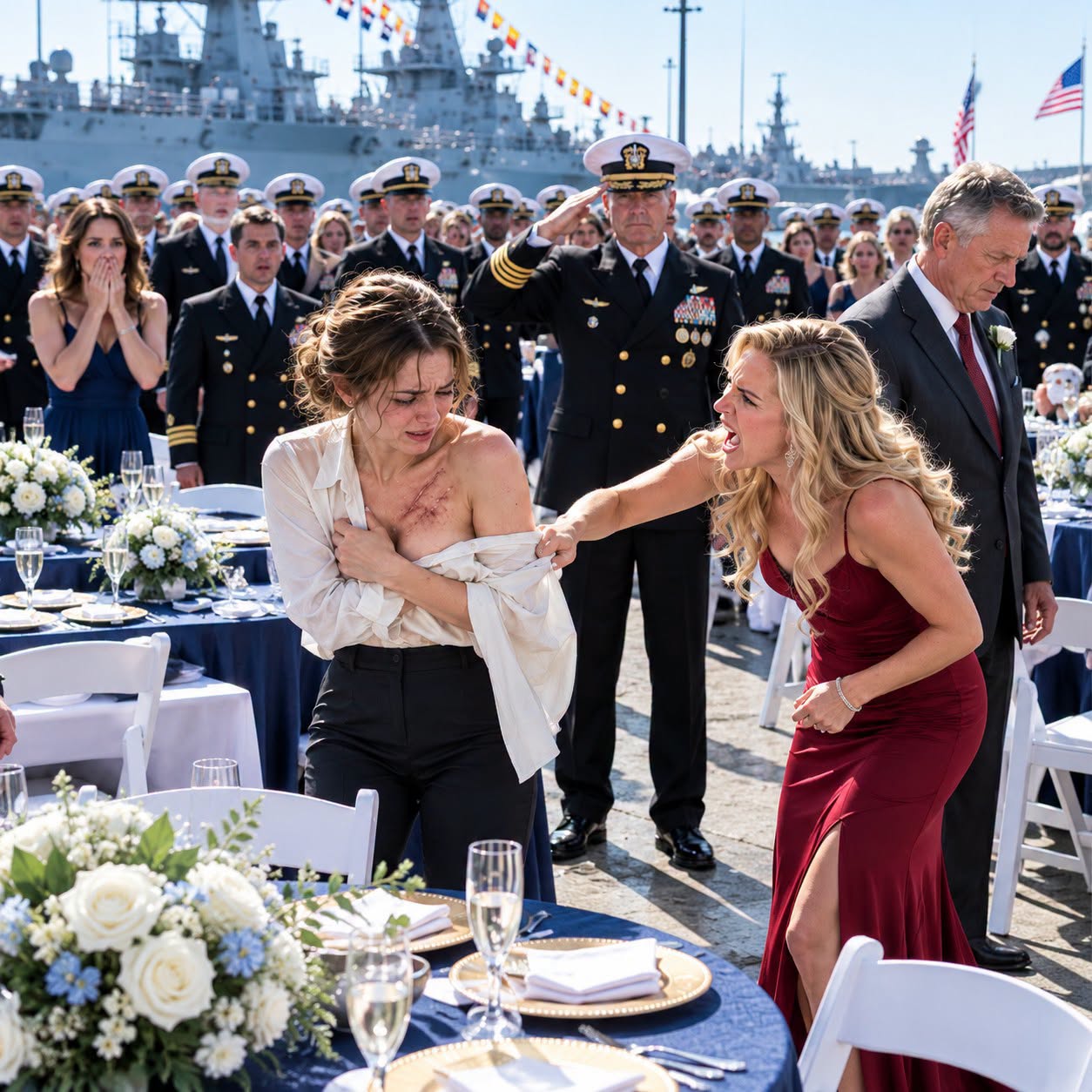
El salón de baile del Norfolk Waterside Marriott olía a latón pulido, costillas de primera calidad y sal marina añeja, disimulado por cera de lavanda. Era un aroma que el capitán Hugh Alden, USN (Ret.), llevaba consigo como un manto ancestral. Durante cincuenta años, nuestro apellido había pertenecido a la aristocracia azul y dorada de Norfolk. En la mente de mi padre, solo existían dos tipos de personas en la tierra: las que servían con un expediente intachable hasta su jubilación y las que deshonraban al cuerpo de oficiales.
Durante cinco años, ocupé una tercera categoría, tácita: la del fantasma.
Llevaba un traje de seda azul marino de cuello alto, con hombros estructurados y una espalda opaca que se extendía limpiamente hasta la nuca. Debajo de la tela, la piel no era piel en absoluto, sino un tapiz de aloinjertos entrelazados, bandas fibrosas rígidas y crestas queloides que tiraban con fuerza cada vez que me inclinaba sobre una mesa. A simple vista, parecía un ejecutivo que se había retirado del servicio militar para dedicarse a la empresa privada; una decisión que mi padre consideraba un acto de cobardía silenciosa, pero que toleraba en público siempre y cuando mantuviera la frente en alto y la boca cerrada.
—Ponte derecha, Maya —murmuró mi padre, apenas entreabriendo los labios mientras el comandante Douglas Vance pasaba con un vaso de bourbon—. Tu postura encorvada hace que se te suba la chaqueta. Pareces una teniente subalterna esperando la orden de alto.
“Estoy de pie, papá”, dije en voz baja, manteniendo las manos ligeramente entrelazadas sobre mi bolso de mano.
“Te ves tenso. La gente pensará que te arrepientes de haberte ido.” Tomó un sorbo seco de su agua con gas y lima. Había dejado de beber alcohol después de su tercer bypass, pero su tono conservaba la dureza de un bourbon de 45 grados. “Intenta sonreír. El marido de Marin está intentando cerrar un contrato con NAVSEA esta noche. Lo mínimo que puedes hacer es no parecer una nube negra que se cierne sobre su mesa.”
Al otro lado del abarrotado suelo de parqué, mi hermana menor, Marin, estaba radiante. Llevaba un vestido de satén color champán, sin mangas y con la espalda descubierta, y su cabello rubio recogido en una corona de rizos sueltos que reflejaban la luz de la lámpara de araña. A su lado estaba Gregory, su marido desde hacía tres años, vicepresidente ejecutivo de Titan Marine Logistics. Gregory nunca había vestido un uniforme, pero tenía la sonrisa agresiva y dentuda de un hombre que vendía juntas auxiliares para motores diésel a las juntas de compras con un margen de beneficio del cuatrocientos por ciento.
Marin caught my eye, waved a manicured hand, and excused herself from a circle of junior officers. She drifted toward us, her silk train whispering against the carpet.
“Look at you, Maya,” Marin purred, stepping between me and our father. She reached out and touched my high neckline, her fingernail grazing the stiffened collar. “Still dressing like a church librarian in August? It’s seventy-two degrees in here. You must be suffocating.”
“I’m fine, Marin,” I said evenly.
“Well, you don’t look fine. You look like you’re hiding.” She turned her dazzling smile onto Dad. “Doesn’t she, Daddy? We brought her out of that drafty little apartment in Portsmouth so she could socialize with normal human beings, and she’s standing by the potted ficus like an escort.”
My father let out a dry, dismissive breath. “Leave your sister alone, Marin. Just make sure Gregory doesn’t corner Admiral Harris until after dinner. Harris hates business talk before the salad course.”
“Oh, Gregory doesn’t need Harris,” Marin said smoothly. Her eyes flickered back to me, sharpening with a predator’s focus. “Actually, Maya, that reminds me. Gregory needs an introduction to Captain Miller over at SUPSHIP. Miller was your old skipper on the Vanguard, wasn’t he?”
My chest tightened beneath the silk. “Miller was my commanding officer five years ago, yes.”
“Great. Titan Marine just released a new line of rapid-seal thermal cut-off valves for auxiliary engine rooms. Gregory needs Miller to sign off on an accelerated field evaluation. Take him over there and give Gregory your personal recommendation.”
I looked across the room at Captain Miller, now grey-haired and thick-waisted, speaking with a pair of supply corps commanders. Then I looked at Marin. “Has the valve completed independent shock-and-vibe testing at NAVSSES?”
Marin blinked, annoyed. “What does that matter? It passed the preliminary factory bench run. Gregory says it’s fine.”
“Factory bench runs don’t simulate a ruptured high-pressure steam line or a secondary electrical fire in sea state five,” I replied, keeping my voice low and level. “If the valve hasn’t cleared Naval Surface Warfare Center certification, I won’t ask Miller to bypass protocol. I won’t put my name behind it.”
Marin’s jaw stiffened. A delicate flush crept up her neck, clashing with the champagne silk. “You won’t put your name behind it? What name, Maya? What name do you actually have left in this room?”
“Marin,” I warned softly.
“No, I’m serious!” Her voice rose, cutting through the murmur of the brass quintet playing nearby. Several heads turned. “You’ve spent five years moping around Hampton Roads, living off your disability pension, acting like you’re some tragic hero who gave everything for the flag. You washed out of the Navy! You had an incident, you lost your nerve, and you quit the moment things got rough!”
“That is enough,” I whispered, every muscle in my spine locking.
“Don’t tell me what’s enough!” Marin sneered, her eyes gleaming with sudden, spiteful malice. She took a half-step closer, lowering her voice so only the surrounding dozen officers could hear clearly. “You think you’re better than me. You think you’re better than Gregory. You sit there with your high collar acting like a saint who sacrificed her youth, when everyone in the wardroom knows you couldn’t take the heat. You panicked, Maya. You ran.”
“I didn’t run.”