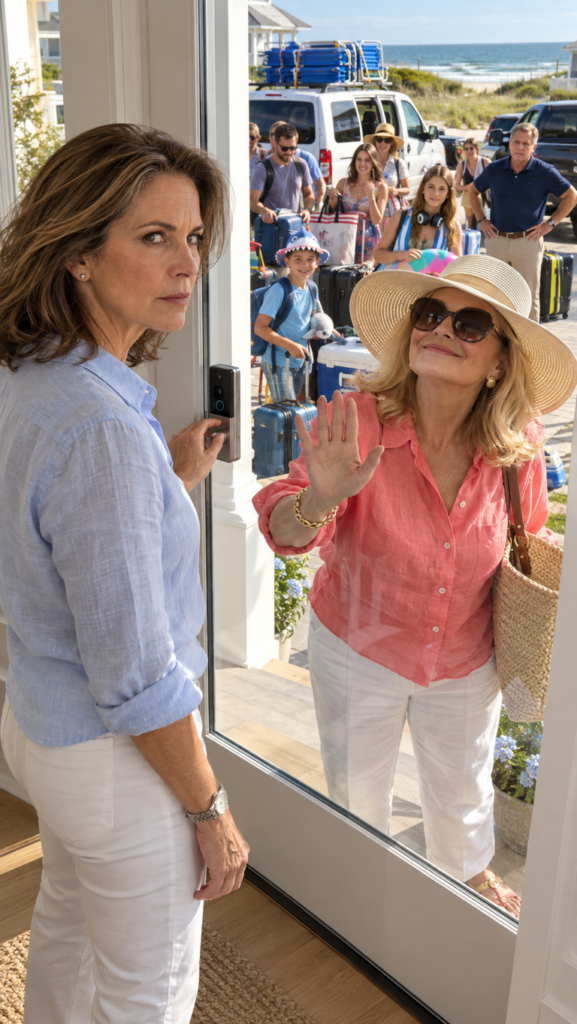
My sister didn’t ask if she could use my brand-new beach house.
She called me less than an hour after I signed the closing papers and announced that she, her husband, and twenty members of his family would be arriving Friday. She told me to prepare the bedrooms, buy extra towels, fill the refrigerator, and plan meals because they intended to stay for two full weeks. I was standing barefoot in my empty living room, holding the silver key to a house I had spent twelve years saving for, when I realized she was completely serious.
The place wasn’t a mansion or a rental resort. It had three bedrooms, one small office, a den, and a single kitchen, yet my sister Marissa had somehow promised twenty-two people there would be “plenty of room.” When I told her she had never asked me for permission, she laughed as though ownership were a technical detail. Then she said the words she had used against me for most of my life: “We’re family.”
That phrase had always meant I was expected to give something up. I had loaned her money she never repaid, organized birthdays she took credit for, babysat when she needed help, handled family emergencies, and swallowed insults because anyone who challenged Marissa was accused of “causing drama.” Even after our mother died, she had turned grief into another weapon, telling relatives that I had abandoned everyone because I eventually moved away from the town where I had spent months caring for Mom.
But this house was different. Every room represented years of overtime, cheap apartments, postponed vacations, and saying no to things I wanted so I could finally have something peaceful of my own. I had imagined quiet coffee on the deck and mornings where no one needed anything from me. I had not imagined my sister volunteering my home as a free vacation property for people I barely knew.
So I told her no.
For once, I didn’t apologize after saying it. I didn’t soften it, bargain, or offer another weekend. I simply told her that she and Greg’s relatives were not spending two weeks in my house.
Marissa went silent for a moment. Then she accused me of being selfish, said Greg’s parents had already taken vacation time, and reminded me that children had been promised a beach trip. When I asked why any of that was my responsibility when I had never invited them, she told me I “owed” her for leaving after Mom died.
That was when something inside me finally settled. I told her grief did not give her ownership of my money, my time, or my house. She answered by threatening to tell the entire family how badly I had treated her.
Then she hung up.
Within minutes, the calls started. An aunt accused me of ruining a family vacation, cousins called me greedy, and Greg’s mother demanded to know why I had suddenly canceled a trip after supposedly inviting everyone. That was the moment I learned Marissa had not merely assumed I would agree.
She had lied.
She had told Greg’s entire family that I had invited them myself. She claimed I wanted everyone together to celebrate the new house and had insisted they not book hotels. By the time I tried to explain the truth, she had already created a story where I was the cruel sister who had promised children a vacation and then changed my mind at the last second.
Then she posted publicly.
She wrote that money and property had “changed me,” that I had invited the family and then withdrawn the invitation simply to humiliate her. Relatives who knew nothing about the real conversation began commenting that family should matter more than possessions. People who had not contributed one dollar toward my home suddenly had strong opinions about what I should do with it.
My first instinct was to defend myself. I wanted to call everyone, send screenshots, explain the closing date, explain the bedrooms, explain that Marissa had only told me about this trip two days before it was supposed to begin. That was what I had always done—worked twice as hard to prove I was reasonable whenever she crossed a line.
But then another message arrived.
“We’re coming Friday whether you like it or not.”
A second followed.
“You won’t embarrass me in front of Greg’s family.”
Then came the one that changed everything.
“I still have the garage code. Don’t make this uglier than it needs to be.”
I stared at those words until my hands went cold. Marissa had never lived in the house, had never been given permission to enter it, and yet she was speaking as though my refusal were merely an inconvenience she planned to walk around.