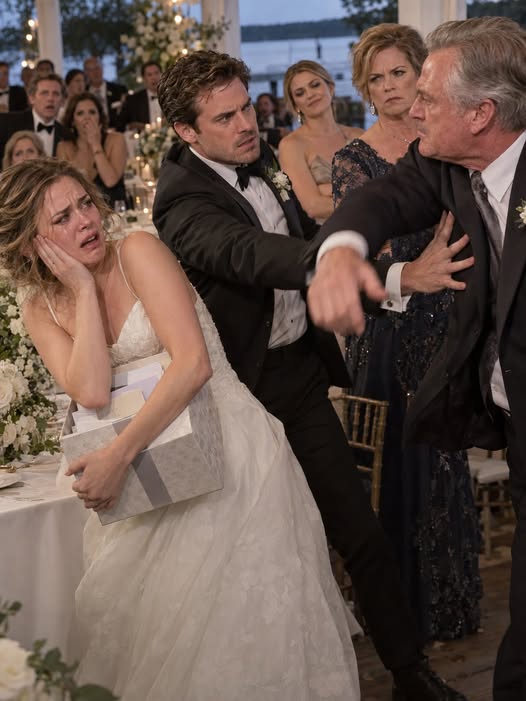
My grandmother had taken only three steps when my father told her to sit down.
It wasn’t a request. It was the voice he used on contractors, restaurant servers, and me when I was seventeen and had the nerve to question why Bridget got a car while I got a lecture about earning things.
“Mother, you’re making a scene.”
Grandma Marin stopped beside the chair where Aunt Loretta had been eating cheesecake. The room remained impossibly quiet. I could hear my own heartbeat in the ear Dad had slapped.
“Vaughn,” Grandma said, “you’ve been making a scene for six years. I’m only joining it.”
There are sentences that change the temperature of a room. This one seemed to change its architecture. Dad’s shoulders pulled back. Mom’s mouth opened and stayed there. Bridget stopped smiling.
Ivy Kesler stood beside Grandma, one hand near her elbow without touching it. “Mrs. Stark is steady,” she said to no one in particular. “Let her take her time.”
Ellis reached behind him and took the walnut box from my shaking arms. “I’ve got it,” he whispered. Then he asked our wedding coordinator, Trish, to bring two chairs and a glass of water. He didn’t ask my parents for permission. That small fact felt revolutionary.
Grandma took another step. “Esther, sweetheart, come here.”
I didn’t move at first. My cheek burned; my wedding dress felt suddenly too tight. I was thirty-one years old, and my body still obeyed my father’s anger before it understood my own wishes.
Ellis gently touched my back. “It’s okay.”
I crossed the floor. Grandma lifted her hand. Her fingers were thin, their joints crooked from arthritis, but when she cupped my uninjured cheek, the gesture was exactly the one I remembered from childhood.
“Did he hurt you badly?” she asked.
“No.” It was the lie I always told.
Her eyes filled. “Don’t protect him tonight.”
A sound escaped me, smaller than a sob and more humiliating because I couldn’t control it. Grandma pressed a folded tissue into my hand as though she had known for years that I would need one.
Dad stepped closer. “This is none of your concern, Ma. Esther misunderstood a private financial arrangement.”
“What arrangement?” Ellis asked.
Dad’s jaw moved. “Family business.”
“Then explain it to the family,” Grandma said.
He turned toward her with the practiced pity he used during our rare visits to Bellweather Grove. “You’re overtired. You have trouble remembering—”
“I remember,” she interrupted. “I remember the account number you told me had to change. I remember the papers you brought to my room. I remember your wife taking my phone and telling me Esther wasn’t interested in visiting anymore.”
Mom clutched her necklace. “Marin, that’s unfair.”
Grandma looked at her. “Then let’s be fair, Diane. Tell Esther what you did with her letters.”
I stared at my mother. “What letters?”
For a second I was twenty-five again, sitting in my kitchen with an envelope and a fountain pen, trying to write Grandma something cheerful despite being told visits would upset her. I had sent one letter every Sunday for almost a year. Then another every two weeks. When none came back, I switched to cards. Eventually I stopped because Mom said Grandma became confused by mail.
Mom’s eyes slid toward Bridget.
Bridget folded her arms. “This is ridiculous. Grandma gets things mixed up.”
“I keep a calendar,” Grandma said. “I keep a list of my medications. I know the difference between what happened and what you wish happened.”
A few guests shifted in their seats. Aunt Loretta set down her fork.
Grandma turned toward me. “Your husband visited me and asked why I wasn’t coming to your wedding. Do you know what I told him?”
I shook my head.
“That you hadn’t invited me because you’d been angry for years. That’s what they told me.”
The room tipped sideways in my mind. Ellis’s hand found mine.
“I thought you didn’t want me,” I whispered.
“I wanted you every day.” Grandma’s voice broke. “I asked after you every day.”
Dad exhaled sharply. “Enough.”
But she wasn’t finished.
“I wasn’t losing my mind when you started saying it,” she told him. “I was grieving Sanford. My hip hurt. I was afraid of being alone. And you made yourself the only person who could explain the world to me.”
The words felt too large to absorb. My father’s face had become a stranger’s face: hard, alert, calculating what witnesses might remember.
Ellis turned to Trish. “Could you please ask our photographer to preserve every photo and video from the last fifteen minutes? And please don’t let anyone remove anything from the gift table.”
Trish nodded, white-faced, and disappeared into the crowd.
Dad laughed again, without humor. “You’re treating a family argument like a crime.”

