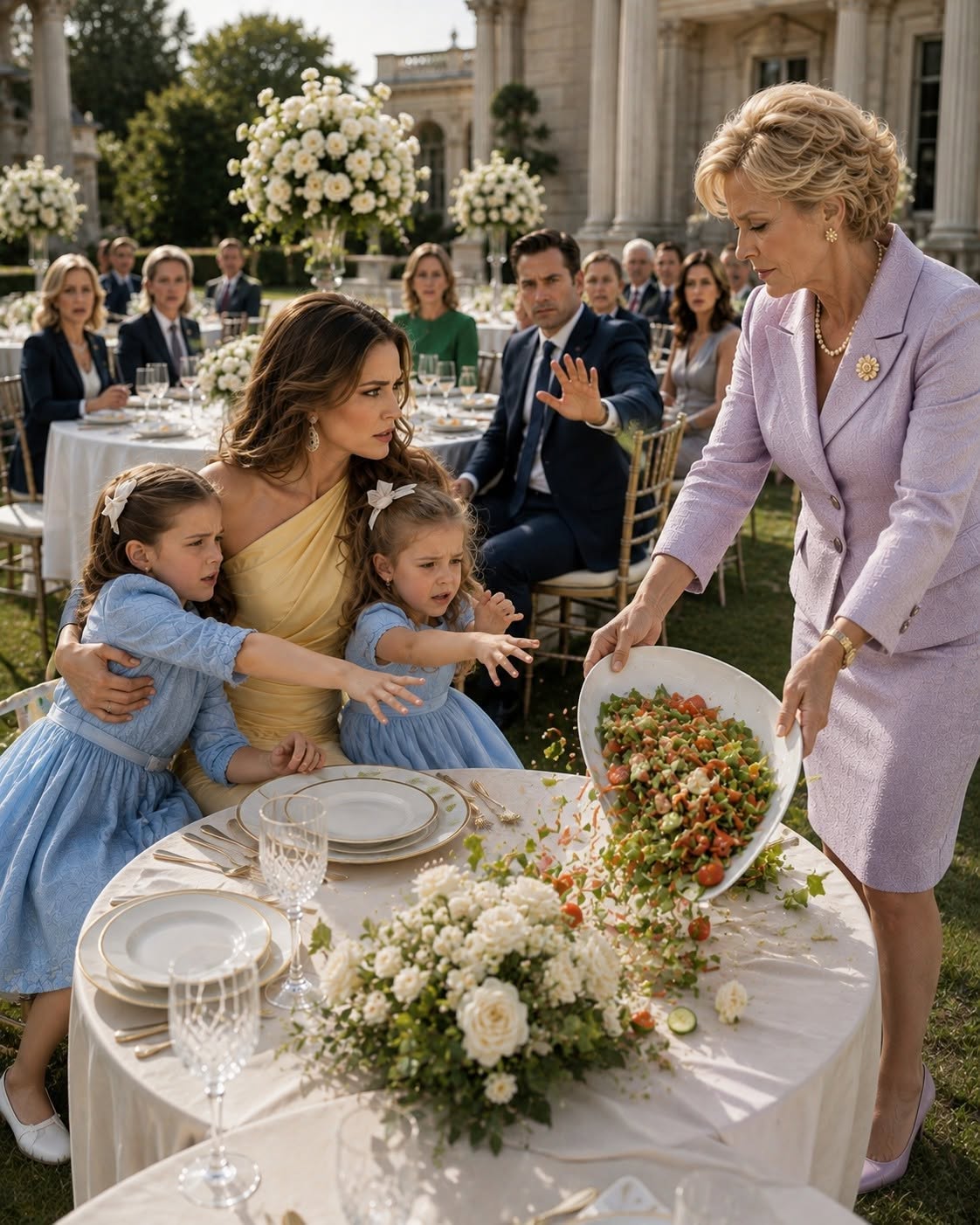
The gravel crunched beneath the soles of my low heels as I guided Piper and Noelle toward our white Volvo wagon.
Behind us, the smooth brass notes of the hired jazz quintet drifted across the velvet-manicured lawns of the Potomac property. Crystal flutes still clinked against fine china; loud, self-satisfied laughter from men in tailored seersucker and women draped in linen drifted through the summer air like sweet poison.
Neither of my daughters made a sound until the heavy passenger doors clicked shut, sealing us inside the quiet cabin. The air-conditioning hummed to life, washing over our flushed faces.
Noelle, just five years old, curled her small sneakers up onto the leather seat. Her lower lip quivered. In her small hands, she still held a paper cocktail napkin she had tucked into her lap fifteen minutes earlier, hoping for the chocolate mousse tartlets that were never going to arrive.
“Mommy?” she whispered, her voice tiny against the hum of the engine. “Did I do something bad to Grandma Constance?”
I reached into the backseat, resting my hand gently over her knee. “No, sweet pea. You didn’t do a single thing wrong. Neither of you did.”
Piper, eight years old and far too observant for her own good, stared out the tinted glass at the crowd gathered under the billowing white pavilion. Her dark eyes, identical to her father’s, were wide and sharp.
“She did it because of you, didn’t she?” Piper said evenly. “She took our plates because Dad told everyone you only work part-time from the kitchen counter, and she said we didn’t deserve prime rib on a free-loader’s budget.”
My stomach tightened, but my voice remained steady as a mountain stream. “Your grandmother has a very small heart, Piper. People with small hearts often try to make other people feel small so they don’t have to look at their own emptiness.”
“I was really hungry,” Noelle murmured softly, a lone tear finally tracking through the faint dust on her cheek. “I only ate two bites of potato.”
“I know, baby,” I said, shifting the car into reverse and smoothly steering out of the VIP parking row. “Which is why we’re making our first stop right now.”
Twenty minutes later, we were parked outside a quiet, sunlit diner off Old Georgetown Road. The red vinyl booths were worn and honest. There were no caterers with silver trays, no ninety-dollar flower arrangements, and no grandmothers monitoring who had earned the right to chew.
I ordered them warm sourdough rolls with whipped butter, two bowls of creamy tomato soup, grilled chicken strips, crisp fries, and two towering sundaes with maraschino cherries on top.
I watched them eat. I watched the tension melt from Piper’s small shoulders. I watched Noelle giggle as a dollop of whipped cream landed on the tip of her nose.
While they ate, my phone buzzed incessantly against the laminated tabletop.
*Grant [5:14 PM]: Where the hell did you go? Uncle Richard is asking where the girls are.*
*Grant [5:22 PM]: Elena, pick up. My mother said you threw a fit and dragged the kids off over nothing.*
*Grant [5:35 PM]: Don’t embarrass me today. This is my day. Bring them back right now before the speeches.*
I looked at the screen until the light faded to black. I didn’t type a single letter in response.
For eleven years, Grant Holloway had operated under the absolute conviction that silence equaled submission. When his mother sneered at my thrifted coats during our early marriage, I said nothing. When his brother made snide jokes about my “little internet hobbies” at Thanksgiving dinners, I simply cleared the table. When Grant told his country club partners that his wife “dabbled in graphic design to keep herself busy between school drop-offs,” I merely smiled and poured the wine.
He thought my silence was the quiet of a caged bird.
He had no idea it was the silence of an engineer laying charges beneath a foundation.
“Mom,” Piper said, wiping her mouth with a napkin. “Are we going home now? Dad is going to be really mad.”
“We are going home,” I replied, standing up to pay the cashier. “Just not to the house on Maple Street.”
Noelle tilted her head, her brown curls bouncing. “Where are we going?”
“To our real home,” I said, kissing the crown of her head. “A place where nobody can ever tell you what you’re allowed to eat again.”
We drove northwest, away from the suburban tract homes where Grant had insisted we live—the neighborhood where he could show off his leased German sedan while complaining every month about our mortgage payments. We passed the crowded intersections, winding deep into the rolling, wooded hills of Great Falls.

