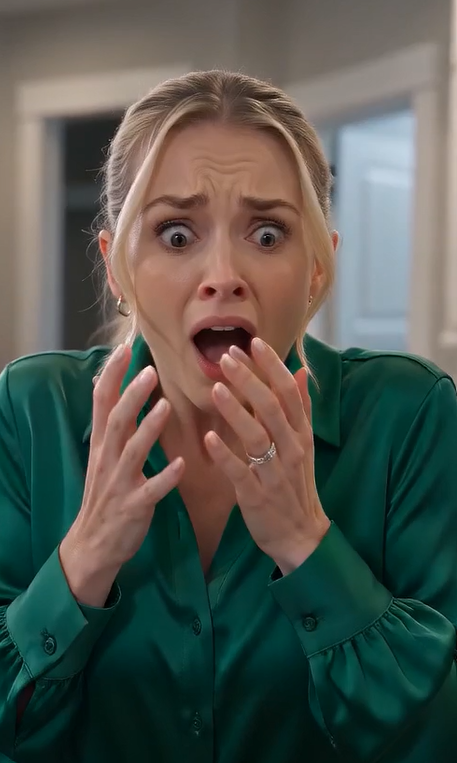
The afternoon sun angled through the leaded glass windows of the kitchen, casting geometric patterns of light across the white marble island.
Everything in the Vance residence had a designated place, and Eleanor Vance took immense pride in that precision.
She wiped down the quartz countertop with a damp microfiber cloth, moving in slow, rhythmic circles.
To the outside world, she was the crown jewel of Crestview Terrace.
She organized the annual country club gala, baked artisan sourdough loaves for the neighbors, and never had a single stray thread on her linen trousers.
People looked at her marriage to Arthur and saw an idyllic suburban romance.
They saw two handsome, successful professionals who had built an enviable life in an enclave of old money.
What they didn’t see was the suffocating weight pressing down on Eleanor’s chest every single morning.
Perfection was an exhausting chore that required constant vigilance.
It was an unpaid performance that demanded every drop of her energy and left her bone-dry by nightfall.
And lately, that performance was unraveling.
In the corner of the expansive kitchen, seated by the bay window, was the primary source of Eleanor’s misery.
Agatha Vance sat motionless in her high-backed motorized wheelchair, a gray wool blanket draped across her knees.
A massive stroke two years ago had robbed the seventy-eight-year-old matriarch of her speech and paralyzed her right side.
Yet, despite her broken body, Agatha’s eyes remained as sharp as broken glass.
Those cloudy gray eyes tracked Eleanor’s every movement with silent, unrelenting hostility.
Eleanor squeezed the microfiber cloth so hard that dirty gray water dripped between her knuckles.
She hated those eyes.
She hated the rasping, rhythmic sound of Agatha’s labored breathing that filled the silence of the house.
Most of all, she hated the subtle, mocking curl of the old woman’s lip whenever Eleanor entered the room.
“It’s almost three o’clock, Agatha,” Eleanor said, keeping her tone smooth and light as she turned toward the sink.
There was no answer, only the steady hiss of the HVAC unit overhead.
“Arthur has that presentation with the zoning board in the city,” Eleanor continued, her back turned to the wheelchair. “He won’t be back until seven.”
She wrung out the cloth and hung it neatly over the brass faucet.
The silence in the kitchen felt heavy, pregnant with a long-simmering resentment that had been building for months.
When Agatha had first suffered her stroke, Arthur had pleaded with Eleanor to let his mother move in.
He hadn’t wanted to send her to an assisted living facility, claiming it would break her spirit.
Eleanor had agreed at the time, playing the part of the gracious, devoted daughter-in-law.
She had thought it would be a brief inconvenience, a short chapter before the old woman naturally faded away.
Instead, Agatha had lingered, turning their luxurious colonial home into an open-air hospice.
Every aspect of Eleanor’s routine had been warped around medication schedules, physical therapy appointments, and the stench of antiseptic.
Worse, Agatha possessed the family trust, an eight-figure inheritance tied up in an ironclad legal structure.
Arthur’s boutique architectural firm was secretly drowning in debt, bleeding money on failed municipal bids.
They needed that estate liquidity, but Agatha refused to transfer power of attorney.
Even with her compromised motor skills, the old woman had stubbornly shaken her head whenever the lawyers visited.
Agatha knew Eleanor’s true nature, and she was deliberately choking the couple financially from her wheelchair.
Eleanor walked slowly toward the china cabinet near the dining alcove.
Her loafers clicked softly against the white oak floorboards, each step deliberate and measured.
On the sideboard sat a pair of heavy, antique bronze candlesticks that had belonged to Arthur’s grandmother.
Each piece weighed nearly seven pounds, cast in solid metal with a dark, tarnished patina.
Eleanor reached out, her fingers wrapping around the thick, fluted base of the nearest candlestick.
The bronze felt icy against her warm skin, sending a jolt of cold electricity straight up her forearm.
She lifted it off the mahogany sideboard.
It was remarkably well-balanced, the heft of the base carrying devastating potential.
Eleanor turned around, cradling the metal against her side like a folded umbrella.
She looked at the old woman sitting by the window.
Agatha had turned her head slightly, her gaze locking onto the bronze object in Eleanor’s hands.
For the first time all afternoon, the old woman’s breathing hitched.
A flicker of comprehension flashed through those rheumy, gray eyes, followed quickly by something else.
It wasn’t panic.
It was a cold, knowing disgust.
Agatha’s left hand, the only hand that still functioned, twitched beneath the wool blanket.
Eleanor stepped closer, her soft leather shoes gliding silently over the hardwood.
“You’ve been such a burden, Agatha,” Eleanor whispered, her voice barely louder than the hum of the refrigerator.

