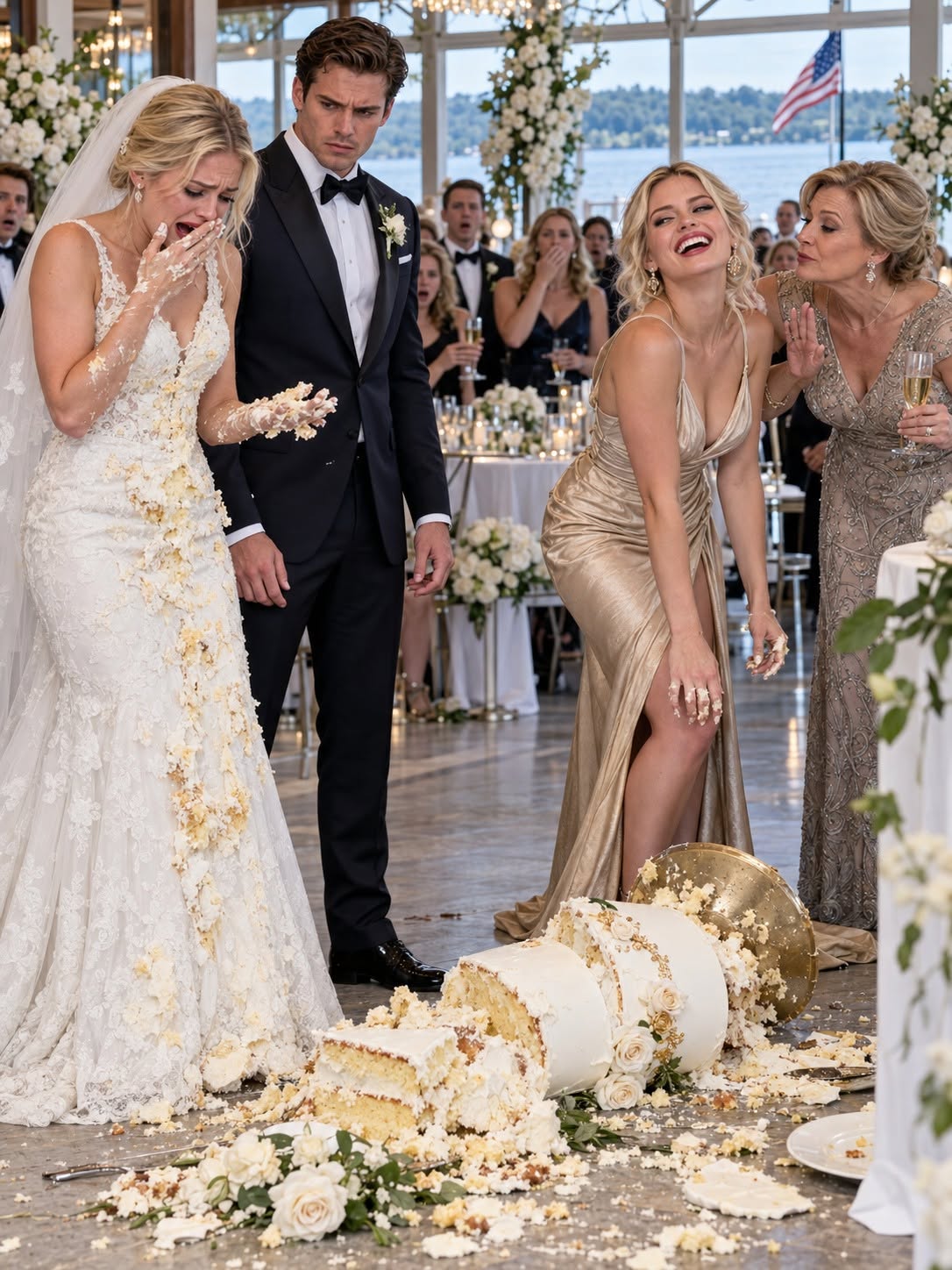
The sound a wedding cake makes when it hits the floor is not a crack. It is not an explosion. It is a wet, suffocating thud, like wet concrete dropping from a wheelbarrow onto gravel.
For half a second, the glass pavilion on Lake Michigan was dead silent.
The lake breeze had died down behind the tall, seamless panes of glass. The string quartet had just finished their transition into an acoustic arrangement of an old Sam Cooke song. Eighty people—friends from the commercial site, Leah’s colleagues from the physical therapy clinic, cousins who had flown in from Denver and Atlanta—froze with champagne flutes suspended halfway to their lips.
Then came the laugh.
It was high, breathy, and unbothered. It was the sound Kendra made when she dropped a water glass at a diner or scratched the bumper of our mother’s sedan: an amused, performative exhale designed to tell the world that nothing she touched was ever valuable enough to mourn.
“Oops,” she said.
Her phone was already raised, the gold-rimmed camera lens catching the amber glow of the chandeliers.
“Guess you should’ve bought me that condo.”
She looked down at her work. Three tiers of handcrafted ivory fondant, imported sugar lace that had taken a baker named Yvette three weeks to assemble petal by petal, and pure Bourbon vanilla sponge lay flattened into the varnished parquet floor. The top tier had sheared off against the mahogany edge of the display table, smearing a thick, grease-heavy swath of yellow-gold buttercream down the side before detonating across the toes of Leah’s satin heels.
A single sugar blossom, dusted with twenty-four-karat edible gold leaf, lay intact on the hem of Leah’s dress.
Leah didn’t scream. She didn’t even flinch. That was Leah’s way—she had spent six years working in acute spinal rehabilitation; she was accustomed to sudden, catastrophic failures of balance, and her immediate biological response was stillness. But her hand, which had been resting loosely inside the crook of my elbow, clamped down until her manicured nails bit straight through the worsted wool of my rented tuxedo sleeve.
I felt her breathing stop.
“Oh my God,” Kendra giggled, panning her camera down to Leah’s waist. “Look at your dress. It looks like someone threw a pie at you. Literally like a clown car exploded.”
My mother materialized out of the second row of tables like a ghost smelling a crisis. She moved with that familiar, fluttering panic that had dictated every holiday, every Sunday dinner, and every family emergency for thirty years. Her beige chiffon wrap trailed behind her, catching the corner of a folding chair. She didn’t look at Leah. She didn’t look at the ruin on the floor.
Her hands went instantly to Kendra’s bare shoulders, pulling the girl back half an inch—not to discipline her, but to shield her from the sight of what she had done.
“Liam, honey, please don’t make a scene,” Mom whispered, her voice tight, vibrating on that thin wire between plea and order. “You know how Kendra gets when she feels excluded. She’s had a glass of wine. It was an accident. The floor was slippery.”
“The floor is dry, Eleanor,” my father’s voice came from behind her. Robert Carter looked tired. He had looked tired since 2008, when his independent tool-and-die shop had gone under, but tonight his posture was sunken, his gray suit hanging off his shoulders like a coat on a wire hanger. He looked at the cake, then at Kendra’s phone, which was still glowing, recording. “Kendra, put the damn phone away.”
“Dad, chill, it was a joke,” Kendra snapped, though she lowered the lens three inches. Her chin came up. That chin was her weapon. It was pointed, stubborn, and identical to our mother’s. “The table was wobbly. If Liam had paid for a decent venue instead of this rustic barn knockoff, the furniture wouldn’t be collapsing.”
“It’s a five-star private club, Kendra,” Leah said.
Her voice wasn’t loud. It didn’t tremble. It had the flat, lethal cadence of a surgeon telling a family that the operation had failed.
Kendra rolled her eyes, her lips pursing into that practiced, glossy pout she reserved for retail workers and parking enforcement officers. “Whatever. It’s just cake, Leah. You can eat cake anywhere. Honestly, you should thank me. That much sugar isn’t good for your hips anyway, especially if you’re trying to fit into that thing again for photos.”
Two of Leah’s bridesmaids, Sarah and Chloe, surged forward, their faces flushed dark with fury, but Leah raised her left hand—the one carrying the modest diamond band we’d picked out together in the jewelry district—and stopped them in their tracks.
“Liam,” Leah said softly. She didn’t look at me. She kept her eyes on Kendra’s face, watching the younger girl’s smirk twitch with the first faint stirrings of unease. “Get me out of this dress.”

