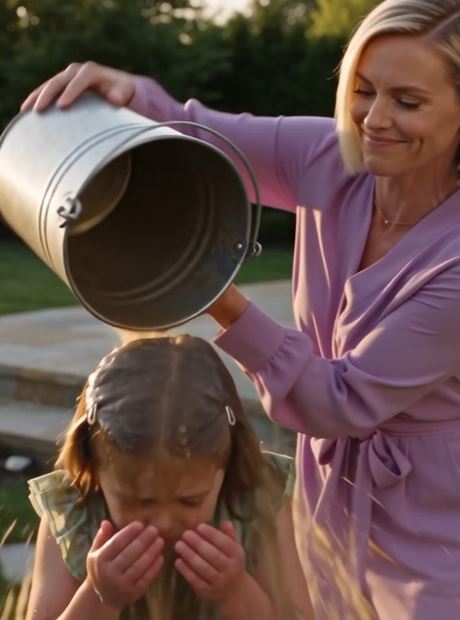
The first thing Daniel Mercer noticed was not the bucket, not Vanessa’s hand, and not even the muddy water arcing through the late-afternoon light, but the way his seven-year-old daughter Lily did not scream when it hit her, because a child who still expected adults to protect her would have cried out in surprise, while Lily simply staggered backward as if some part of her had already learned that making noise only made bad moments last longer. The garden behind the Mercer house had always been Daniel’s favorite part of the property, a long green rectangle bordered by white hydrangeas and old maples, with a stone patio where Lily used to chase soap bubbles when her mother was alive, yet in one violent second the place changed in his mind from home into a crime scene of memory, because dirty water streamed through Lily’s brown hair, stained the pale green dress he had bought her for spring pictures, and dripped from the ends of her sleeves while Vanessa stood over her with an empty galvanized bucket and a laugh that seemed too practiced to belong to a single impulsive mistake.
“Cry harder. Nobody’s saving you,” Vanessa said, and Daniel heard the words from thirty yards away with such clarity that later he would remember the exact tone more vividly than the sound of his own footsteps as he began to run. He had come around the side of the garage carrying a cardboard box of replacement sprinkler heads, irritated by a delayed contractor and thinking about dinner, and the instant he understood what he was seeing the box dropped from his hands, plastic pieces scattering over the grass while every ordinary concern in his mind disappeared beneath a single cold command: get between them.
Vanessa saw him halfway across the lawn, and the satisfaction left her face so quickly that Daniel understood before either of them spoke that she knew what she had done could not be explained away if he had witnessed it with his own eyes. He reached Lily first, took the bucket out of Vanessa’s hand without yanking or striking, set it hard on the ground, and planted himself between the two of them with his shoulders squared and one arm extended behind him until his fingers found Lily’s trembling hand, then he looked at Vanessa and said, “You picked the wrong kid.”
Vanessa’s first response was outrage rather than shame, which frightened Daniel more than an apology would have, because she snapped that Lily had been “throwing mud everywhere,” that the child had ignored instructions, that Daniel had no idea what he was interrupting, and that he was once again turning his daughter into “a little princess who thinks rules don’t apply to her.” Daniel did not move, and when Vanessa stepped forward he matched the step without touching her, blocking the path to Lily as he answered, “Stay away from my daughter,” with a quietness that stripped the argument of its usual rhythm.
Behind him, Lily’s fingers tightened around his hand, but she still said nothing, and that silence reached Daniel in a place anger could not, because over the previous six months he had explained away too many small changes in her as grief, school stress, or the difficulty of adjusting to Vanessa moving into the house after their engagement. Lily had stopped asking to bake pancakes on Saturdays, stopped leaving drawings on the refrigerator, stopped running down the stairs when Daniel came home from work, and started asking strangely adult questions before making tiny decisions—Is it okay if I use the blue cup, Dad, is it okay if I sit here, is it okay if I take a shower now?—yet Daniel had accepted Vanessa’s claim that structure was helping Lily become “less clingy,” never considering that obedience could look almost identical to fear if a parent only saw the final result.
The confrontation might have become another ugly private argument, one in which Vanessa reframed everything and Daniel was forced to choose between his own eyes and the woman he had planned to marry, if a voice had not come from the patio behind them. “I got all of it,” said Rosa Alvarez, the Mercer family’s housekeeper, standing beside the open French doors with a phone raised in one hand and her other hand pressed against her chest, and Vanessa’s face changed so completely that Daniel felt the situation shift beneath his feet.
Rosa had worked for Daniel’s family for four years, long before Vanessa entered their lives, and Daniel trusted her in the vague comfortable way busy people trust someone who keeps the household running without demanding attention, but now he saw the older woman’s hands shaking and realized she had not filmed casually. Vanessa turned toward her and shouted, “Delete that,” taking two quick steps before Daniel blocked her again, and Rosa answered, “No,” with the kind of firmness that usually comes only after fear has been tolerated for too long.

