The deed to the eastern pasture had smelled of dry cedar and forty years of attic dust.
When I laid it on the polished mahogany desk of the county clerk’s office three weeks before the wedding, my fountain pen hovered over the signature line like a trembling needle. That parcel of land—fourteen rolling acres of sweet clover and ancient post oaks—had belonged to Robert’s family since 1912. It was where my husband had taught our boy, Daniel, how to cast a fly rod into the slow bend of the creek; where Robert had sat on the tailgate of his battered Ford pickup on humid July evenings, watching the fireflies rise from the tall grass, his rough, calloused fingers intertwined with mine.
*“Land stays, Margaret,”* Robert used to murmur into my hair when the crop yields were low and the bank grew nervous. *“People pass through, storms tear off the shingles, but the dirt endures. Never part with the dirt.”*
Yet there I had sat, sixty-two years old, surrendering the eastern pasture to an aggressive real estate developer who intended to level the trees for modern spec homes. I did it because my son had sat at my kitchen table two nights prior, his head buried in his hands, weeping until his broad shoulders shook with an ugly, suffocating exhaustion.
“Tiffany says her family will be humiliated, Mom,” Daniel had choked out, his voice muffled by his palms. “Her father’s business associates are coming from Chicago. The local country club wasn’t available, so she booked the Highgrove Estate. But the deposit… the catering minimums… she didn’t realize how fast the add-ons piled up. If I can’t produce the final eighteen thousand by Friday, they cancel the venue. She’ll leave me, Mom. She told me she can’t start a life with a man who breaks his word before we even reach the altar.”
I should have recognized the poison in those words then. A woman who threatens desertion over the floral arrangements at an estate she cannot afford does not want a husband; she wants a stage prop.
Instead, I looked at Daniel’s hollowed eyes and remembered the little boy who used to bring me dandelions in cracked jelly jars. I remembered standing beside his hospital bed when he contracted pneumonia at age seven, praying to a God I barely understood to take my breath so long as Daniel kept his.
“I’ll handle it,” I had told him softly, reaching across the table to smooth down his unkempt hair. “I will make it right.”
The initial plan had been so modest, so honest. When Daniel first slid that modest diamond onto Tiffany Vance’s manicured finger, we had celebrated with a Sunday roast in my dining room. We had spoken of eighty guests—lifelong friends from our parish, Daniel’s fraternity brothers, our immediate cousins, and a modest barbecue buffet under a marquee at the town park. I had earmarked twelve thousand dollars from my teacher’s retirement fund—a comfortable, generous gift that would leave my principal intact.
Then Tiffany took the wheel.
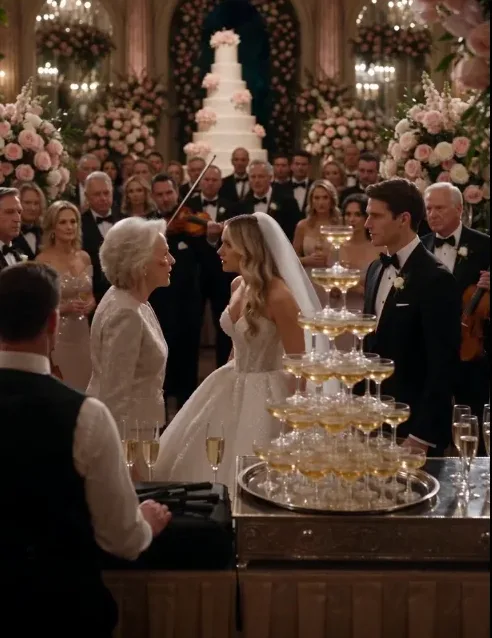
Within forty-eight hours, the eighty guests had expanded to two hundred and fifty. Tiffany’s mother, Evelyn, a woman whose face had been pulled so tight by cosmetic procedures that she seemed perpetually startled by her own insignificance, decreed that a municipal park was “an insult to their lineage.” The local barbecue became a five-course plated dinner featuring wild sea bass and dry-aged filet mignon. The simple seasonal wildflowers I had offered to cultivate in my own greenhouse were dismissed as “weeds fit for a cemetery,” replaced by thousands of white Ecuadorian roses, cascading phalaenopsis orchids, and silver dollar eucalyptus flown in on refrigerated cargo flights.
Every bill landed on my kitchen counter.
*“Please, Mom. It’s only one day,”* Daniel would plead when I showed him the invoices, my stomach churning with nausea.
*“Her parents had a bad year in commercial real estate, Mom. They’ll reimburse you after the quarter closes. Just float it for now.”*
*“Can you let it go, Mom? Just this once? I want her to look at me the way you looked at Dad.”*
That was the hook, wasn’t it? The cruel, emotional barb that snagged deep in the softest part of my heart. I wanted Daniel to know the holy, quiet communion of a true marriage. Robert had been my shelter, my mirror, my harbor. If forty-five thousand dollars—and then sixty thousand, and ultimately eighty-two thousand dollars of my life’s blood—could purchase that brand of joy for my only child, how could I withhold it?
I cashed in the municipal bonds Robert had bought before his heart failed him. I quietly canceled the autumn tour of Italy I had spent twelve years dreaming of—the tickets to Florence, the small pensione overlooking the olive groves of Lucca. I folded the travel brochures and tucked them beneath the shelf paper in the pantry.
