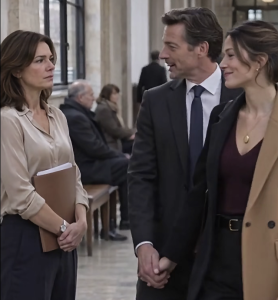
 My husband arrived at our divorce hearing with his mistress’s hand in his, convinced he was going to leave me homeless, penniless, and without credibility. He didn’t know that at the Lyon courthouse that morning, I hadn’t come to beg: I had come to show what he had spent years trying to make disappear.
My name is Émilie Vasseur, I’m forty-four years old, and for a long time I believed that Laurent would always end up winning. At 8:45, in the third-floor hallway, he walked past me with Chloé Martin on his arm as if they were entering a reception. She was wearing my grandmother’s old necklace, a delicate pale gold chain with a small oval medallion. I had been looking for it for months.
Laurent stopped just long enough to look at me.
“Enjoy your last morning as the owner,” he whispered. “Perhaps you’ll be looking for a thirty-euro room tonight.”
Chloé looked down at the locket and smiled.
The smell of cold coffee coming from the vending machine, the rustling of coats, the sharp slam of a door at the end of the corridor: it all came flooding back. Another door. Another night. Laurent telling me that no one would believe me because he knew the right people and that all I knew how to do was “make a scene.”
I didn’t reply.
My lawyer, Antoine Collin, was waiting for me near the courtroom. He simply placed two fingers on the cardboard folder he was holding. The gesture meant: stick to what we’ve prepared.
Inside, Laurent took his seat with his two lawyers. Chloé sat behind him. He had brought in an impressive file: psychological evaluations, witness statements, bank statements, deeds of transfer, bank correspondence. On paper, I was an unstable, jealous woman, incapable of accepting the end of my marriage. On paper, almost everything my family had passed down to me now seemed to belong to them.
The restoration workshop founded by my father in Villeurbanne. Two investment accounts. A house near Pérouges. Even some shares I received after my mother’s death appeared in documents I never signed.
When my lawyer challenged the authenticity of several signatures, Laurent shrugged.
“She’s been contesting everything since she realized I was leaving,” he said calmly. “That’s precisely the problem.”
One of his lawyers filed a series of documents with Judge Delmas intended to show that, according to them, I suffered from delusions of persecution. Laurent looked at me as one looks at a locked door.
“You have nothing to say?” he murmured while the files were being reorganized.
Then, even further down:
— You’ve always been very good at playing the victim.
Behind him, Chloé let out a nervous little laugh.
I felt my fingers grow cold. For years, it was precisely at this moment that I gave in: when he turned what he had done to me into evidence against me. I explained too much. I trembled. I apologized for being upset. And the more I tried to convince him, the more reasonable he seemed.
This time, I simply watched Mr. Collin.
He opened his leather shirt, checked the first piece, then nodded.
The judge turned towards me.
— Ms. Vasseur, you may speak.
I got up slowly.
The room was so quiet I could hear the hum of the ventilation. I was wearing a beige silk blouse buttoned up to my neck. My hands were trembling, but my voice was steady.
— Madam Judge, before discussing the accounts and actions, I would like to address one thing. It has just been said that I invented years of violence.
Laurent straightened up.
For the first time that morning, her smile disappeared.
I undid the first button of my blouse. Then the second.
A breath of fresh air swept through the room.
The scars that ran from my chest to my collarbone and those that ran along my forearms were far from being an abstract detail in a file. Some were fine and old. Others formed larger, irregular areas, impossible to mistake for the “minor domestic accidents” that Laurent had described for years.
Judge Delmas leaned slightly forward. Her face changed.
Chloé stopped smiling.
Laurent, on the other hand, jumped up suddenly.
— No. That proves nothing. She knows very well what she’s doing.
Her voice had lost all its controlled sweetness.
I didn’t turn my head towards him. I fastened one button, left the collar open enough for the judge to still see the marks, then I placed both hands on the bar in front of me.
“I’m not asking you to believe me because of my scars,” I said. “I’m asking you to look at why they correspond to dates, consultations, money withdrawals, and documents that my husband thought he had disposed of.”
