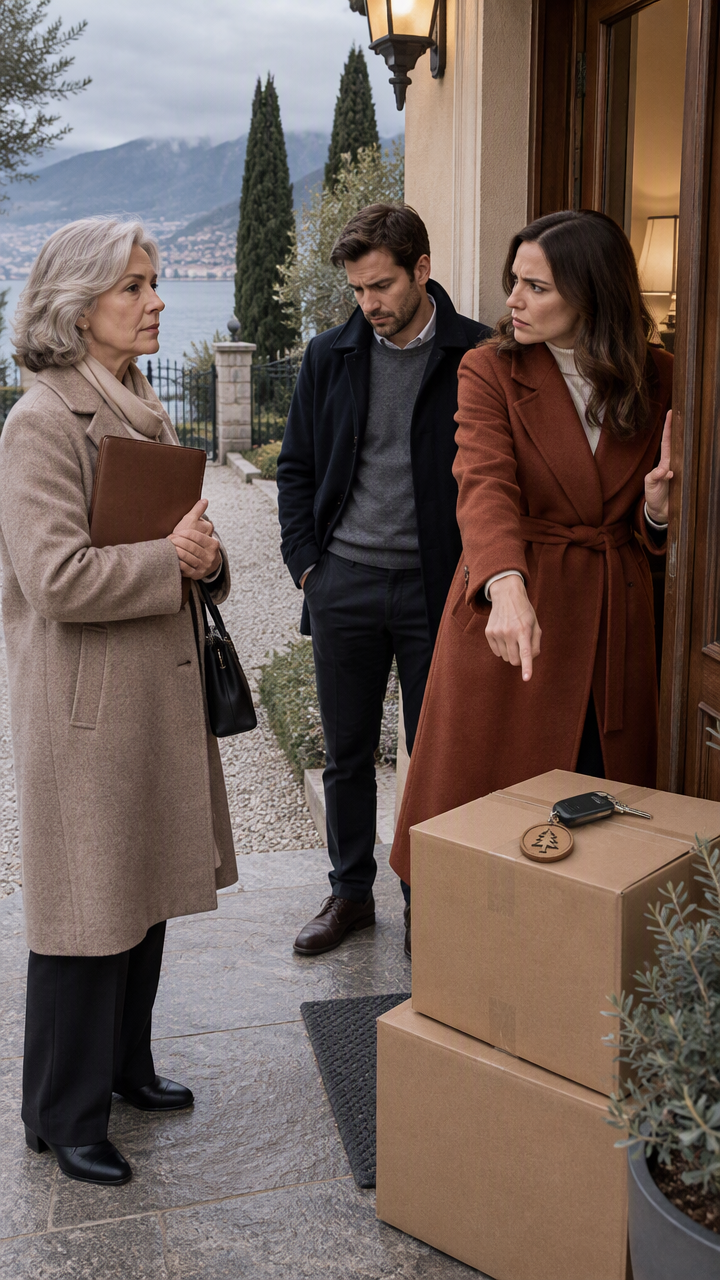
“You give me the badge today, or you acknowledge that this house means more than your family.”
Silvia told me on the portico of my villa in Iseo, in front of Andrea’s car and two neighbors stopped near the gate.
I was sixty-three years old. In my hand, I held the cardboard folder containing the notarized deed for the house, bought for 2,080,000 euros after forty years of work and saving . On the step, two boxes were already waiting to be taken up to the guest room.
Andrea, my son, kept his eyes downcast.
That’s what struck me the most.
Not Silvia’s words. Not the badge pinned to a small wooden pine tree. Her silence.
Three days earlier, I had sent a very simple message to his wife:
“No. You can come when I invite you.”
She replied that she needed permanent access to the villa. I refused.
The house was located in the hills above Iseo, in the province of Brescia, with a terrace overlooking the lake and a small metal gate at the end of a gravel path. I had bought it after the death of Carlo, my husband.
For two years, I had lived in an apartment above a pharmacy, with the scooters and the metal shutters banging every night. I often woke up there at three in the morning, my heart pounding, convinced that I had heard Carlo come home.
This villa had become my first place of my own .
On the evening of the inauguration, twelve friends had come. The table was covered with blue linen napkins, roasted pears, and ceramic bowls. My friend Lucia shook my hand, saying:
“Finally, a house that reflects you.”
Andrea and Silvia hadn’t come. At 7:18 p.m., Andrea had written that Silvia had a headache. I read her message under the kitchen arch, a stack of plates in my arms.
I then remembered a stormy night, twenty-six years earlier.
Andrea was eight years old. To reassure him, I tied a blue cloth around my neck like a cape and checked all the locks with him. Before going to sleep, he gave me a small piece of cedar engraved with a pine tree.
“That way, you’ll know you’re safe here, Mom.”
I still keep that piece in a drawer.
This wasn’t their first absence. Andrea had missed the luncheon organized after Carlo’s memorial service because Silvia was opening a showroom. He also hadn’t come to my retirement party.
Each time, I invented an excuse to protect him.
This time, I hadn’t found any.
The next morning, Silvia wrote to me:
“Andrea and I need a badge today. We need to be able to use the house whenever we want.”
I replied:
« Non. »
Andrea called me immediately.
“Mom, you’re putting Silvia in a terrible situation.”
“You were invited.”
“She wasn’t doing well.”
“She’s well enough to ask for the keys to my house.”
He had spoken of family heritage, gratitude, and what he had done for me during my bereavement. I had reminded him that helping his mother did not create a right of ownership.
“You’ve changed,” he had whispered.
“No. I simply stopped confusing love with free access to my possessions.”
Then I hung up.
Three days later, I saw their small dark green car arrive on the road.
Andrea came down with a box. Silvia was carrying another one. Neither of them had warned me.
The badge was new. It hung from a cedar tree carved into the shape of a pine tree, exactly like the souvenir given to him by Andrea when he was a child.
“You should go home,” said Silvia. “Otherwise, you’ll look unstable.”
“I am at home.”
She pointed to the boxes.
“We’re putting our things away in the upstairs bedroom.”
“You don’t have a room here.”
Andrea finally looked up.
“Mom, we talked about it.”
“You demanded it. I refused.”
Silvia smiled, then she pointed to the cardboard folder lying on the table in the portico.
“Very well. Now open the document in front of the witnesses.”
Behind the cedars, two headlights came on. More people were arriving. Andrea took a step back, as if he no longer recognized me.
I placed the badge on the notary’s folder.
Then I took out my phone, not to call the police, but to open a file that Silvia had never seen.
On the first page, there was a date, a transfer, and a signature.
Silvia stopped smiling.
“What is it?” asked Andrea.
I closed the shirt before he could read it.
“Proof that this house was never a gift.”
The gate opened behind them.
A figure got out of the car with a brown envelope in hand.
And, this time, Andrea understood that I wasn’t alone either.
