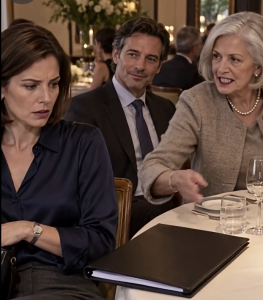
 When my mother-in-law pushed the bill for twenty-two people towards me, in the middle of a chic restaurant in the 6th arrondissement of Lyon, I finally understood why I had been invited to my sister-in-law’s engagement party.
“You’re paying, Claire,” said Monique, almost distractedly. “That’s the only reason we invited you.”
Around the large table, the forks fell still. Twenty-two people had just spent the evening ordering cuts of beef, lobster, cocktails, several bottles of wine, appetizers to share, and desserts. The small black envelope containing the bill now rested a few centimeters from my hand.
Élodie, my sister-in-law, leaned back in her chair and looked me over with a dry smile.
— You should already be glad that we let you sit with us.
Two cousins lowered their eyes. At the other end of the table, an uncle suddenly became engrossed in his coffee. I could hear the clinking of glasses, the discreet hum of the air conditioning, and, in the next room, the laughter of another group who had no idea what was going on at our house.
I did not reply to Elodie.
I looked at my husband.
Julien was sitting two seats away, one arm resting on the back of his chair. He was smiling.
Not embarrassed. Not sorry.
He was genuinely smiling.
And that smile hurt me more than anything Monique or Élodie had just said.
I didn’t protest. I didn’t ask the amount. I simply opened my handbag.
Monique gave that little satisfied lip movement I knew so well. The same one she’d made in Deauville two years earlier, when her card had supposedly “stopped working” at the hotel and I’d paid for two rooms. The same one she’d made after Élodie had borrowed €1,600 from me for her car and never paid back.
For years, I had tried to preserve the peace. Each time, Julien would tell me:
— We’ll sort that out later.
Later had never come.
Then my father died.
Dad had repaired cars for thirty-eight years near Saint-Étienne. He kept his tools until they were completely unusable and carried his lunch in the same dented old metal box he’d had for decades. Years before, he had bought a small commercial space next to his garage. By the time he died, there were no outstanding loans on it.
He had left it with me.
Two weeks after the funeral, Monique called me.
— Julien told me that your father left you a property.
– Yes.
— Is it expensive?
I found the question inappropriate, but I answered politely.
Very quickly, Julien started asking if I was planning to sell, how much the premises brought in, how much we could get for it. Then Élodie wanted to know if the inheritance was solely in my name.
I had tried to see it as curiosity.
Until Wednesday when my bank sent me a security alert: someone had tried to change the contact details of the joint account that Julien and I used for the apartment loan, bills, groceries and insurance.
That same evening, I had asked him:
— Did you change anything on the account yesterday?
He had barely looked up from his computer.
— Non.
That night, I had checked six months’ worth of statements.
900 euros. 1,400. 750. 2,200. Irregular transfers to an account I didn’t know about.
In total: a little less than 18,000 euros.
The next day, I had an appointment with Maître Anne Morel, the lawyer who had dealt with my father’s estate.
She had studied the records, then asked me:
— Did you authorize these transfers?
— Non.
— Did Julien tell you about it?
– Never.
She had taken off her glasses.
— Don’t confront him yet. You know enough to be angry. I want you to know enough to make good decisions.
Two days later, I discovered a draft email on our computer addressed to Monique. Julien wrote: “When Claire sells the premises, we’ll have plenty to work with. Tell Élodie not to worry, I’ll cover the difference.”
I had never agreed to sell.
I never promised a single cent for Elodie’s wedding.
Three days before dinner, Julien had even sent me: “Take your card with the high limit on Saturday. Mom might need help.”
So I called Maître Morel back.
And before dessert, I discreetly gave her number to the waiter, asking him only one thing: if the bill ended up in front of me, to call her.
Now, the black sleeve was there.
I slipped my hand into my bag.
At that moment, the waiter approached and leaned towards me.
— Madam, the person you asked me to call has just arrived.
Julien’s smile disappeared.
He turned his head towards the entrance of the restaurant.
