I didn’t scream when Claire told me I had to leave the house because I was “unpleasant” to her. I was seventeen, she hadn’t even been married to my father for a year, and he, sitting three meters away from us in the kitchen of our house in Tassin-la-Demi-Lune, didn’t say a word.
My mother, Marianne, had died of cancer two years earlier. Six months after the funeral, my father, Marc, married his former assistant, Claire. At that time, I still often wore my mother’s old dark blue cardigan to school. Meanwhile, Claire was already talking about “starting over with something lighter.”
She started with photos.
My parents’ wedding photo had disappeared from the sideboard. Then my baby photos. A week later, everything was in boxes in the attic, between the Christmas decorations and a broken suitcase.
Then came my mother’s books, her dishes, the curtains she had sewn herself. One Wednesday, when I came home from school, I noticed that her china dinner service, which had belonged to my grandmother, was no longer in the cupboard.
“It was taking up space,” Claire explained as she wiped down the work surface. “You have to know what happens next.”
My father looked down at his coffee.
That was always what hurt the most.
He used to teach me how to ride a bike on a small path behind the house. During my mother’s chemotherapy, he held me tightly in his arms in the hospital corridor when I couldn’t breathe. After her death, he became a man who always looked at his plate when Claire was too far away.
That’s why I’ve learned to take up as little space as possible.
One evening, after my part-time job at a bakery, I left two plates and a fork in the sink. The next day, Claire organized a “family meeting” on the topic of mindfulness in the use of shared spaces.
A few weeks later, I discovered that my bedroom lock had been dismantled.
“We live here like a family,” she said with that quiet smile that sent a shiver down my spine. “A family doesn’t need closed doors.”
I thought: A family doesn’t erase a dead person from the walls, either.
I did not reply.
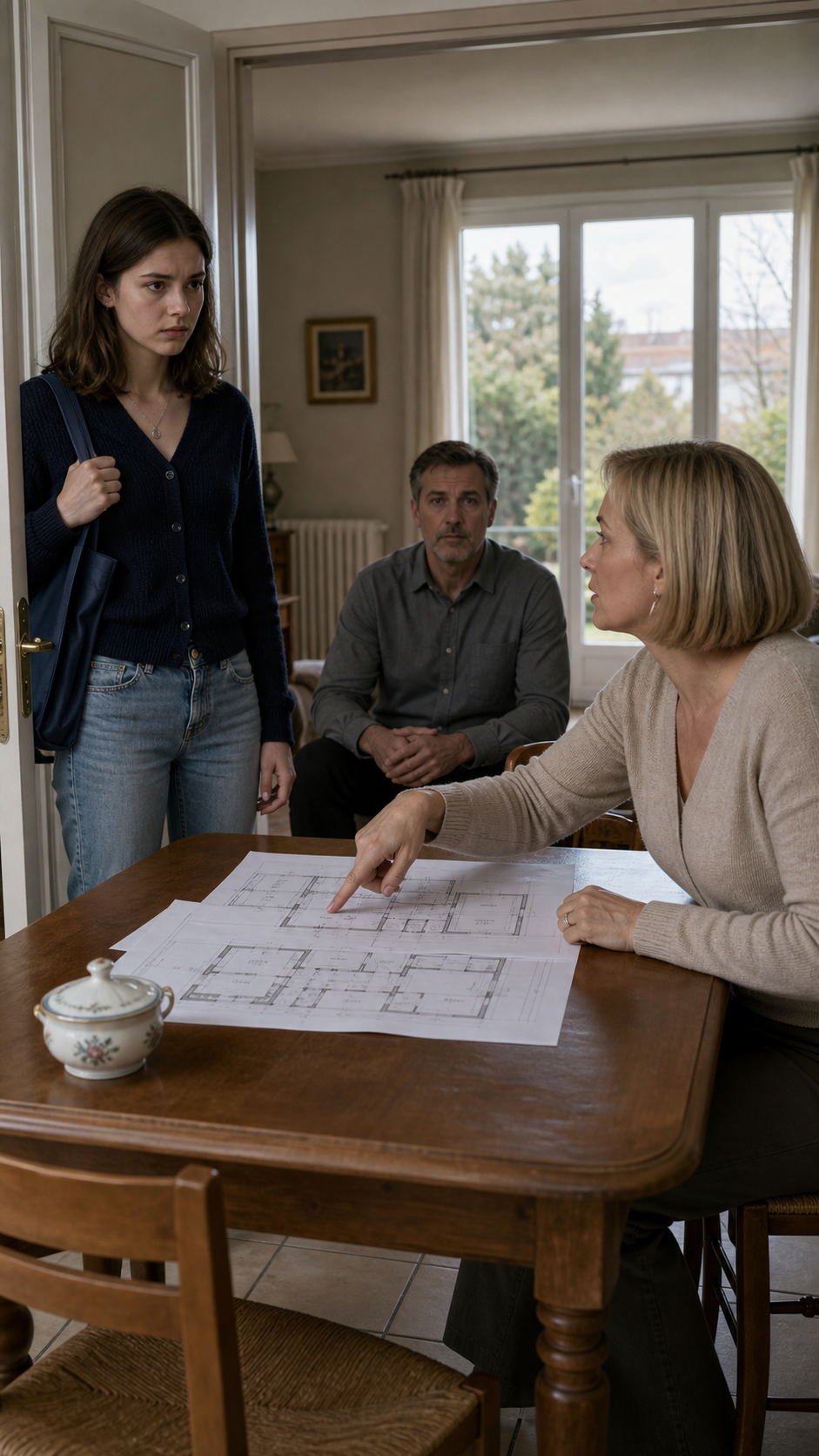
At seventeen, I spent more time in the Lyon library, at a friend’s house, or in a café near Bellecour than at home. Then, one Saturday morning, I walked into the kitchen to find Claire with a real estate agent. The house plans were spread out on the table, right next to my mother’s earthenware sugar bowl—the only thing Claire hadn’t yet thrown away.
“When she goes away to study,” Claire said, pointing to my room, “we can finally set up a proper office here.”
I stayed in the doorway.
— I’m not leaving. I’m accepted at Lyon 2. I’ll be making the journeys.
The real estate agent lowered her eyes to her documents.
Claire’s face closed off.
In the afternoon, she cornered me in the hallway.
— This is my home now. I’ve been patient, but your presence makes me deeply uncomfortable. You need to find another solution.
My father was behind her.
I looked at it. I was waiting for something, anything.
He said nothing.
Only the next day, as if his courage always arrived twenty-four hours too late, did he put some papers on the kitchen table.
“The house belonged to your mother,” he told me. “She had planned for you to inherit a portion of it. I made sure that fifty percent was in your name.”
Claire turned pale. That same evening, she slept in the guest room.
But I wasn’t reassured.
Because two years earlier, while looking for a box of my mother’s clothes in the attic, I had found her notebook.
Blue leather. His initials in gold in one corner.
I thought I’d find recipes or gardening notes. Instead, I found dates, copies of emails, hotel numbers. Mom had discovered that my father had been seeing Claire when she was still his assistant, several months before the diagnosis.
Towards the end of the notebook, one name kept recurring: Maître Laurent Vignal, lawyer in Lyon.
Next to it, mom had written the same thing several times: “conditions not met”.
When my father laid out his pretense of being the landlord in front of me, I picked up the notebook again. I looked for Maître Vignal. His office was still there, near the courthouse.
I called him from a friend’s phone.
— Maître Vignal? My name is Élodie Morel. I am the daughter of Marianne Morel.
The silence lasted so long that I thought the line had cut out.
Then he replied:
— I was wondering when you would finally call me.
