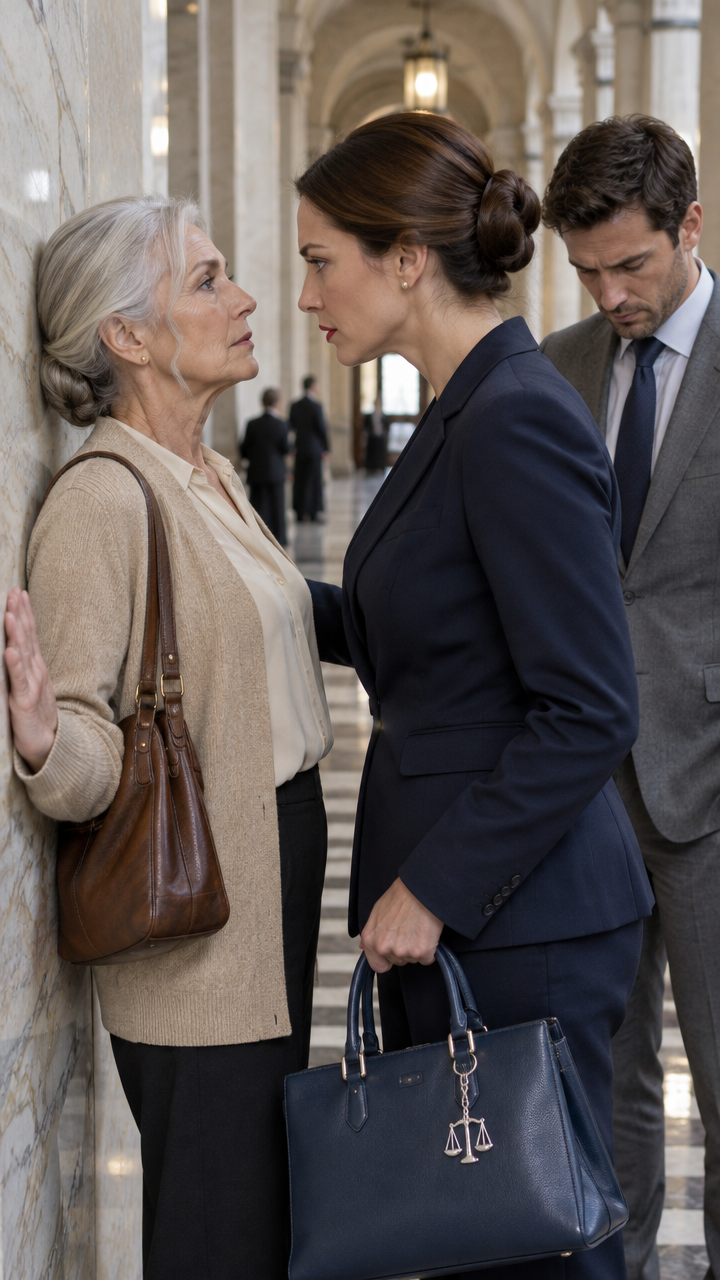
On the other side of the door, the clerk announced that the hearing was about to begin. My fingers closed on the fabric.
The black dress was heavier than I remembered.
I carefully took it out of the wardrobe and then placed it on my shoulders. The white collar framed my tired face. In the mirror, I no longer saw the seventy-year-old widow with silver hair, a wrinkled cardigan, and a aching back.
I saw President Hélène Moreau .
The one who was once called, in the corridors of the Court of Appeal, “the woman who never trembles”.
I closed my eyes for a few seconds.
Eighteen years earlier, I had left the judiciary to care for Damien after his father’s death. I no longer wanted to dispense justice to others while my own son grew up without his mother. I had traded my robes for simple blouses, court hearings for pre-prepared meals, and nights of study for vigils at the bedside of a sick child.
But I had never stopped being a magistrate.
I had continued to follow the cases. To advise certain judges. To participate in committees. And, for a few months, the court had entrusted me with an exceptional mission: to preside over a solemn hearing devoted to a vast network of fraud against vulnerable people .
An investigation in which the name of Damien Moreau appeared.
Not as an accused person.
As a protected witness.
And Claire, for her part, was not simply an arrogant wife.
She was at the heart of the network.
I had discovered his name six months earlier, in a file anonymously submitted to the prosecutor’s office. Elderly people stripped of their possessions. Powers of attorney obtained under duress. Donations miraculously signed just weeks before the owners’ deaths.
Always the same pattern.
An elegant woman visited the victims. She presented herself as a close friend, an advisor, sometimes even a family friend. She reassured them, spoke to them gently, and then, when they were weakened, she pressured them to change their wills.
This woman’s name was Claire Delmas-Moreau.
My stepdaughter.
At first, I refused to believe it. You don’t suspect a woman who shares her child’s life without feeling like you’re betraying your own blood.
I had asked Damien to explain it to me.
He looked at me for a long time, then replied:
“Mom, you’re wrong. Claire isn’t perfect, but she’s not a criminal.”
I saw a strange fear in his eyes.
Not the anger of a man whose wife is being accused.
The fear of someone who already knew.
I then realized that he was hiding something from me.
That same evening, Claire came into my kitchen without knocking. She was wearing a cream coat and holding a kraft envelope in her hand.
“You should stop your search,” she had said.
It was the first time she had addressed me formally since we met.
I had placed my knife on the cutting board.
“What research?”
She had smiled.
“Don’t play games with me, Hélène. You may be used to courtrooms, but you’re no longer protected by your position.”
“Are you threatening me?”
“I’m warning you.”
She had placed the envelope on the table. Inside were photographs of Damien leaving a doctor’s office, copies of bank statements and a picture of my grandson, Paul, in front of his school.
Claire knew exactly where to strike.
She knew my weaknesses, my habits, my fears.
But she was unaware of one essential thing: I had spent my life recognizing lies.
So I pretended to back away.
I had let people believe that old age was weakening me, that the death of my husband had broken me, that I no longer understood the documents that Claire was placing under my nose.
I had even agreed to let her become my agent for certain procedures.
While she thought she was victorious, I had every document copied and every recording sent to the prosecutor’s office.
The problem was Damien.
My son had discovered the truth before I did. He understood that Claire hadn’t married him for love. She had chosen him because he was a lawyer, because he knew the intricacies of inheritance law, and because his name could open doors.
He had wanted to leave her.
She had threatened to accuse his deceased father of financial misconduct, and then to reveal alleged professional irregularities that would have destroyed his career.
Damien had then agreed to cooperate with the investigators.
He had become their informant.
But in order for Claire not to suspect anything, he had to continue to play his role: that of the submissive husband, unable to choose between his wife and his mother.
Even in front of me.
Even when I begged him to help me.
