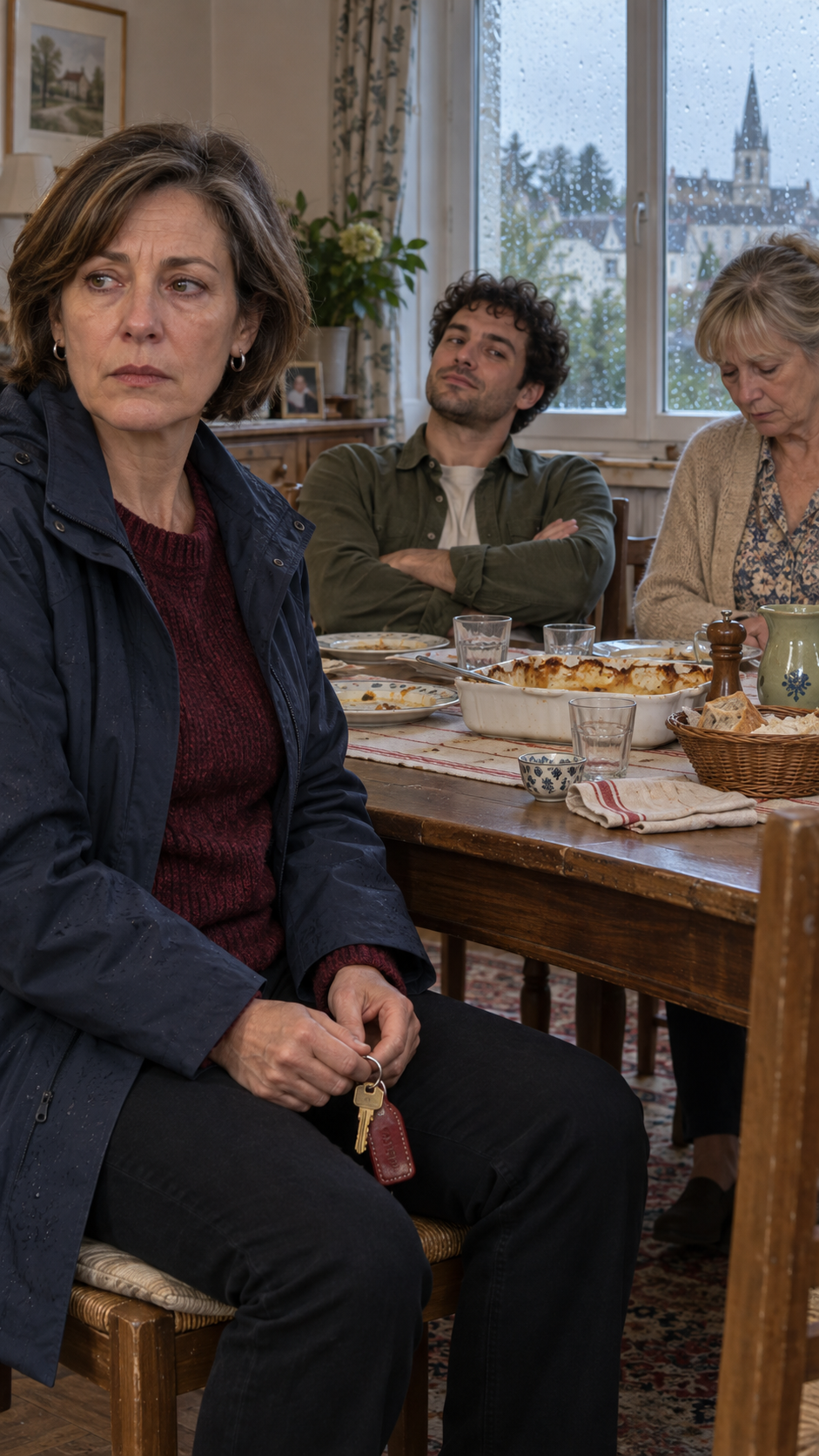
My nephew Maxime, thirty-one years old, told me in front of my sister that no one would miss me if I stopped helping him in his flower shop in Angers. My sister Sophie, who owned the shop and knew that I spent almost every afternoon there since her husband’s death, looked down at her plate instead of picking it up again.
It was a Sunday in September, at her house in Avrillé. The rain pattered gently against the bay window, and the smell of gratin dauphinois lingered in the kitchen. Maxime had just complained again because I had corrected an order he had sent twice to the wholesaler.
— You control everything, Auntie. Honestly, do you think we can’t live without you?
I put down my fork.
— I think your mother is mainly asking me to check the orders because she doesn’t have time to do everything.
He gave that little laugh through his nose that he’d had since adolescence when he wanted to show that he felt above the conversation.
— Stop. If you didn’t come tomorrow, nobody would miss you.
The silence that followed was very short. That’s precisely what hurt me.
Sophie could have said his name sharply. She could have asked him to apologize. Instead, she just pushed the bread basket towards me.
— Maxime is tired, Claire. Don’t take everything literally.
That sentence took me back thirty years, to our father who always said I was “the sensible one,” the one who didn’t make a fuss, the one who cleaned things up after everyone else. I looked at my hands. On my index finger, a small cut left the day before by the wire of a funeral wreath still pricked.
In my bag, there was the brass key to the shop, attached to an old red keyring. I had it for eighteen months. I opened when Sophie had to go to the accountant, I received the flowers, I prepared the order forms, I called the families for the ceremonies, I checked the invoices and I often stayed until closing time when Maxime had “something planned”.
I never asked for a salary. At first, it was to help Sophie out after her husband died. Then, helping out became a habit. Then it became obvious. And, eventually, something that no one noticed anymore.
I got up to clear my plate. Sophie told me to leave it, as if the matter were over.
In the entrance hall, I took the key off my keyring. I placed it in the small ceramic dish where my sister kept her coins and parking tickets.
Maxime saw me do it.
— What is this?
— The key to the shop.
He smiled, convinced that I was acting out a scene.
— Are you sulking now?
I put on my raincoat.
— No. I heard you.
Sophie followed me to the door.
— Claire, we’re not going to get angry over a silly comment.
I looked at her for a few seconds. I wasn’t angry. It was almost more worrying: I no longer wanted to convince anyone.
— I’m not angry. I won’t come tomorrow.
On the way back, the windshield wipers were beating at a steady pace. Twice, I almost turned around. I had in mind the orders for Monday, the deliveries scheduled for a ceremony in Sainte-Gemmes-sur-Loire, the statement to send to the accounting firm, and the stock of white roses that needed to be confirmed before nine o’clock.
Then I remembered Maxime’s laughter and Sophie’s silence.
At 8:12 a.m. the next day, my sister texted me: “What time will you be coming?”
I didn’t reply right away.
At 9:03 AM: “Claire, Maxime can’t find the order file.”
At 9:41 a.m.: “Please call me.”
At 10:17, my phone rang. This time, I answered.
Sophie’s voice was no longer relaxed.
— Claire… what’s that blue folder in the back drawer?
I closed my eyes. She had finally opened them.
The blue folder wasn’t a trap. It was quite the opposite. I had started it three months earlier because I had realized that an absurd amount of things existed only in my head.
On the first page, I had simply written down the week’s deadlines: deliveries, ceremonies, deposits to check, Inès’s schedule, supplier contact information, and an appointment with the accountant. Behind it, I had slipped in copies of purchase orders, to-do lists, and notes for Sophie. Nothing secret. Nothing she shouldn’t have known.
— That’s what we need to do today, I said.
There was a silence.
— Was all of that for today?
— A part.
— But Maxime tells me there are three commands he doesn’t understand.
I looked at the clock in my kitchen. I had made myself some coffee. For once, it was still hot.
