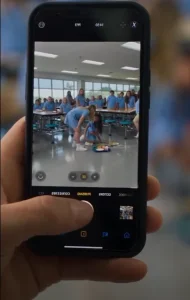
The moment Madison Clark slapped me across the face in front of a crowded school cafeteria, I thought the worst thing I would have to endure was another afternoon of humiliation.
I had no idea that forty minutes later, seventy Harley-Davidsons would roll into our school parking lot and force the most powerful man in Westbrook to confront a secret he had buried for seventeen years.
“Maybe your biker daddy can buy you another lunch!”
Madison’s voice cut through the cafeteria as I staggered backward.
My lunch tray slipped from my hands.
The crash sent milk splashing across my worn sneakers, while spaghetti scattered over the polished floor.
A sharp pain spread across my left cheek.
I pressed my fingers against it.
My skin was already burning.
Around us, dozens of students stopped eating.
Some laughed.
Others raised their phones.
Nobody moved to help.
Madison Clark stood in front of me, perfectly dressed in an expensive cream-colored sweater, designer jeans, and white sneakers that probably cost more than my father earned fixing motorcycles in a week.
She was fifteen, a year older than me, and one of the most popular girls at Westbrook High School.
Her father, Richard Clark, was president of the school board.
Her family owned property throughout the town, donated money to the athletics department, and sponsored nearly every school celebration.
Madison never had to worry about consequences.
I worried about them every day.
“Get up, Emily,” she sneered. “You’re making the floor dirty.”
Her friends laughed.
I knelt beside my ruined lunch and reached for the textbooks that had fallen from my backpack.
My name was Emily Lawson.
I was fourteen years old.
And the only thing I had done wrong was have a father Madison considered embarrassing.
Six weeks earlier, Dad and I had moved to Westbrook, Colorado.
He had purchased a struggling motorcycle repair shop on the edge of town.
The building needed repairs, the equipment was outdated, and some days he barely earned enough to cover the bills.
But Dad believed he could rebuild the business.
He believed almost anything broken could be repaired if someone cared enough to try.
His name was Jack Lawson.
He was forty-six, broad-shouldered, with a gray beard, tattoos covering both arms, and a collection of leather vests that always smelled faintly of gasoline and engine oil.
He rode a black Harley-Davidson.
To strangers, he looked intimidating.
To me, he was the man who made pancakes every Sunday, remembered exactly how much cinnamon I liked in my hot chocolate, and sat beside me until midnight whenever algebra made me cry.
My mother had died when I was seven.
I remembered her warm hands, her soft brown hair, and the way she sang while folding laundry.
But memories fade when you’re little.
Sometimes I worried that I was forgetting her voice.
Whenever that happened, Dad would take out an old video of her laughing in our kitchen.
He never told me to stop crying.
He just sat beside me.
“Missing someone means they mattered,” he would say.
Since Mom died, Dad had been everything.
My family.
My protector.
My favorite person in the world.
But at Westbrook High, his appearance became the reason people hated me.
It started during parent orientation.
Dad arrived wearing a black leather vest with his motorcycle club’s patch stitched across the back.
Madison saw him in the hallway.
She stared at his tattoos.
Then she looked at me.
“That’s your father?”
I nodded.
She smiled.
“Seriously?”
By the following Monday, students were calling me Biker Trash.
Someone taped a photograph of a motorcycle helmet to my locker.
Another student wrote LOSER across the cover of my science notebook.
At lunch, girls moved their bags onto empty chairs so I couldn’t sit beside them.
I told myself it didn’t matter.
I told myself I only had to survive until graduation.
Most importantly, I told myself Dad could never find out.
He was already working twelve-hour days to keep the repair shop open.
Every evening, he returned home exhausted, with black grease beneath his fingernails.
Yet he still asked about school.
“Making friends, sweetheart?”
I always smiled.
“A few.”
He studied my face.
“Good people?”
“Yeah, Dad.”
I hated lying to him.
But I hated the thought of adding another burden to his life even more.
Madison became crueler as the weeks passed.
She knocked books out of my hands.
She convinced classmates to exclude me from group assignments.
Once, she told a substitute teacher I had stolen a calculator.
The calculator was later found inside Madison’s own backpack.
She laughed and called it a misunderstanding.
When I complained to a teacher, I received the same answer everyone seemed trained to give.
“Madison is a good student, Emily. I’m sure it wasn’t intentional.”
