La salle de bal du Norfolk Waterside Marriott exhalait un parfum de laiton poli, de côte de bœuf et de vieux sel marin, masqué par une cire à la lavande. C’était une odeur que le capitaine Hugh Alden, USN (à la retraite), portait comme un linceul ancestral. Pendant cinquante ans, notre nom de famille avait appartenu à l’aristocratie bleu et or de Norfolk. Pour mon père, il n’existait que deux sortes de personnes sur terre : celles qui servaient sans faute jusqu’à la retraite, et celles qui déshonoraient le carré des officiers.
Pendant cinq ans, j’ai occupé une troisième catégorie, tacite : celle du fantôme.
Je portais une robe en soie bleu marine à col montant, taillée avec des épaules structurées et un dos opaque qui remontait jusqu’à la nuque. Sous le tissu, ma peau n’était plus de la peau, mais une tapisserie de greffes hétérogènes entremêlées, de bandes fibreuses rigides et de crêtes chéloïdes qui tiraient violemment dès que je tendais le bras pour m’asseoir sur une table. Aux yeux d’un observateur extérieur, j’avais l’air d’un cadre ayant quitté l’armée pour se lancer dans l’entrepreneuriat – un choix que mon père considérait comme un acte de lâcheté silencieuse, mais qu’il tolérait en public tant que je gardais la tête haute et le silence.
« Tiens-toi droite, Maya », murmura mon père, en entrouvrant à peine les lèvres, tandis que le commandant Douglas Vance passait nonchalamment avec un verre de bourbon. « Ta posture avachie fait que ta veste tire. On dirait un jeune lieutenant qui attend son tour de passe-passe. »
« Je me tiens droite, papa », dis-je doucement, en gardant les mains légèrement serrées sur mon sac.
« Tu as l’air tendu. On va croire que tu regrettes d’être parti. » Il prit une gorgée rafraîchissante de son eau gazeuse au citron vert. Il avait arrêté de boire de l’alcool après son troisième pontage, mais son ton conservait la force d’un bourbon à 45 degrés. « Essaie de sourire. Le mari de Marin essaie de conclure un contrat avec NAVSEA ce soir. Le moins que tu puisses faire, c’est de ne pas avoir l’air d’une ombre planant sur leur table. »
De l’autre côté du parquet bondé, ma jeune sœur Marin rayonnait. Elle portait une robe sans manches et dos nu en satin champagne, ses cheveux blonds relevés en une couronne de boucles naturelles qui captaient la lumière du lustre. À côté d’elle se tenait Gregory, son mari depuis trois ans, vice-président exécutif chez Titan Marine Logistics. Gregory n’avait jamais porté l’uniforme, mais il arborait le sourire franc et éclatant d’un homme qui vendait des joints auxiliaires pour moteurs diesel aux commissions d’approvisionnement avec une marge de quatre cents pour cent.
Marin caught my eye, waved a manicured hand, and excused herself from a circle of junior officers. She drifted toward us, her silk train whispering against the carpet.
“Look at you, Maya,” Marin purred, stepping between me and our father. She reached out and touched my high neckline, her fingernail grazing the stiffened collar. “Still dressing like a church librarian in August? It’s seventy-two degrees in here. You must be suffocating.”
“I’m fine, Marin,” I said evenly.
“Well, you don’t look fine. You look like you’re hiding.” She turned her dazzling smile onto Dad. “Doesn’t she, Daddy? We brought her out of that drafty little apartment in Portsmouth so she could socialize with normal human beings, and she’s standing by the potted ficus like an escort.”
My father let out a dry, dismissive breath. “Leave your sister alone, Marin. Just make sure Gregory doesn’t corner Admiral Harris until after dinner. Harris hates business talk before the salad course.”
“Oh, Gregory doesn’t need Harris,” Marin said smoothly. Her eyes flickered back to me, sharpening with a predator’s focus. “Actually, Maya, that reminds me. Gregory needs an introduction to Captain Miller over at SUPSHIP. Miller was your old skipper on the Vanguard, wasn’t he?”
My chest tightened beneath the silk. “Miller was my commanding officer five years ago, yes.”
“Great. Titan Marine just released a new line of rapid-seal thermal cut-off valves for auxiliary engine rooms. Gregory needs Miller to sign off on an accelerated field evaluation. Take him over there and give Gregory your personal recommendation.”
I looked across the room at Captain Miller, now grey-haired and thick-waisted, speaking with a pair of supply corps commanders. Then I looked at Marin. “Has the valve completed independent shock-and-vibe testing at NAVSSES?”
Marin blinked, annoyed. “What does that matter? It passed the preliminary factory bench run. Gregory says it’s fine.”
“Factory bench runs don’t simulate a ruptured high-pressure steam line or a secondary electrical fire in sea state five,” I replied, keeping my voice low and level. “If the valve hasn’t cleared Naval Surface Warfare Center certification, I won’t ask Miller to bypass protocol. I won’t put my name behind it.”
Marin’s jaw stiffened. A delicate flush crept up her neck, clashing with the champagne silk. “You won’t put your name behind it? What name, Maya? What name do you actually have left in this room?”
“Marin,” I warned softly.
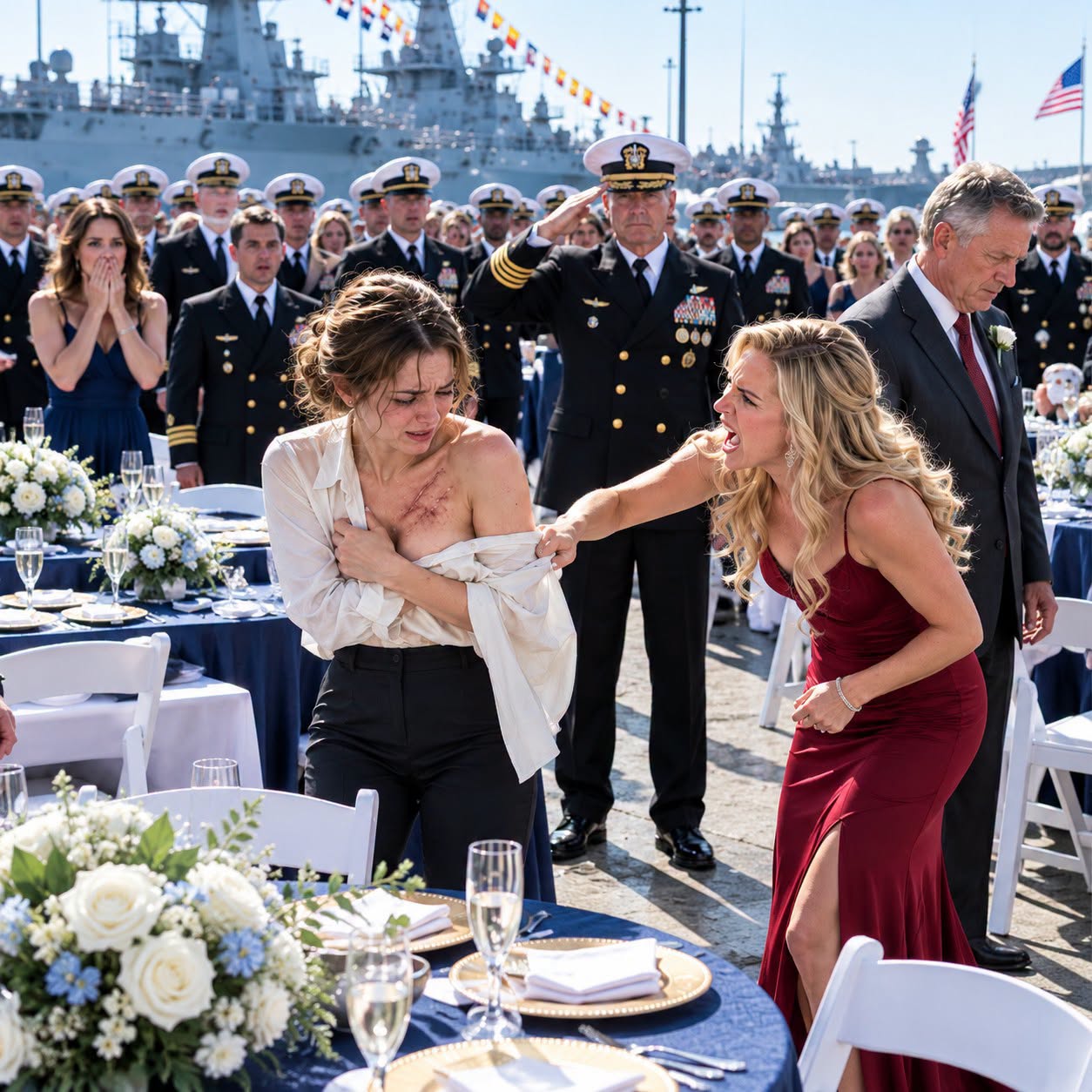
“No, I’m serious!” Her voice rose, cutting through the murmur of the brass quintet playing nearby. Several heads turned. “You’ve spent five years moping around Hampton Roads, living off your disability pension, acting like you’re some tragic hero who gave everything for the flag. You washed out of the Navy! You had an incident, you lost your nerve, and you quit the moment things got rough!”
“That is enough,” I whispered, every muscle in my spine locking.