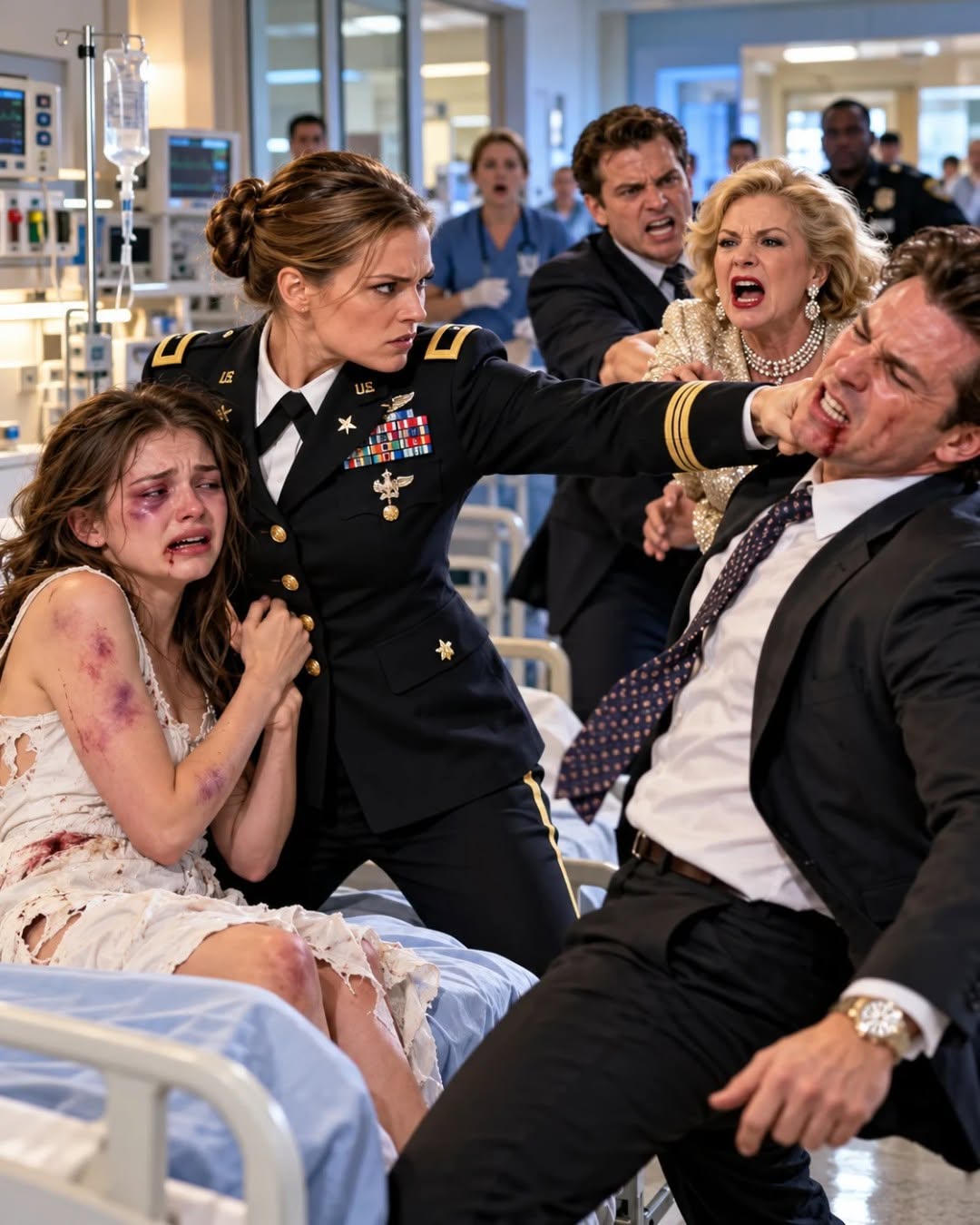
The fluorescent lighting of Room 3B hummed with an almost sickening vibration. Outside the observation room, the Charlotte hospital corridor carried the muffled sounds of life continuing—pagers chirping, rubber soles squeaking against linoleum, a distant cart rattling.
Inside, the air had turned to ice.
Gregory Ferguson was still smiling, his hands shoved casually into the pockets of his four-thousand-dollar bespoke wool trousers. Nicholas adjusted the platinum bezel of his watch, his breathing shallow, shifting his weight from one foot to the other like an athlete anxious to get off the bench. But Patricia—Patricia stood dead-center, her chin angled upward, her eyes fixed on my rank insignia with unmistakable derision.
“You look ridiculous in that costume, Rachel,” Patricia murmured, her voice dripping with Southern-accented venom. “This is North Carolina, not Fallujah. You don’t have jurisdiction over domestic affairs. My family built this wing of St. Bernard. My late husband’s name is carved into the marble in the lobby. If you think your little silver eagles give you authority here, you are dangerously out of your depth.”
I didn’t blink. In combat, when a threat establishes its position and displays its weaponry, the worst mistake an officer can make is to mirror their emotional cadence. Rage is undisciplined; discipline is lethal.
I looked down at Abigail. Her fingers were digging into the cuff of my uniform jacket, knuckles bone-white. The right side of her face was purpling under the pale hospital lights, the orbital bone swollen to the size of a walnut. Her lip had split straight through to the lower gum, dried crimson crusting on her chin.
“Mom,” she whispered again, her voice barely carrying above the fluorescent hum. “They took my purse. My passport. The keys to the car. Nicholas said if I walked to the front gate, he’d turn the Rottweilers loose and tell the sheriff I was trespassing.”
Nicholas scoffed, taking a half-step forward. “Oh, give me a damn break, Abby. You fell down the stairs of the carriage house while you were having one of your hysterical episodes. You’re lucky Gregory and I even drove you here instead of calling a private clinic to put you under observation.”
He reached out toward Abigail’s shoulder, his manicured fingers extending with familiar, casual entitlement. “Get up. We’re going home. We have a dinner party with Judge Hollister tomorrow night, and I am not dealing with—”
He never finished the sentence.
Before his hand could bridge the remaining six inches, I stepped inside his reach. My left hand caught his wrist at the nerve cluster above the radial artery, twisting with precise, downward leverage. My right forearm planted flat across his sternum, driving him backward into the corridor wall with a dull, hollow *thud*.
Nicholas gasped, his eyes bulging as the air rushed out of his lungs.
“Don’t touch her,” I said. My voice wasn’t raised. It was flat, measured, pitched at the frequency of a countdown timer. “You touch my daughter again, Nicholas, and I will treat you as an active combatant.”
“Get your hands off my son!” Patricia shrieked, her aristocratic composure shattering into shrill hysteria. “Gregory, call security! Call the police right now! This woman is assaulting him!”
Gregory reached into his jacket for his phone, his smirk vanished, replaced by an ugly flush of red across his cheeks. “You just ruined your career, Colonel. You’re finished. You hear me? We own the district attorney.”
The curtain behind them whipped back.
A tall man in plain civilian clothes—faded denim, dark tactical jacket, steel-rimmed glasses—stepped through the entryway. Behind him were two Charlotte-Mecklenburg police officers, their hands resting on their duty belts, looking distinctly uncomfortable.
“Colonel Gardner?” the civilian said.
“Master Sergeant Vance,” I acknowledged, releasing Nicholas’s wrist.
Nicholas stumbled, clutching his arm, his face pale with sudden, humiliating fear. He looked between Vance and the two city officers, his voice rising. “Officers! Arrest her! She just assaulted me inside a private hospital room! I am Nicholas Ferguson of Ferguson Shipping & Logistics—”
The older of the two Charlotte officers glanced at Nicholas, then at the paperwork Vance was holding, and stepped between Nicholas and me.
“Mr. Ferguson,” the officer said quietly, “we were dispatched to this room on a priority domestic distress call logged directly with state dispatch forty minutes ago. Furthermore, this woman is an active-duty commanding officer who called in an emergency federal evidentiary preservation request under DoD Directive 6495.02.”
Patricia’s jaw dropped. “Federal? This is a civil matter between a husband and wife!”
“No, Patricia,” I said, stepping back to Abigail’s bedside and gently brushing a strand of matted hair behind her ear. “It ceased being a civil matter the moment you locked her inside a federal communications black hole on an active enterprise property that holds over thirty million dollars in Department of the Army transport contracts.”
I looked at Gregory. The smug corporate arrogance in his eyes flickered, replaced by the faint, cold dread of a businessman who suddenly realized he had brought a pen to an artillery duel.
“I have already placed an emergency hold on your logistics terminal in Wilmington,” I continued, each syllable striking like a hammer on an anvil. “I have notified the Staff Judge Advocate at Fort Liberty. And right now, Master Sergeant Vance is coordinating with Mecklenburg County Forensic Services to conduct a full, certified rape-and-trauma kit on my daughter.”
Abigail let out a shuddering breath, her tears finally spilling over her swollen cheek.
Nicholas stepped back into his brother’s shadow, rubbing his bruised chest, his lips trembling. “You’re crazy. You’re out of your goddamn mind. You can’t prove anything.”
May you like
“I don’t need to prove anything tonight, Nicholas,” I whispered, holding his terrified gaze until he looked away. “Tonight, I’m just taking my daughter home. Tomorrow… tomorrow, the United States Army looks at your books.”
The Ferguson family compound sat on eleven manicured acres behind double-wrought-iron gates in the most exclusive enclave of Quail Hollow, Charlotte. To the outside world, it was an architectural monument to three generations of old Carolina money—white brick, neoclassical columns, sweeping dogwoods, and centuries-old live oaks weeping Spanish moss.
