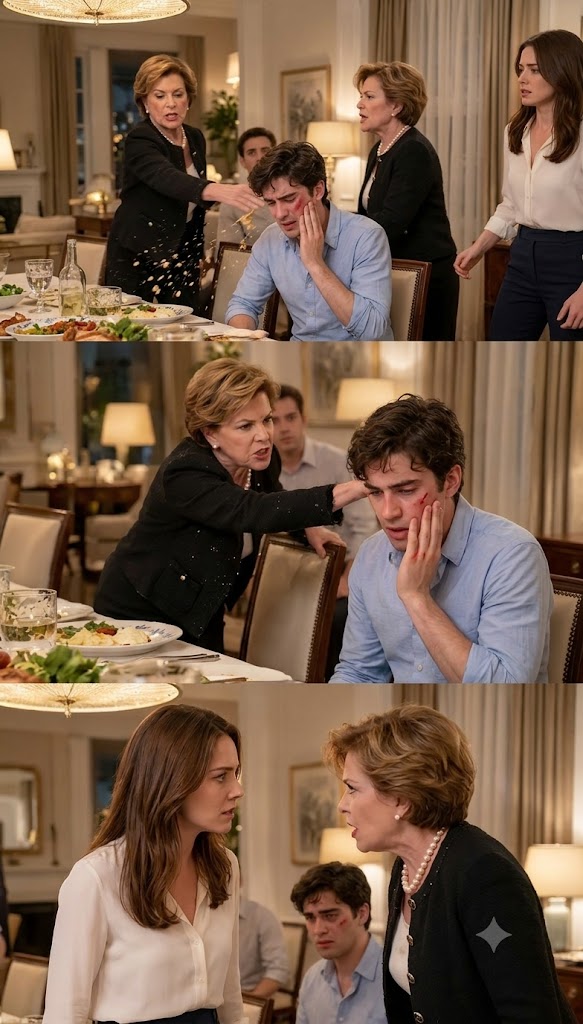
“You greedy little freeloader!” Diane shouted, loud enough for the entire house to hear. She told Noah he had walked into her son’s home and grabbed the best piece of chicken as though he hadn’t eaten in a week. Noah didn’t argue, didn’t raise his voice, and didn’t even ask why she had hit him. He simply looked down and whispered, “I’m sorry.”
That apology hurt me worse than the slap. Noah had spent years learning not to ask for much because our parents had struggled financially after Dad’s construction business collapsed. He wore old shoes without complaining, kept a laptop long past the point when it should have been replaced, and even pretended expensive school activities didn’t interest him because he knew what they cost. Now he was standing in my dining room apologizing because somebody else had struck him.
I looked at Diane, then at my husband Ethan, waiting for him to do what any husband should have done. Instead of confronting his mother, Ethan looked straight at me and said my name in a warning tone. “Claire.” That one word told me he wasn’t frightened by what his mother had done—he was frightened by what I might do about it.
Then Ethan made everything worse. He admitted his mother should not have slapped Noah, but added that Noah “needed to understand basic manners.” Diane folded her arms and insisted Noah had reached for Ethan’s piece of chicken, as if that somehow justified putting a hand across an eighteen-year-old boy’s face. Something inside me, something I had been forcing down for four years, finally snapped.
For four years, Diane had been living in our townhouse because Ethan said she only needed a temporary place after selling her condo. Three months became six, six became twelve, and eventually nobody talked about when she would leave. She rearranged my kitchen, criticized the food I bought, complained about the thermostat, invited friends over without asking, and even returned curtains I had purchased because she thought they made “Ethan’s home” look cheap. Every time I objected, Ethan gave me the same answer: “She’s my mother. Keep the peace.”
So I kept the peace until the price of that peace was my little brother standing at my table with a handprint on his face. I pushed my chair back, stood up, and told Diane to get out. She stared at me in disbelief before giving a bitter laugh and saying, “Your house? This is my son’s house.” Ethan immediately told me to stop.
I didn’t stop. For the first time in years, I said one word without explaining or softening it afterward: “No.” Then I told Diane the truth Ethan had apparently never bothered to tell her—my name was on the deed, my money had paid the down payment, and my salary had carried most of the mortgage since we moved in. Diane turned toward Ethan, and the look on his face told me something I had never realized before.
She truly hadn’t known.
Ethan had allowed his mother to live under my roof for four years believing the townhouse belonged to him. He had listened while she called it his house, rearranged my rooms, criticized my choices, and treated me like a woman lucky enough to be living in something her son had provided. I walked to the front closet, took out Diane’s coat and purse, placed them beside the door, and told her she had two minutes to leave.
When she refused, I reminded her that our security cameras covered part of the dining room. The moment she realized the slap had been recorded, her expression changed. I told her that if she refused to leave, I would call the police and show them exactly what she had done. She grabbed her coat, accused me of destroying my marriage, and stormed outside.
The second the door closed, Ethan exploded. He said I had humiliated his mother over “a stupid piece of chicken,” while I reminded him that his mother had assaulted my brother in front of us and he had defended her. Noah immediately offered to leave for his dorm because he didn’t want to cause trouble, which only proved how deeply that dinner had wounded him. I told him none of this was his fault.
Then I gave Ethan a choice. If he walked out the door to chase after his mother, I told him to take a suitcase because I needed to know whether I had a husband or simply Diane’s spokesman living with me. Ethan looked at me, looked at Noah, picked up his car keys, and walked out anyway. Before leaving, he turned back and said, “You’ll regret this tomorrow.”
I thought that might be the worst thing that happened that night.