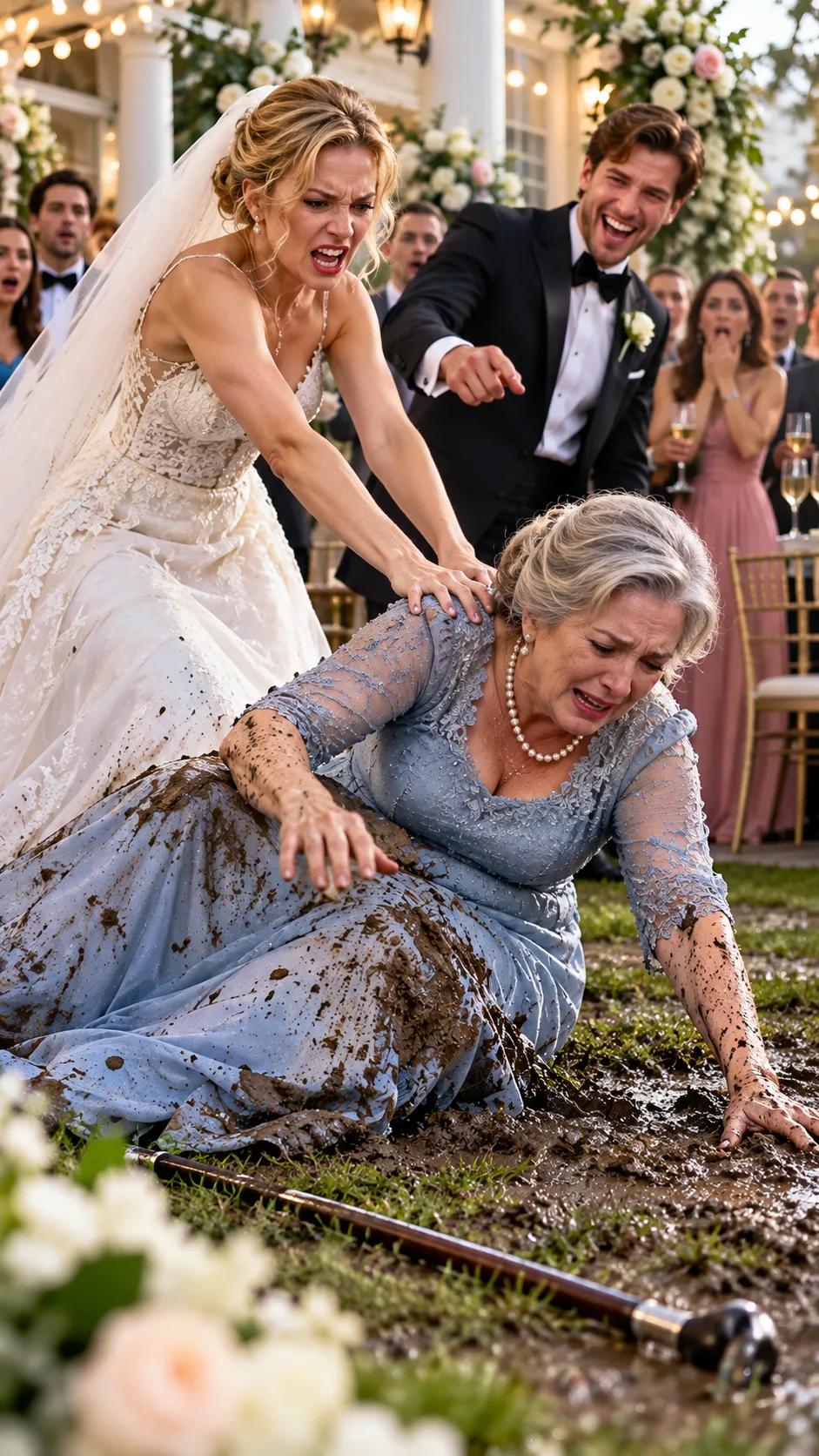
My son’s bride shoved my wife into a puddle of mud, and my son laughed while she tried to reach her cane.
It happened beside the rose-covered fountain at Briarwood Estate, with two hundred wedding guests watching.
Margaret’s pale-blue dress darkened from the knees down. She put one hand into the wet grass, tried to rise, and winced. Nine months after hip surgery, getting off the floor still hurt her.
“Mom, you’re making it worse,” Daniel said, smiling as if this were a harmless joke.
Vanessa brushed imaginary dirt off her white gown. “She kept getting in our pictures. I barely touched her.”
I had already seen both hands leave Vanessa’s shoulders and strike my wife’s. That was not an accident.
I found Margaret’s cane under a table, helped her up, and put my dinner jacket over her shoulders. Her fingers were shaking.
“Graham,” she whispered, “please don’t let this ruin the day.”
“It wasn’t your day they ruined.”
A few guests looked away. Others kept their phones raised. Our son stared at the mud as though it had appeared by itself.
I climbed the two steps to the little platform where the band was supposed to introduce the speeches.
“I owe everyone an explanation,” I said. “Margaret and I promised to contribute eighteen thousand dollars toward this wedding. We will not be making that payment.”
Vanessa laughed. “You can’t do that. The reception’s already started.”
“The vendors have contracts with you and Daniel. They can send you their invoices.”
Daniel hurried toward me. “Dad, put the check away. Let’s talk privately.”
“You had a chance to speak when your mother was on the ground.”
I took the unsigned gift check from my envelope. Then I removed the other paper: a notarized statement Margaret had signed three days earlier.
Daniel’s face changed when he saw her signature.
“What did you cancel?” he asked.
May you like
Before I could answer, Margaret called from behind us.
“Tell him what you tried to take from me, Daniel.”
Daniel stood between his new wife and his mother, looking as though he had been caught in somebody else’s nightmare.
“Mom, you don’t understand,” he said.
“I understand my name,” Margaret replied. “I also know when I haven’t signed it.”
The paper in my hand was an affidavit of nonconsent. Margaret had signed it before an independent notary and our attorney, Leah Bennett. It identified an access agreement someone had submitted to a title company, supposedly authorizing a permanent road across Margaret’s waterfront land.
The agreement carried her signature. She had never seen it until Leah showed us a copy.
“That’s not what Vanessa’s father said it was,” Daniel muttered.
Vanessa stepped close. “Your father is turning our wedding into a business dispute.”
“You turned it into this when you pushed her,” I said.
I didn’t wave the affidavit around for the guests. I folded it and put it away. Margaret’s health, not public humiliation, came first.
Richard Caldwell, Vanessa’s father, appeared at the foot of the steps. He had paid for the flowers that framed them and liked people to notice.
“Graham,” he said quietly, “perhaps we can keep family matters out of the spotlight.”
“They were in the spotlight the second your daughter pushed my wife.”
Richard’s smile didn’t move. “You’ll regret confusing an unissued wedding gift with a signed commercial obligation.”
That sentence told me more than he meant it to.
The affidavit had already been delivered to the title company. It did not magically undo a contract; it put the forged signature in dispute and warned the insurer not to proceed without verifying consent. Neither Richard nor Daniel knew we had filed it.
Margaret took my arm. “I want to go home.”
We were nearly to the parking lot when Daniel caught up with us.
“Dad. Please. Caldwell’s people are supposed to close Monday.”
I stopped.
“Close on what?”
May you like
Daniel swallowed. “The road. They told me you agreed.”
Then Richard’s voice came through Daniel’s phone: “Do not tell him about the second parcel.”
I drove Margaret home without turning on the radio. The mud on her dress had dried into hard, brown patches, and every bump in the road made her shift in her seat.
“Did you know about the second parcel?” I asked.
“No. I only signed what Leah put in front of me.”
At our kitchen table, Margaret removed her ruined shoes. She had spent months helping plan that wedding, calling elderly relatives, checking accessible seating, and saving old family recipes for the dessert station.
“I even gave Vanessa Mama’s pearls,” she said.
Her mother had worn that bracelet when she married Margaret’s father. Each pearl was slightly imperfect, and its clasp was repaired with a tiny gold hook.
