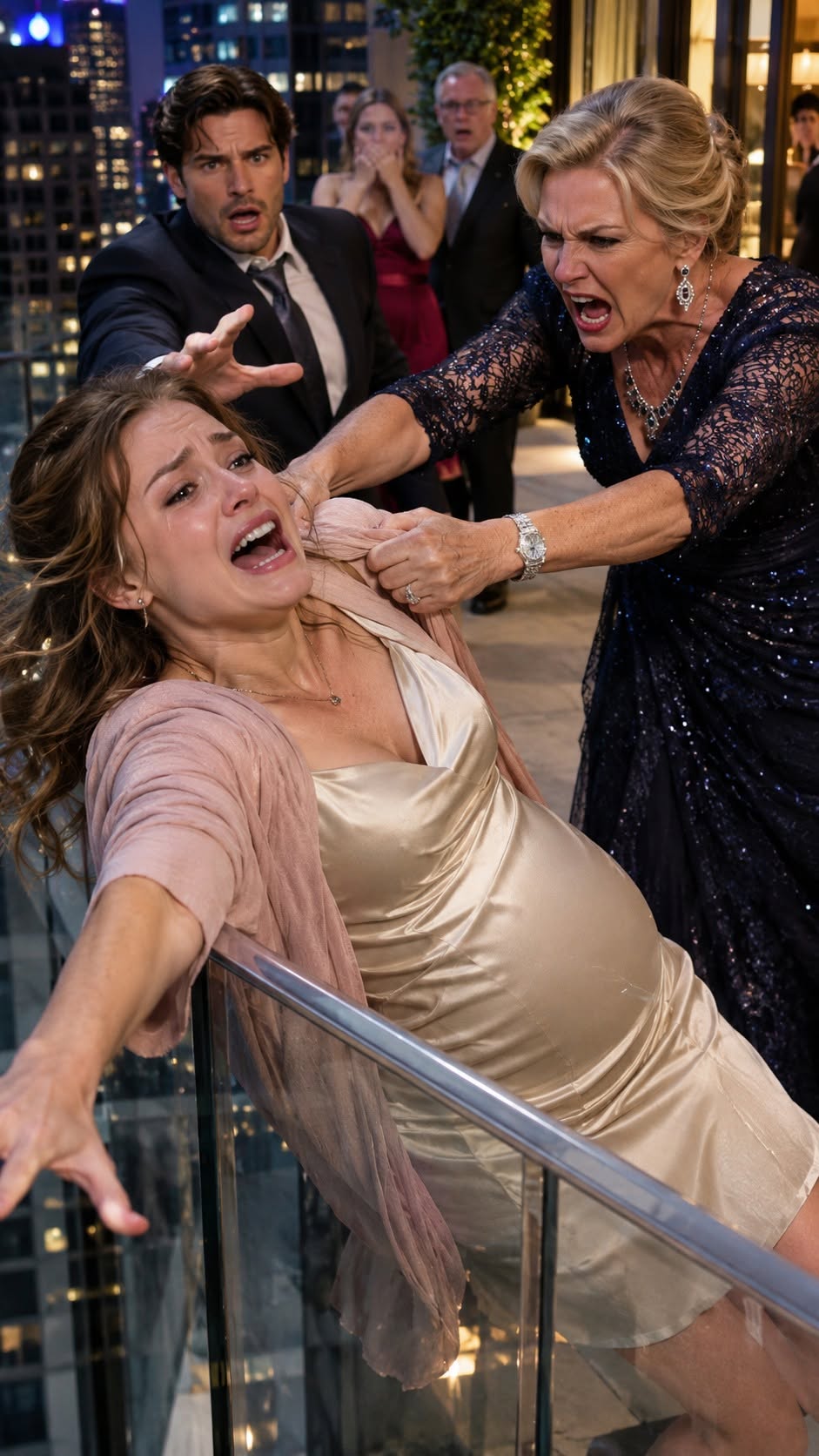
The harsh fluorescent glare of Emergency Trauma Bay 4 hummed like an angry hornet. The smell was an assault of iodine, sterile alcohol, and the metallic tang of dried blood clinging to my torn evening dress.
Every breath sent jagged lances of agony through my lower left ribs and bruised pelvic girdle. My knuckles were bone-white where I clamped down on the vinyl guardrail of the gurney, but my right hand was encased in Daniel’s grip. My husband was shivering, his custom tuxedo shredded at the elbows from where he had scrambled across the lower concrete terrace to pull me out of the shattered glass.
“Emily, keep your eyes on me,” Daniel choked out, his voice cracked with terror. His hair was plastered with sweat and rain, streaks of terrace dust smudged across his cheekbones. “Look at me, sweetheart. Stay with me.”
“The baby, Daniel…” I gasped, fresh tears cutting tracks through the grime on my face. “She pushed me. She looked right into my eyes and shoved me. It went dark… Daniel, please, is the baby gone?”
Before he could answer, Dr. Harrison—a gaunt, silver-haired trauma obstetrician whose badge identified him as the Chief of Perinatal Surgery—pressed the cold transducer wand back against the conductive gel on my lower abdomen. The ultrasound monitor stood angled between us, its screen casting an eerie greenish glow over the sterile suite. Beside him, an emergency ultrasound fellow, Dr. Alvarez, squinted at the monitor, his brow knit so fiercely his eyebrows met.
“Doctor, talk to us,” Daniel demanded, his voice hardening with the instinctive authority of a CEO who was used to commanding boardrooms, though the tremor in his throat betrayed him. “Is my wife hemorrhaging internally? Did we lose the pregnancy?”
Dr. Harrison didn’t answer right away. He clicked a trackball, capturing frame after frame of high-resolution sonographic imaging. His jaw worked silently.
“Dr. Alvarez, bring up the Doppler color flow,” Harrison instructed quietly. “Isolate the lower posterior uterine wall. Magnify quadrant three.”
The fellow’s fingers flew across the keyboard. Instantly, the rhythmic, oceanic *woosh-woosh-woosh* of rushing maternal blood filled the room. But beneath that familiar rhythm came another sound.
*Thump-thump-thump-thump.*
Rapid. Fierce. Unmistakable.
A sob broke from my throat. “A heartbeat! Daniel, listen! It’s beating!”
“Thank God,” Daniel breathed, collapsing forward until his forehead rested against the edge of my mattress, his shoulders heaving with ragged relief. “Oh God, thank God.”
“Wait,” Dr. Harrison said. His voice was completely devoid of celebration. He looked at Alvarez, then reached out and tapped the screen with a gloved fingertip. “Listen to the frequency modulation. That isn’t a single fetal heart tone.”
Daniel lifted his head, his brow furrowing. “What do you mean? Are you saying there are twins?”
“It isn’t just that there are twins, Mr. Carter,” Dr. Harrison said, turning the wide monitor so both Daniel and I had a direct view. He pointed to two tiny, distinct gestational sacs tucked safely into the high fundus of my uterus. “You are carrying identical monochorionic twins. But look right here, at the retroplacental margin.”
On the screen, beneath the glowing pockets of life, lay a jagged, dark crescent.
“Is that a hematoma?” I whispered, my medical vocabulary dredged up from anxious late-night reading during the early weeks. “Did the fall cause bleeding behind the placenta?”
“Partially, yes. You have a subchorionic hematoma caused by the blunt force trauma against the lower ledge,” Harrison explained gravely. “Your babies survived the impact because the second sac was positioned in a way that mechanically cushioned the primary vascular junction. It is a genuine miracle that neither sac ruptured when your pelvis took the brunt of the landing.”
“Then what changed your face, Doctor?” Daniel pressed, his eyes narrowing as he read the physician’s lingering severity. “There’s something else.”
Dr. Harrison set the wand back in its holster and wiped the excess gel from my abdomen with a warm towel. He looked directly at Daniel, then down at me.
“Mrs. Carter, how long have you been taking progesterone or synthetic gestagen supplements?”
I blinked, confused. “Never. I haven’t taken any medication. Just standard prenatal vitamins with folic acid. Daniel bought them from our compounding pharmacy three weeks ago.”
Dr. Harrison pulled a clipboard toward himself, flipping to the emergency toxicology and endocrinology panels that had just printed out from the lab pneumatic tube.
“When a patient presents with major blunt-force trauma during early gestation, we run an extensive stat tox screen,” Dr. Harrison said, keeping his voice level, deliberate, and chillingly precise. “Your blood contains dangerous, elevated concentrations of Mifepristone.”
The room went deathly still.
“Mifepristone?” Daniel repeated blankly. “What is that?”
“It is a synthetic steroid compound,” Dr. Alvarez interjected grimly. “Commonly used in medical terminations. It blocks progesterone receptors, detaching the trophoblast from the uterine lining and inducing labor.”
