Chapter 1: THE CHAIR THAT DISAPPEARED 003
The moment my sister removed my chair from her wedding reception, I understood that she wasn’t trying to change the seating arrangement—she was trying to erase me from our family.
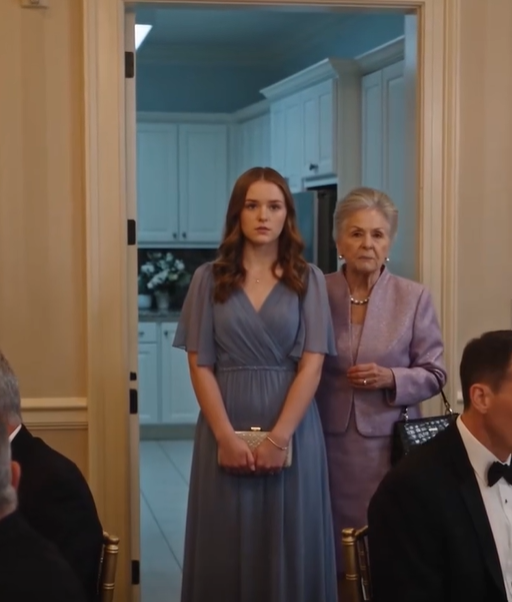
There were nearly two hundred people inside the magnificent ballroom of Marlowe House that October evening, and somehow, every single one of them seemed to witness my humiliation.
I stood beside Table Seven, holding my small silver purse, staring at the empty space between Grandma Margaret and Aunt Patricia.
Only three hours earlier, a chair had stood there beneath a cream-colored place card bearing my name in elegant gold lettering.
CLARA WHITAKER.
Now the chair was gone, although the place card remained like a cruel little joke.
My older sister, Vanessa, stood across from me in a wedding gown that probably cost more than my car.
Her dark hair had been twisted into an elaborate arrangement of pearls and delicate white flowers, and the diamond necklace around her throat glittered beneath the chandeliers.
At forty-five, she looked beautiful, successful, and entirely certain that the world existed to accommodate her wishes.
I was twenty-seven, eighteen years younger than Vanessa, and I had spent most of my life struggling to understand why someone who had once loved me so fiercely now seemed determined to make me feel unwanted.
“We’ve moved you to the table beside the kitchen,” Vanessa announced.
She said it with the same detached politeness someone might use when informing a customer that a particular dessert was unavailable.
I followed her pointing finger toward the far end of the ballroom.
A tiny round table stood beside the swinging kitchen doors, surrounded by equipment cases, spare flower arrangements, and a folding screen concealing the service corridor.
Three people already occupied its five chairs.
One was a musician from the wedding band, another appeared to be the photographer’s assistant, and the third wore the black uniform of the catering company.
I turned back toward Vanessa.
“Why would I sit there?”
Her smile remained in place, although something unpleasant moved behind her eyes.
“Because that’s where your seat is now.”
“But you confirmed my place at the family table this morning.”
“Plans change, Clara.”
“Only my plans?”
Aunt Patricia stopped arranging her napkin.
Grandma Margaret, who was eighty-two and had recently begun walking with a cane, slowly raised her silver-haired head.
Vanessa noticed their attention and lowered her voice.
“Don’t embarrass me at my own wedding.”
The accusation was so absurd that I almost laughed.
I hadn’t shouted.
I hadn’t complained to anyone.
I had simply asked why the bride had removed the only chair belonging to her own sister.
“I’m not trying to embarrass you,” I answered.
“Then stop making everything about yourself.”
There it was, the familiar sentence that had followed me through birthdays, holidays, family dinners, and the difficult years after our father’s death.
Vanessa could wound me with a thousand tiny cuts, but the moment I admitted that I was bleeding, she would accuse me of making a scene.
I looked at my place card again.
She had even left it behind, as though my name were welcome at the family table but my actual presence was not.
“Vanessa,” I whispered, “I’m your sister.”
Her smile vanished.
She looked directly into my eyes.
“Half-sister.”
The word dropped between us with the unmistakable sound of something breaking.
For a moment, the orchestra seemed terribly loud.
Then even the music faded beneath the silence spreading across the neighboring tables.
Aunt Patricia’s hand froze above her champagne glass.
Grandma Margaret closed her eyes.
I stood perfectly still because moving felt dangerous, as though one wrong breath might release all the humiliation I had spent years swallowing.
Vanessa and I shared the same father, Thomas Whitaker.
At least, that was the history I had known since childhood.
Her mother had died when Vanessa was young, and several years later Dad married Olivia, the woman who raised me.
Olivia died when I was nine, leaving our father to raise me through the difficult, lonely years that followed.
Vanessa had already become an adult by then.
Nevertheless, my earliest memories of her were full of tenderness.
She taught me to ride a bicycle on the cracked driveway behind our house.
She braided my hair before my first day of kindergarten.
During thunderstorms, she sometimes let me drag my blanket into her bedroom and sleep beside her bed.
When I was six, I fell into the lake behind Grandma’s cottage, and Vanessa jumped into the freezing water without even removing her shoes.
After she pulled me out, she held me so tightly that I could barely breathe.
“Don’t you ever scare me like that again,” she had cried.
For years, I remembered that embrace whenever she became cold or distant.