I told myself that the woman who had saved my life was still somewhere inside the woman who kept pushing me away.
When Dad died three years earlier, Vanessa gripped my hand beside his grave.
I thought losing him might finally bring us closer.
Instead, it seemed to release something bitter that she had carried for years.
She stopped inviting me to Sunday dinners.
She forgot my birthday twice.
At Christmas, she gave me a gift card while everyone else exchanged thoughtfully chosen presents.
Whenever I tried to talk about the distance between us, she insisted that I was imagining things.
And now, in front of nearly two hundred wedding guests, she had finally said what I suspected she had been thinking all along.
I was only half a sister, and apparently that meant I deserved half a place in the family.
I looked around Table Seven.
Grandma Margaret was watching Vanessa with an expression I couldn’t decipher.
Aunt Patricia looked furious.
Uncle Robert had set down his fork.
My cousins Emma and Nicholas were staring at me with helpless sympathy.
Suddenly, I knew I could not sit at that miserable little table by the kitchen doors.
Not because there was anything shameful about sitting beside the people working that evening.
Those people deserved every bit as much respect as anyone wearing diamonds beneath the chandeliers.
But Vanessa hadn’t chosen that table because she respected them.
She had chosen it because she believed it was a place where I would be less visible.
I reached for my coat.
“Clara, what are you doing?” she demanded.
“Leaving.”
Her eyes widened.
“You can’t leave.”
“Why not?”
“Because people will notice.”
I looked at the empty space at the family table.
“You should have thought about that before you made sure there was nowhere for me to sit.”
Then I turned away.
Walking across the ballroom was harder than I expected.
The soles of my shoes made tiny clicking sounds against the polished floor, and each step seemed to attract another pair of watching eyes.
I kept my head high.
I had learned from experience that Vanessa treated tears as evidence of weakness.
Tonight, I refused to give her that satisfaction.
I had nearly reached the double doors when a chair scraped loudly behind me.
The sound sliced through the room.
Then another chair moved.
And another.
I stopped.
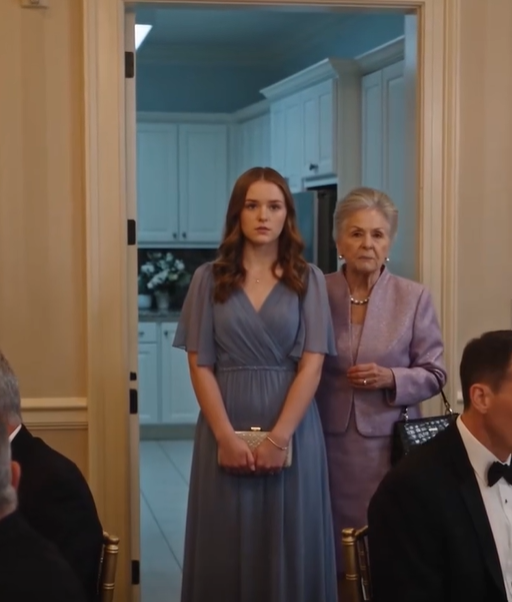
When I turned around, Grandma Margaret was standing beside Table Seven.
She had one trembling hand wrapped around her cane and the other holding her small black handbag.
Vanessa stared at her.
“Grandma, please sit down.”
Grandma did not move.
Instead, she looked directly at my sister.
“If Clara isn’t family, Vanessa, then neither am I.”
A murmur spread through the ballroom.
Aunt Patricia immediately rose from her chair.
“I’m leaving too.”
Uncle Robert pushed his seat backward.
“Patricia, get your coat.”
Emma and Nicholas stood together.
Within seconds, the entire table was emptying.
Then relatives from the neighboring tables began rising.
Some had heard Vanessa’s insult.
Others had merely watched Grandma Margaret stand, and that was enough.
My grandmother had been the quiet center of our family for more than five decades.
She rarely raised her voice, never wasted words, and had attended every birthday, graduation, baptism, funeral, and family celebration anyone could remember.
If Grandma Margaret was walking out, people knew something serious had happened.
Vanessa’s face drained of color.
“Everybody, sit down!”
Nobody obeyed.
Chairs scraped against the floor.
Handbags snapped shut.
A dozen conversations burst into life.
Soon a small crowd of relatives was moving toward the exit, carrying coats and expressions of disbelief.
I felt suddenly dizzy.
I hadn’t asked anyone to follow me.
I hadn’t wanted to destroy Vanessa’s wedding reception.
I had only wanted to leave without being forced to accept her humiliation.
But the scene was no longer mine to control.
The orchestra stopped playing.
The abrupt silence made the ballroom feel enormous.
Daniel Hale, my sister’s new husband, emerged from a conversation near the dance floor.
He was forty-seven, tall, with graying brown hair and an easy, thoughtful manner that had made me like him almost immediately.
Daniel was a high school principal who had spent twenty years working with teenagers, and he possessed the kind of patience that made people lower their voices without being asked.
Until that evening, I had believed Vanessa was fortunate to have found him.
Now he looked from the departing relatives to his bride.
“What happened?”
“Nothing,” Vanessa answered too quickly.
Daniel glanced at Grandma.
Then at me.
“Clara, are you leaving?”
I nodded.
“I’m sorry, Daniel.”
His forehead creased.
“Why are you apologizing?”
Before I could answer, Vanessa stepped between us.
“She’s upset about a minor seating adjustment.”
Daniel looked toward Table Seven.