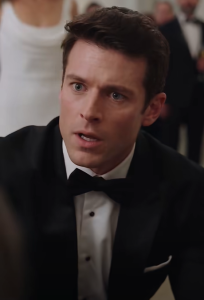
The sound of my fiancée’s hand striking my mother’s cheek was so sharp that almost two hundred of the city’s most influential people seemed to stop breathing at the same instant.
Only a heartbeat earlier, champagne glasses had been chiming beneath immense crystal chandeliers.
Then the entire ballroom changed.
My mother sat completely still in her wheelchair, her head turned slightly to one side. Her glasses had slipped crooked across her face, and a loose strand of silver hair lay against her cheek.
Chloe stood over her.
Her chest rose and fell beneath the white gown she had chosen for our engagement party.
Her right hand was still hanging in the air.
And in that second, every belief I had ever held about the woman I intended to marry shattered before the first champagne glass even hit the marble floor.
“Get this woman out of here!” Chloe shouted, pointing hard toward the ballroom entrance.
Nobody obeyed.
Not the security staff.
Not the waiters.
Not the politicians who had spent the evening perfecting the ability to ignore anything uncomfortable happening nearby.
Not even Chloe’s father, Richard Ashford, who stood about thirty feet away beside a marble column, holding a champagne flute halfway to his mouth.
I immediately moved between Chloe and my mother.
“What the hell is wrong with you?”
Chloe stared at me as though I had become the problem.
“Julian, look around.”
“I am looking.”
“Then behave like you understand what tonight means.”
I did understand.
That was exactly the problem.
For two years, I had believed tonight represented something extraordinary: Chloe Ashford and I had somehow crossed the enormous distance between the lives we came from and chosen to build one future together.
Now I finally realized Chloe had been measuring those two worlds the entire time.
And in her mind, my mother belonged below hers.
When Chloe tried to step around me, I pushed her backward.
Not hard enough to injure her.
Only enough to make her stop.
She stumbled into a waiter carrying a tray of champagne.
The tray tipped.
Six glasses fell against the marble.
Crack.
Crack.
Crack.
Crack.
The orchestra went silent.
I dropped immediately beside my mother.
“Mom.”
My hands were shaking.
“Mom, look at me. Are you okay?”
For several seconds, she said nothing.
Then she slowly reached up and straightened her glasses.
She touched her cheek once.
There was no drama in the motion.
If anything, she looked strangely thoughtful.
Finally, Mom turned toward me.
I expected tears.
Embarrassment.
Fear.
What I saw instead confused me far more than tears would have.
Certainty.
She smoothed the front of the same old navy dress she had worn to my college graduation eight years before.
Then she looked past me.
Straight at Chloe.
“They’re already here, dear.”
Her voice was barely above a whisper.
Still, the room had become so quiet that people across the ballroom heard her.
I frowned.
“Who?”
Mom shifted her gaze toward the entrance.
And at that exact moment, the huge double doors opened.
Every face in the room turned.
Four people entered.
The man in front was tall, somewhere in his late sixties, with silver hair and a charcoal suit that probably cost more than my first car.
I recognized him immediately.
So did everyone else.
Henry Mercer.
Chairman of Meridian Capital.
His investment firm controlled major interests in banks, airlines, hotel chains, technology corporations, media companies, and enough commercial real estate to make portions of the skyline itself seem negotiable.
Behind him walked a woman carrying a black leather portfolio.
Lydia Cross.
One of the most feared corporate attorneys in the country.
A broad-shouldered Black man wearing a dark suit followed her.
I didn’t recognize him.
The fourth member of the group was a younger woman carrying two document cases.
But the arrival of those four people was not what changed the atmosphere in the ballroom.
It was what Henry Mercer did when he reached my mother.
He stopped beside her wheelchair.
His eyes settled on the red mark appearing across her cheek.
Then one of the most powerful financiers in the country slowly lowered himself onto one knee.
“Margaret,” he said.
His voice trembled.
“Tell me who did this.”
A strange sound passed through the crowd.
Not exactly a gasp.
Something lower.
Heavier.
I looked between Henry and my mother.
“Mom?”
She didn’t answer me.
Chloe did.
She gave a nervous laugh.
“This is ridiculous.”
No one laughed with her.
Chloe turned toward Henry.
“I don’t know what sort of performance this is, but this woman wandered into a private event looking like—”
“Stop talking.”
The words came from Richard Ashford.
Chloe turned toward her father.
He had gone white.
Not embarrassed.
Not irritated.
Terrified.
“Dad?”
