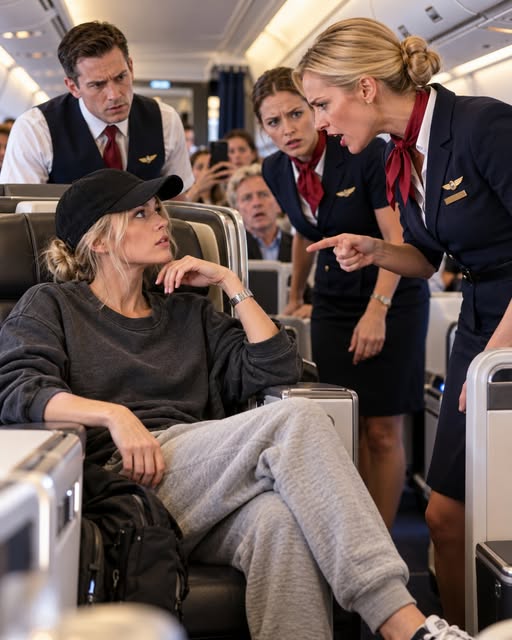
“And please don’t change your handling of this complaint based on who you think I might be.”
Rachel went completely still.
For several seconds, she stared at Olivia.
Then she whispered:
“Understood.”
She returned to the forward galley.
Olivia looked out the window as the cabin door finally closed.
The aircraft began preparing for departure.
She had won the right to keep a seat she’d already paid for.
But as the engines started, one question remained.
Why had Graham Voss’s office been so determined to give her seat to someone els
Chapter 3 – THE NAME ON THE BOARDROOM DOOR
The plane landed in Seattle shortly after nine that morning.
Olivia thanked the flight attendants politely as she left.
Richard met her near the forward door.
“Ms. Reed?”
She stopped.
“Yes?”
He looked uncomfortable.
“I wanted to apologize for what happened.”
Olivia studied him.
“You didn’t cause it.”
“I should have spoken sooner.”
“You did speak.”
“Only after it became obvious.”
She gave him a small smile.
“Sometimes speaking up takes longer than we wish. What matters is whether we’re willing to do it when it counts.”
Richard nodded.
Then he hesitated.
“There’s something I think you should know.”
Olivia’s expression changed.
“What?”
“Caroline was told that seat 2A had to become available.”
“By whom?”
“Someone from executive customer services.”
“Did they explain why?”
Richard shook his head.
“Not to me.”
Olivia looked toward the gate.
“Would you be willing to provide that information through a formal investigation?”
He hesitated.
Then nodded.
“Yes.”
“Good.”
She took a small card from her backpack.
It contained the contact information of an independent corporate ethics office.
Richard examined it.
His eyebrows drew together.
“Aster Airways Board Oversight?”
Olivia nodded.
“Use that address. The report won’t go directly through Caroline’s management.”
He looked up sharply.
“How do you have this?”
Olivia smiled faintly.
“It’s publicly available to employees.”
Richard nodded, though his confusion remained.
“Thank you, ma’am.”
Olivia walked away.
She retrieved her suitcase, passed through the terminal, and stepped into a waiting car.
The driver greeted her.
“Good morning, Ms. Quinn.”
Olivia removed her baseball cap.
“Morning, Daniel.”
“Straight to headquarters?”
“Yes.”
He glanced at the clock.
“The meeting starts in two hours.”
“Then we have time.”
He smiled.
“Your father would have called that cutting it close.”
Olivia looked toward the city.
“I know.”
Six months earlier, William Quinn had died after a long illness.
He had spent forty years building Aster Airways from a small regional carrier into an international airline.
Olivia had grown up around airports.
She learned the difference between a boarding pass and a baggage tag before she could spell her own name.
At sixteen, she worked summers cleaning aircraft cabins.
At twenty-one, she spent nights in operations centers learning how delays affected passengers and employees.
At twenty-eight, she became a director of the company.
And after William’s death, she inherited the controlling voting interest held through the Quinn family trust.
Her marriage had ended two years earlier.
She had continued using her married surname, Reed, in everyday life.
Most frontline employees had never met her.
Some senior executives knew her only from board meetings and corporate photographs.
But in less than two hours, Olivia Quinn Reed would chair a meeting concerning a major outsourcing agreement proposed by Graham Voss.
An agreement worth nearly two hundred million dollars.
And now she had personally experienced something that made her question the leadership team recommending it.
At headquarters, Rebecca Lane, the company’s general counsel, met Olivia near the private boardroom.
“Olivia.”
“Rebecca.”
They embraced briefly.
“How was the flight?”
Olivia looked at her.
“Interesting.”
Rebecca noticed her expression.
“What happened?”
Olivia explained.
As she spoke, Rebecca’s face grew increasingly serious.
“Caroline said premium passengers dress differently?”
“Yes.”
“And she threatened removal after you showed a valid first-class ticket?”
“Yes.”
Rebecca closed her eyes.
“Jesus.”
Olivia continued.
“Rachel confirmed a manual reassignment request originating from Graham’s office.”
Rebecca looked sharply at her.
“Graham?”
“That’s what Caroline said.”
Rebecca exhaled.
“We need to preserve the records immediately.”
“I agree.”
Olivia took a seat.
“And Rebecca?”
“Yes?”
“Don’t treat this as an emergency because it happened to me.”
Rebecca nodded.
“Understood.”
“Treat it as an emergency because it could happen to anyone.”
Rebecca studied her.
“Your father would have said the same thing.”
Olivia looked toward the window.
“I hope so.”
At eleven o’clock, the directors entered the boardroom.
Graham Voss arrived last.
He was fifty-two, handsome, polished, and famously charming.
He had spent years telling investors that premium passengers were the airline’s most valuable customers.
He approached Olivia with an easy smile.
“Good morning, Olivia.”
“Graham.”
“How was your trip?”
She looked directly at him.
“Educational.”
He laughed.
“That’s an unusual answer.”
“It’s been an unusual morning.”
Graham sat down.
The meeting began.
Rebecca reviewed the agenda.
The main proposal involved transferring parts of Aster Airways’ airport customer-service operations to an outside company.
Graham described the arrangement as efficient, modern, and financially beneficial.
Then Olivia raised one hand.
“Before we vote, I have a question.”
Graham smiled.
“Of course.”
“What protections does this proposal provide for passengers whose seats are manually reassigned?”
Graham hesitated.
“That’s a fairly technical matter.”
“Then explain it technically.”
A director glanced toward him.
Graham straightened.
“Our service teams use established procedures.”
Olivia nodded.
“And who authorizes exceptions?”
“Station management.”
“Only station management?”
He paused.