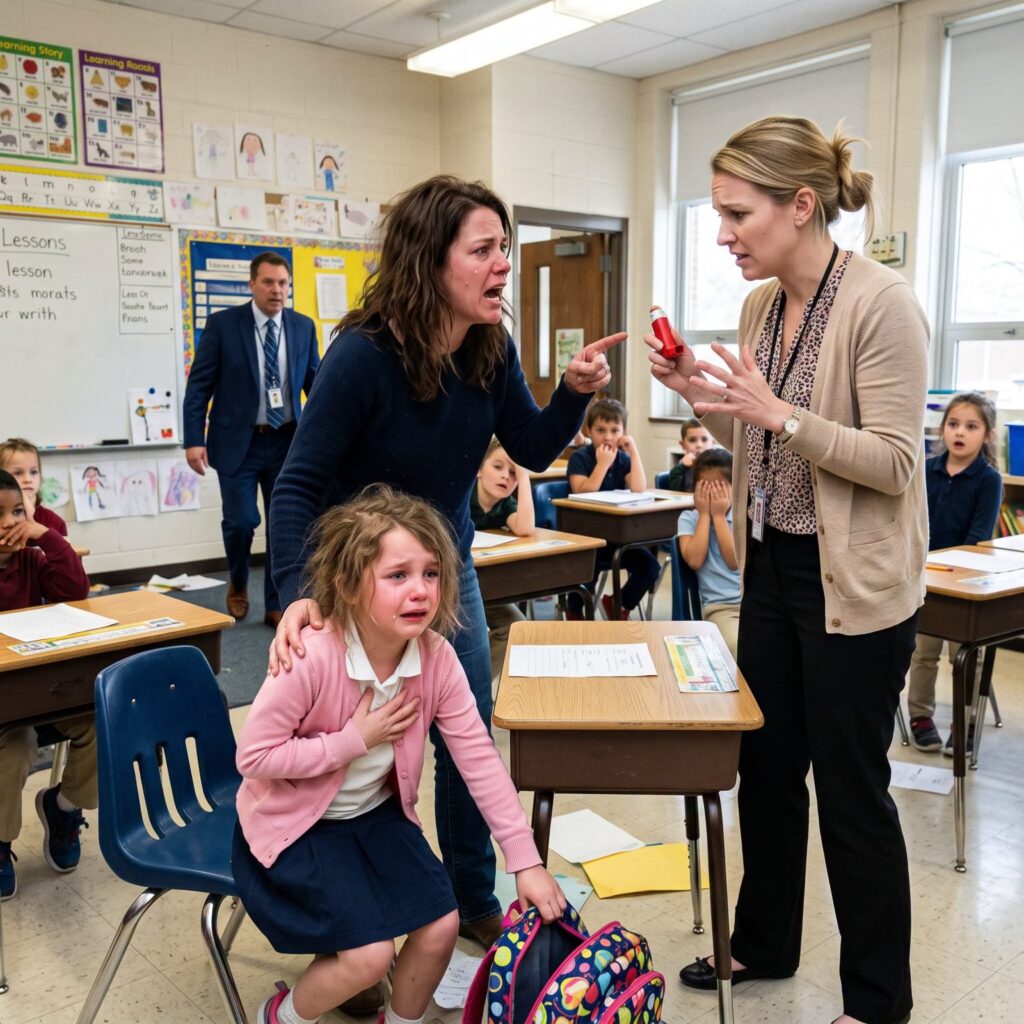
“I tried to tell her,” Maya whispered against my collarbone, her little voice cracking with residual hoarseness. “I told Mrs. Collins my chest was tight. Like an elephant was sitting on me. But she took the red puffer and put it inside her top drawer. She locked it, Mommy. She turned the key and put it in her pocket. She said big girls don’t make excuses.”
Nurse Daniels closed her eyes, a muscle in her jaw twitching violently. She looked at me, and in that silent exchange, I saw pure, unadulterated disgust.
“Her pulse ox was eighty-four when I reached her, Sarah,” Nurse Daniels said in a hushed, trembling voice. “That is profound hypoxia. If another two minutes had elapsed… brain damage was a distinct mathematical possibility. Cardiac arrest was on the table.”
“Why did Vance say this wasn’t the first time?” I demanded, my hands gripping Maya’s shoulders gently.
Nurse Daniels looked away, glancing nervously at the clinic door before stepping toward the corner counter. She picked up a landline receiver, hung it up deliberately, and leaned in close.
“I can’t speak on the record without losing my pension,” she whispered, her voice barely audible over the hum of the refrigerator where the insulin was stored. “All I will tell you is this: look up Lucas Campbell. Four years ago. And check your phone. Whoever called Vance knows the system from the inside.”
At that precise moment, my phone buzzed violently in my purse.
A notification popped onto the screen. It was an incoming text from an unknown, spoofed number:
*They are already drafting the incident report. They are going to classify it as a panic attack exacerbated by seasonal allergies to protect Collins’ tenure. Do not let Maya leave without the paramedics’ independent medical evaluation. Meet me at St. Jude’s park at 7:00 PM if you want the records Vance shredded.*
My thumb hovered over the screen. Below the text was an attached image: a low-resolution photograph of a handwritten incident log dated November 14, 2021.
In Mrs. Collins’ distinctive, sharp cursive, one sentence was circled in red ink: *Student’s reliance on medication successfully curtailed through disciplinary intervention.*
—
Chapter 3 – The Black Ledger
The afternoon dissolved into a blur of flashing red emergency lights, clinical antiseptic smells, and bureaucratic maneuvering. The paramedics arrived, their professional indignation mirroring my own when they reviewed Maya’s vitals and heard Nurse Daniels’ clinical testimony. They transported Maya to St. Luke’s Children’s Hospital, where pediatric specialists kept her on supplemental oxygen and continuous monitoring for six hours to ensure her airways didn’t rebound into severe bronchospasms.
My husband, Mark, arrived at the hospital straight from the municipal water authority where he worked as a civil engineer. Standing six-foot-two, Mark was normally the picture of stoic patience—the kind of father who calmly untangled kite strings and methodically taught Maya how to ride a bike without training wheels. But seeing our daughter hooked up to monitors in a pediatric observation ward stripped his calm away entirely. When I showed him the text message, his knuckles turned white against the edge of the hospital bed.
“She locked it in a drawer?” Mark’s voice dropped an octave, vibrating with an unnatural stillness. “A licensed teacher withheld a child’s rescue medication behind a locked lockbox?”
“She called it a behavioral crutch,” I said, sitting beside Maya, who had finally drifted into an exhausted, medication-induced sleep. “Mark, Vance knew. The nurse practically warned me that they’ve covered this up before.”
“We call the police. Right now. We file a felony endangerment report.”
“The paramedics already notified child welfare services,” I replied, running a hand through my disheveled hair. “The officer who took the preliminary statement at the school told me it was a ‘civil administrative dispute’ unless intent to harm could be proven beyond a reasonable doubt. He said teachers have qualified immunity within classroom disciplinary boundaries unless there is explicit malice.”
“Malice?” Mark choked out. “She watched our daughter turn blue!”
“That’s why I have to go to this park,” I said firmly, glancing at the clock on the hospital wall. It read 6:35 PM. “Whoever sent this text has documentation. Without physical evidence, it’s our word against a thirty-year veteran with an unblemished public personnel file and a school board determined to shield themselves from insurance liability.”
Mark looked at Maya, then at me. “Be careful. Take pepper spray. Keep your phone on speaker in your pocket.”
St. Jude’s Park was a derelict pocket of green space tucked between an abandoned textile warehouse and a row of modest mid-century tract houses on the town’s east side. By seven o’clock, a frigid autumn drizzle had settled over the playground, turning the wood chips beneath the swing sets into a damp, dark sponge.
I sat on a peeling green wooden bench near the gazebo, pulling my coat collar tight against the damp wind. Every nerve in my body was wired on pure adrenaline.
At 7:04 PM, footsteps crunched along the gravel pathway.
A woman emerged from the shadow of the weeping willows. She was petite, wearing an oversized beige trench coat and a baseball cap pulled low over her brow. She held a battered brown leather messenger bag clutched tightly against her ribs.
“Mrs. Carter?” she asked, her voice cracking slightly with nerves.
“Yes. Clara?” I guessed, recognizing the name Nurse Daniels had vaguely hinted at earlier.
The woman hesitated, then stepped into the pale amber circle of the single functioning streetlight. She pushed up the brim of her cap. She was young—no older than twenty-eight—with dark circles carved deeply beneath her eyes.
“My name is Clara Evans,” she said, her hands trembling as she adjusted her grip on the bag. “Two years ago, I was Mrs. Collins’ full-time instructional aide.”
“You worked in her classroom?”
“Until she destroyed my career,” Clara said, her voice dripping with bitter venom. “I spent seven months watching that woman torture seven-year-olds under the guise of ‘traditional pedagogy.’ She hates modern medicine. She belongs to some fringe holistic ideology that views modern pharmaceuticals—especially respiratory and behavioral drugs—as spiritual and character-based failings.”
Clara sat beside me, keeping a wide perimeter of caution as she unzipped the messenger bag. She pulled out a thick, black three-ring binder and laid it across her knees.
“Why didn’t you report her?” I asked, my voice rising in disbelief.
“I did!” Clara flared, her eyes blazing in the dim light. “I went to Vance three separate times. The first time was when she refused to let a boy with type-1 diabetes check his glucose before gym class. She told him his dizziness was a lack of mental fortitude. The second time, she confiscated an EpiPen from a girl who had a mild contact reaction to peanut dust during art class. She made the child sit in the hallway until the hives subsided on their own.”
My stomach dropped into a bottomless void. “And Vance did nothing?”

