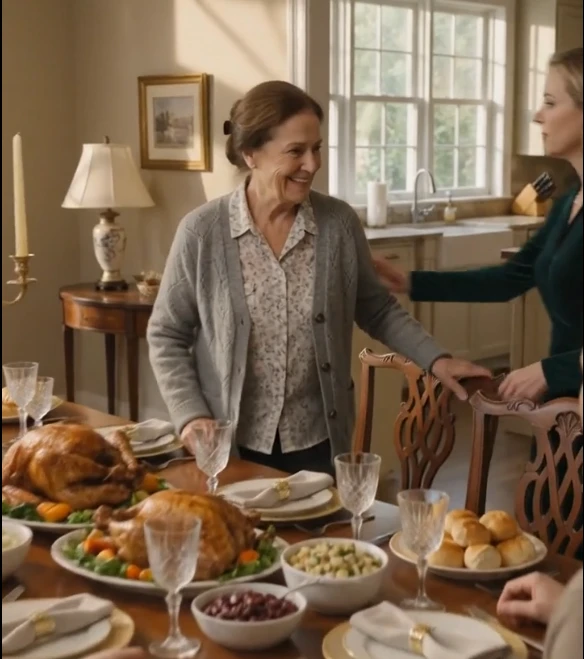
At 72, Eleanor spent 2 days cooking an entire Thanksgiving feast for her son’s family. But when everyone sat down, her daughter in law pulled her aside and whispered, “Your seat is in the kitchen. I don’t want you in the family photos.” So Eleanor sat alone with an empty plate while the guests ate the meal she had prepared. Then her son arrived early, looked at his mother’s untouched plate, and asked one question tha
I did not know that the next few minutes would divide my life into a before and an after. What began as one painful moment involving my daughter in law exposed a pattern I had spent years trying not to name.
The strange thing about a breaking point is that it rarely announces itself. It often arrives inside an ordinary day, surrounded by familiar people, while part of you is still expecting everyone to behave the way they promised they would.
Before dawn had fully broken, Eleanor was already pulling the first pie from the oven. The kitchen glowed warmly as she brushed butter over a tray of fresh rolls. At 72, standing for hours made her knees throb, but she barely noticed. Thanksgiving had always meant more to her than food and decorations. It meant family. Most of all, it meant spending the day with her son. She was checking the turkey when her phone began to ring.
The temptation to make peace arrived automatically because I had practiced that response for years. I had often chosen silence because I thought silence protected relationships. I had not understood that silence can also protect the behavior damaging them. One detail kept returning to me because it changed the meaning of everything around it: Before dawn had fully broken, Eleanor was already pulling the first pie from the oven. The kitchen glowed… I understood that a boundary delayed is usually a boundary made harder to enforce. I had always connected the house with safety, belonging, or celebration. That assumption no longer felt automatic. The familiar excuses appeared almost immediately: stress, misunderstanding, bad timing, family pressure. None of them changed the facts. I reminded myself that calm was not surrender. Calm was how I would remember details later. Whatever happened next, it would happen with my eyes open.
There was a strange clarity in realizing that the words had already been said and could not be taken back. I had spent a long time believing that family loyalty meant giving people the benefit of the doubt long after doubt had become evidence. The immediate conflict was painful, but the larger danger was the pattern becoming normal. Love complicated the decision because love remembers good days even while trust is breaking. The expressions around me told their own story. Confidence became caution, and caution became calculation. I chose not to negotiate against myself by offering compromises before anyone had even acknowledged the harm. I could not yet see the ending, but I could finally see the next honest step.
The first reaction inside me was not anger. It was disbelief. The pattern had never looked dangerous when it arrived in small pieces. A rude comment here, an assumption there, a favor treated like an obligation. Only now did the pieces connect. The immediate conflict was painful, but the larger danger was the pattern becoming normal. The fact that this involved my daughter in law made the choice more painful, but it did not make the behavior acceptable. The expressions around me told their own story. Confidence became caution, and caution became calculation. I knew I could revisit my decision later if new facts appeared. What I could not do was pretend the existing facts were harmless. At the time, I only knew I was finished pretending the situation was smaller than it was.
I remember thinking that nothing about the situation looked dramatic enough to explain how deeply it hurt. The pattern had never looked dangerous when it arrived in small pieces. A rude comment here, an assumption there, a favor treated like an obligation. Only now did the pieces connect. This was no longer about winning an argument. It was about deciding what behavior would be allowed to shape the next day, the next month, and perhaps the next several years. The fact that this involved my daughter in law made the choice more painful, but it did not make the behavior acceptable. The situation became simpler once I separated intention from impact. They could claim whatever intention they wanted. I still had to respond to what had actually happened. I decided not to threaten anyone. A decision becomes stronger when it does not require theatrics. At the time, I only knew I was finished pretending the situation was smaller than it was.
