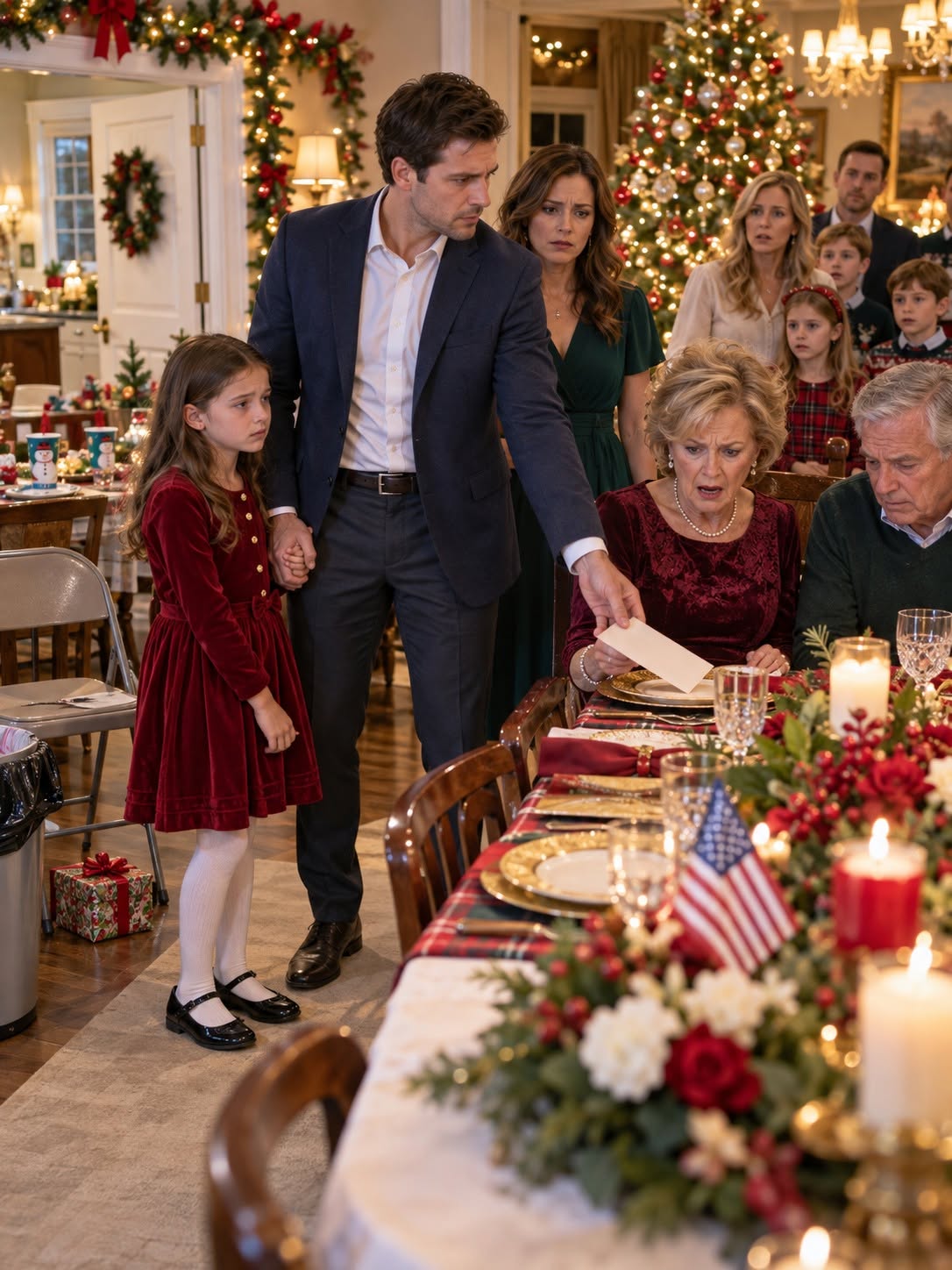
At Christmas dinner, my 9-year-old daughter was seated alone beside the trash can on a folding chair—then she asked me to keep the promise I’d made her. Five minutes later, my mother started screaming.
My name is Graham.
Leah is nine.
I legally adopted her when she was three, but I’ve been her dad since she was two. In our house, we don’t use the word “step.” She’s my daughter. Period.
And years ago, I made her a promise: if my family ever made her feel like she didn’t belong again, she wouldn’t have to sit there quietly and endure it. She only had to tell me.
Christmas at my parents’ house was always elaborate. Matching decorations. Perfect table settings. Coordinated outfits for the grandkids. My mother, Eleanor, liked everything to look like the perfect family Christmas.
That night, my wife Nah and I walked in with Leah between us. Leah wore a red velvet dress with gold buttons and carried a small present she had wrapped herself for my mother. *“To Grandma, from Leah,”* written carefully on the tag.
Then we reached the dining room.
The kids’ table looked beautiful. Snowman cups. Gold Christmas crackers. Fancy plates. Every seat had a handwritten name card.
Except one.
At the far end of the room, beside the swinging kitchen door and directly next to the trash can, sat a folding chair. No name card. No Christmas cracker. No plate. Just a napkin and a fork.
That was Leah’s seat.
She stopped walking. For a few seconds, she simply stared at it. Nobody said anything.
My mother called from across the room. “Oh, good. You made it. We’re about to start.” Like this was normal.
Leah quietly walked to the folding chair. She smoothed her dress before sitting down and tucked the gift she had made for Grandma underneath her seat. I watched my sister taking pictures of her children in matching sweaters. I watched my father stare into his wine. I watched everyone pretend they couldn’t see what had been done.
And I watched my daughter try desperately to act like it didn’t hurt.
That was the worst part. She didn’t cry. She didn’t complain. She tried to smile.
Then, a few minutes later, Leah stood up. She walked away from the table. Past my mother. Past my father. Past three adults who suddenly found other things to look at. She stopped beside my chair.
“Dad?”
I looked up. Her voice was quiet.
“Can you do the thing you said you’d do if it felt bad again?”
Everything inside me went still. I knew exactly what she meant. A year earlier, Leah had asked me a question that nearly broke me: *“Is it like I’m not really your kid to them?”*
That night, I promised her she would never have to fight for a place in my family. If they made her feel unwelcome again, she could tell me. I would handle the rest.
Now she was standing beside me on Christmas. Asking me to keep my word.
I looked into her eyes. “Are you sure?”
She nodded. “Yeah. I’m sure.”
So I stood. I tapped my glass. The entire room went quiet. Mom turned toward me smiling, clearly expecting some sentimental Christmas toast.
I lifted my glass. “To the last family event we’ll ever attend.”
Her smile disappeared. My sister froze. Dad slowly lowered his eyes.
I reached inside my jacket and pulled out a sealed envelope. Then I walked to my parents’ end of the table. I placed it between their plates.
“Merry Christmas.”
I took Leah’s hand. Nah stood beside us. And we walked out.
Nobody followed. Nobody tried to stop us. We had almost reached the car when a sound tore through the house behind us.
My mother screaming. Loud enough that I stopped for half a second.
But Leah kept walking. So I did too.
She never asked what was inside that envelope. She didn’t need to. Because whatever my mother had just read made her realize this Christmas was going to cost her far more than an empty chair beside a trash can.
The December wind was biting, carrying the sharp scent of oncoming snow as we clicked our seatbelts in the driveway. Through the frosted front window of the sprawling estate on Oakridge Crest, the silhouettes of my family moved like startled shadows behind sheer lace curtains. My mother’s scream had dropped an octave into hysterical shriek-sobbing, the kind she usually reserved for genuine catastrophes—or, more accurately, the sudden collapse of her absolute control.
Nah reached over the console and took my right hand. Her fingers were warm, steadying the tremors that fury had set vibrating under my skin. In the rearview mirror, Leah was looking out into the darkness, her small hands resting in her lap over the red velvet fabric of her dress.

