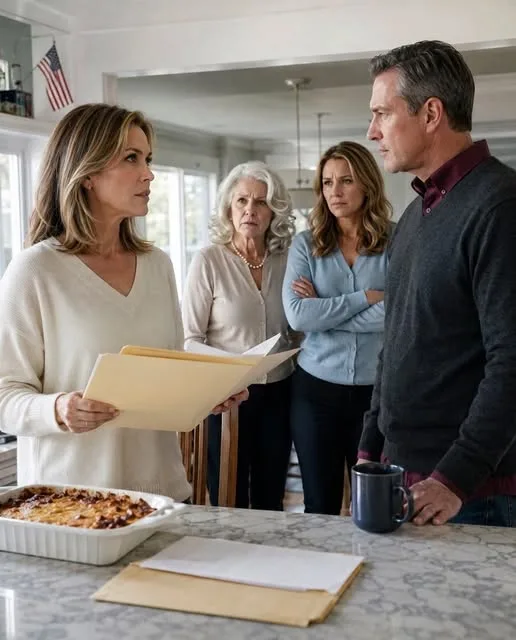
“And what would you like to do about your estate arrangements?”
I looked toward the window, where winter sunlight touched the buildings across Sycamore Street.
“For years, I assumed Reid would eventually receive nearly everything.”
Charles nodded.
“Has that changed?”
“I still love my son, but I no longer believe giving him a fortune would be an act of love.”
We discussed arrangements that would preserve my independence, provide long-term security, and support organizations helping families facing hardships similar to those I had once experienced.
I also wanted to recognize the employees who had helped Tate Freight grow from one struggling truck into a respected company.
Charles explained how the necessary plans could be prepared carefully rather than as an impulsive response to one painful evening.
I appreciated that because I wasn’t interested in punishing Reid forever.
I was interested in making decisions based on who people truly were rather than who I desperately wished they would become.
Over the following weeks, the acquisition moved toward closing.
Reid called several times, sometimes apologizing and sometimes asking questions that revealed how much he had been thinking about the money.
Tessa sent flowers to my apartment with a handwritten note expressing regret about the misunderstanding.
I thanked her politely without accepting her version of events.
Eventually, Reid asked whether he could visit me alone.
I agreed.
He arrived one Sunday afternoon carrying a small bag from the bakery where we used to buy cinnamon rolls when he was young.
For the first time in months, he didn’t ask whether I needed anything expensive.
He simply sat at my kitchen table.
“I’m embarrassed about what happened,” he said.
I waited.
“Not because of the bill or your company.”
He looked down at his hands.
“I’m embarrassed because I saw how badly Tessa hurt you, and I cared more about keeping her happy.”
I felt tears rising but didn’t interrupt.
“I thought being a good husband meant never disagreeing with my wife in public.”
He swallowed.
“But I used that as an excuse to avoid doing the right thing.”
I reached across the table and touched his hand.
“Being a good husband shouldn’t require being a cruel son.”
“I know.”
We sat quietly for a long time.
He eventually told me that he and Tessa had been arguing about the dinner since that night.
He had paid the restaurant with help from several guests who insisted on contributing, and he had personally apologized to everyone for the uncomfortable ending.
I was glad he had taken responsibility.
But I also understood that one apology couldn’t erase years of entitlement.
“Mom, are you cutting me out of your life?”
“No, Reid.”
His eyes filled with relief.
“I’m simply making room for myself in it.”
He nodded slowly.
“And the company?”
“The sale is proceeding.”
“Will you be all right?”
For the first time that afternoon, he asked a question that had nothing to do with what he might receive.
I smiled.
“I’ll be better than all right.”
Several weeks later, the acquisition closed, bringing an end to the forty-two-year journey I had begun with almost nothing.
I cried when I signed the final documents, remembering the younger woman who had worked through exhaustion and uncertainty to keep her little business alive.
I thought about the employees who had trusted me, the customers who had given me second chances, and the family sacrifices that had made success possible.
Then I returned to my apartment on Sycamore Street and made myself a cup of tea.
Ich hatte keine Villa gekauft.
Ich hatte weder teure Kleidung bestellt noch jemanden engagiert, der meinen Alltag organisiert.
Ich hatte einfach beschlossen, dass meine verbleibenden Jahre mir gehören würden.
Ein Teil des Erlöses würde meine Familie nach meinen Vorstellungen von Verantwortung unterstützen, während andere Teile den Menschen und Anliegen zugutekommen würden, die mir schon immer wichtig waren.
Reid würde zwar mein Sohn bleiben, aber er wäre nicht länger der alleinige Zweck all meines Besitzes.
Tessa hat meine Entscheidung nie ganz verstanden.
Sie schlug gelegentlich vor, das unangenehme Abendessen hinter sich zu lassen, meistens im Zusammenhang mit einem kostspieligen Vorhaben, von dem sie hoffte, dass ich es unterstützen würde.
Ich habe immer höflich zugehört.
Dann habe ich meine eigene Entscheidung getroffen.
Eines Abends lud mich Reid zum Abendessen in ein kleines Restaurant in der Nachbarschaft ein.
Als ich ankam, stand er neben einem Tisch in der Nähe des Fensters.
Es gab drei Stühle, obwohl Tessa beschlossen hatte, nicht mitzukommen.
Er zog mir einen Stuhl heraus.
„Ich wollte sichergehen, dass Sie den besten Platz haben“, sagte er.
Ich musterte sein Gesicht und suchte nach der alten Ungeduld, die einst jede Bitte um meine Zeit begleitet hatte.
Stattdessen sah ich Nervosität, Bedauern und etwas, das wie echtes Bemühen aussah.
“Danke, Liebling.”