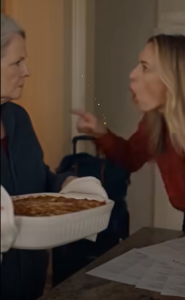
 My daughter-in-law invited twenty-five people to spend Christmas in my house, promised them a magnificent holiday dinner, and then looked at me as if I had committed a crime when I told her I wouldn’t be there.
But the real shock came thirty seconds later.
Because when Vanessa slammed her hand against my kitchen island and shouted, “You can’t leave, Elaine, because I’ve already told everyone this is our house!” my son finally understood that his wife had been telling a very different story behind our backs.
I was sixty-eight years old that December.
My name is Elaine Mercer, and I lived in a modest white house just outside Columbus, Ohio.
It wasn’t a mansion.
It didn’t have marble staircases, a swimming pool, or the kind of enormous kitchen people liked to show off on television.
But it had four bedrooms, a wide front porch, a fireplace made from old red bricks, and a kitchen where nearly thirty years of Christmas dinners had been prepared with love.
My husband, Robert, had bought the house with me when our son Mark was eleven.
Back then, the front steps leaned slightly to the left, the wallpaper in the hallway was covered with tiny yellow flowers, and the furnace made a noise like a lawn mower every time it started.
Robert used to laugh and say, “Ellie, the place has personality.”
I told him it needed a contractor.
We spent twenty-seven years fixing things together.
He replaced the porch railing.
I painted the kitchen cabinets.
We planted maple trees along the driveway and watched them grow taller than the roof.
And every December, Robert climbed onto a ladder to hang white Christmas lights while I stood below, complaining that he was going to break his neck.
He always answered the same way.
“Then you’ll have to find someone else who makes the house look this pretty.”
Robert died seven years before that Christmas.
A stroke took him on an ordinary Tuesday morning.
One moment he was standing beside the kitchen sink asking whether we had any orange juice.
Three days later, I was signing hospital forms with hands that wouldn’t stop trembling.
For months afterward, I couldn’t bring myself to put away his slippers.
I left his favorite mug on the counter.
I kept his winter coat hanging beside the back door.
But Christmas was the hardest.
The first December without him, I nearly canceled dinner.
Then Mark called.
“Mom, Dad would hate that.”
I knew he was right.
Robert had loved Christmas more than anyone I had ever known.
So I decorated the house.
I cooked the roast.
I made the cinnamon rolls.
And I kept the family tradition alive.
What I didn’t understand was that preserving a tradition could slowly become a way of disappearing inside it.
At first, Vanessa seemed grateful.
She married Mark twelve years earlier, and I welcomed her as warmly as I knew how.
She was polished, ambitious, and always beautifully dressed.
She remembered birthdays.
She organized family photographs.
She knew exactly how to say the right thing in front of people who mattered to her.
But gradually, something changed.
Christmas dinner stopped being something we prepared together.
It became something I prepared while Vanessa supervised.
She chose the decorations.
She selected the guest list.
She decided what time everyone would arrive.
And somehow, every compliment ended up belonging to her.
“Vanessa, this table looks gorgeous!”
“Vanessa, how do you manage such wonderful holidays?”
“Vanessa, your house always feels like a Christmas movie!”
She never corrected the last compliment.
She would simply smile, touch somebody’s arm, and say, “Oh, you know how much I love hosting.”
Meanwhile, I stood in the kitchen with flour on my sweater and a roasting pan heavy enough to make my wrists ache.
Some years, I barely sat down.
I ate lukewarm potatoes after everybody else finished.
I washed glasses while guests exchanged presents.
I spent Christmas evening scrubbing burnt sugar from baking trays while Vanessa posted photographs of her perfect family celebration online.
Mark noticed occasionally.
“Mom, sit down.”
Then Vanessa would call for another pitcher of tea, and I would get up.
Mark never stopped her.
He always gave me the same explanation.
“You know how Vanessa is.”
As though knowing somebody’s habits meant I was required to accept them.
The pattern spread beyond Christmas.
Soon my house became the place for Easter brunch, summer barbecues, graduation parties, and Thanksgiving dinners.
Vanessa’s relatives appeared with empty hands and healthy appetites.
When I suggested that someone else host occasionally, Vanessa laughed.
“But Elaine, everybody loves coming here!”
That was her favorite answer.
Everybody loved coming here.
Everybody loved my food.
Everybody loved the decorations.
What nobody seemed especially interested in was whether I still loved doing all the work.
By the beginning of that December, I was tired.
Not ordinary tired.
Not the kind of tired a nap could fix.
I was tired of being needed only when something had to be done.
