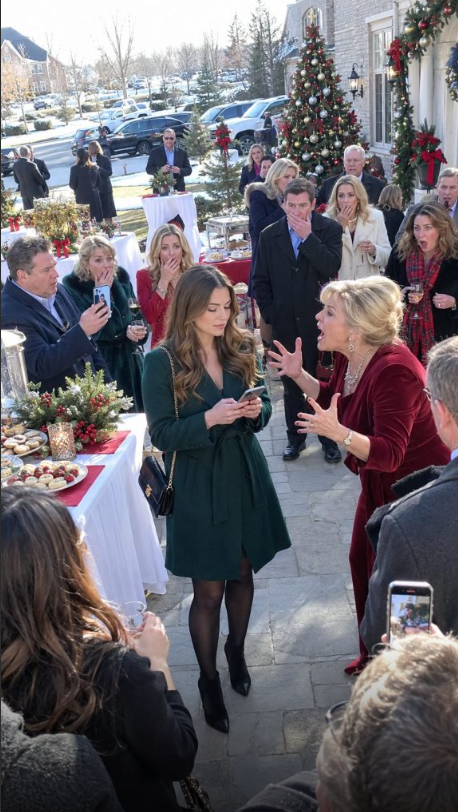
“You left the email on the printer,” Lauren answered. “Right beside the invoices you told me were for your business.”
Several people turned toward Grant.
Margaret raised one hand.
“We’re not conducting a public trial. These documents will be reviewed through the proper process.”
She asked Mom to step away from the microphone.
For a moment, I thought Mom would refuse.
Then Aunt Diane stood and said quietly, “Carol, please sit down.”
Mom lowered the microphone.
Nobody applauded.
Nobody cheered.
The silence was worse than anything she’d planned for me.
The Christmas gathering continued, although the atmosphere had changed. Volunteers distributed the food already prepared, and the children still received their gifts.
I helped an elderly woman carry two bags of groceries to her car.
She thanked me without mentioning what had happened inside.
That small kindness nearly undid me.
After Christmas, the charity’s board placed Mom and Grant on leave from their positions while an independent accountant completed a review.
The findings were ugly.
Northline Holiday Logistics was a small company Grant had registered the previous year. It had no inventory of winter coats and no documented deliveries matching the invoices.
Of the $18,600 paid, most had been used to cover debts connected to Grant’s struggling trucking business.
But the review uncovered something else.
Mom hadn’t merely approved the payments.
She had known the invoices were false.
Grant had approached her after falling behind on payments for his trucks. He promised that borrowing money temporarily from the charity would keep his business alive.
Mom authorized the transfers, expecting him to repay everything before the annual financial review.
When I noticed the discrepancy, she panicked.
Instead of telling the truth, she decided to make me the problem.
The forged approval bearing Dad’s signature came from an old scanned form Grant had reused to make the invoices appear legitimate.
The board referred its findings to the appropriate authorities and pursued repayment through legal counsel.
Grant’s business couldn’t immediately return the money. He agreed to a documented repayment arrangement while the matter was investigated.
Mom resigned from the charity’s board.
She also had to send a written correction to everyone who’d received her accusations against me.
The letter acknowledged that I had not stolen charitable funds and that her statements had been false.
I kept a copy.
Not because I wanted to reread it.
Because I’d spent years being told that defending myself was somehow more shameful than being mistreated.
Lauren separated from Grant several weeks later. She told me she needed time to decide whether their marriage could survive the lies he’d brought into their home.
I didn’t offer advice.
Some decisions couldn’t be made for other people.
Mom called me in February.
I almost ignored it.
“Elise,” she said, “I know I have no right to ask you for anything.”
I waited.
“I thought if Grant lost his business, he’d lose everything.”
“And you were willing to let me lose my reputation instead?”
She started crying.
“I thought you would forgive me eventually.”
That sentence stayed with me.
She hadn’t believed I was guilty.
She’d simply believed I would survive being blamed.
I told her I needed distance and that any rebuilding of our relationship would require honesty, not another promise that things would be different.
She didn’t argue.
By the following December, the charity had new financial controls, independent oversight of payments, and a different volunteer leadership team.
I returned to help organize the winter coat drive.
Not as Mom’s daughter.
Not as Grant’s sister.
Just as someone who still believed in what Dad had built.
On Christmas Eve, I carried the final box into the storeroom.
A volunteer pointed at the faded writing on its side.
NO ONE LEFT OUT.
It was Dad’s handwriting.
He’d written those words on our donation boxes for years.
I ran my thumb over the letters.
Last Christmas, my family had planned to stand me in front of everyone and make me feel small.
They had confused my silence with weakness and my loyalty with permission to hurt me.
But Dad had taught me something they never understood.
Protecting your family doesn’t mean helping them hide what they’ve done. Sometimes it means being the one person brave enough to tell the truth.
Y por primera vez en años, la Navidad volvió a sentirse como algo digno de celebración.