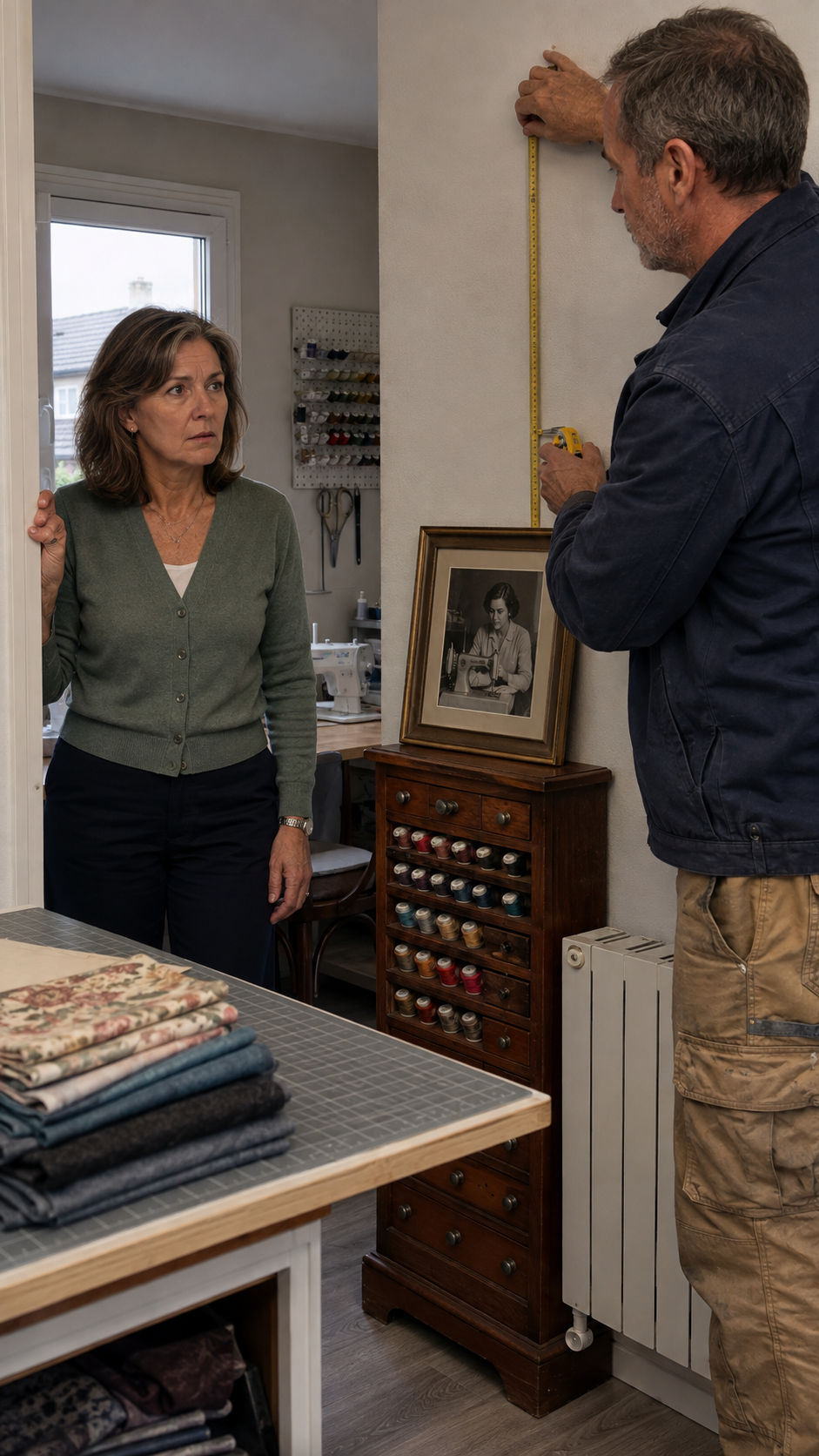
After twenty-eight years of raising three children, I finally had a room in the house that belonged only to me. Three weeks later, I found a craftsman measuring the walls, and I realized that my husband had already promised it to someone else.
I stood on the threshold, unable to move forward. My sewing machine was by the window. The fabric scraps were folded on the sage-green shelves I had painted two weekends earlier. Beneath the photograph of my mother teaching me to sew at twelve, there was still my grandmother’s small wooden thread rack.
In the midst of all this, a man in work boots held his measuring tape above my cutting table.
— Mrs. Morel? I’m Didier. Marc told me you’d probably be here.
Marc hadn’t told me anything at all.
— What exactly are you measuring?
He lowered his eyes to his notebook.
— The location of the TV, first. Then the reinforcements for the grab bars in the bathroom and the passage around the bed.
— Which bed?
Her face has changed.
There are few things as humiliating as seeing a stranger realize that he knows more than you about what’s going on in your own house.
— Your mother-in-law is supposed to move here, isn’t she?
I looked at my machine. My fabrics. The work lamp that Marc had helped me assemble the previous Saturday.
— No. This is my workshop.
Didier took a step back.
— I was asked to transform it.
We live in a single-storey house in Sautron, near Nantes. I am fifty-nine years old. Marc and I have been married for thirty-one years, and we have raised three children.
For almost three decades, each room had a function that took precedence over me. Baby, homework, laundry, returning from studies, boxes that were never collected.
I didn’t see it as a sacrifice. I loved being their mother.
But when our daughter Élodie left home, Marc immediately transformed her room into an office. Two screens, an armchair, his files, his television. No one had asked anyone’s opinion. I even helped him put up the shelves.
When Lucas, our youngest, moved to Lyon, he told me on the phone:
— Mom, I’m not coming back to live at home. Do something with this room.
So I did it.
I had given away the bed, sanded a second-hand table, put up a pegboard, and registered a small alterations business. Nothing spectacular. A few hems, some dresses mended, some jackets adjusted.
But for the first time, a door closed on something that bore my first name.
I called Marc.
— There is a craftsman in my workshop.
Silence.
Then :
— Ah. Didier arrived early.
Pas par erreur. En avance.
— Pourquoi il est là ?
— Pour maman.
Hélène avait quatre-vingt-un ans. Elle vivait à Orvault dans une petite maison à étage depuis la mort de son mari. Deux mois plus tôt, elle avait chuté dans l’escalier. Rien de cassé, mais assez pour l’effrayer. Son médecin venait aussi d’ajuster son traitement contre l’hypertension après un nouvel épisode de vertige.
Si Marc m’avait dit : « Maman a peur, est-ce qu’on peut l’héberger quelques semaines ? », j’aurais probablement accepté.
Mais il avait fait venir un artisan.
— Elle reste combien de temps ?
— On ne sait pas.
— Et pourquoi cette pièce ?
— C’est la plus pratique pour accéder à la salle d’eau.
— Ton bureau aussi.
— Ce n’est pas pareil. J’y travaille.
J’ai regardé ma table de coupe.
— Moi aussi.
Il a soupiré.
— Sylvie, ne transforme pas ça en guerre de territoire.
Une guerre de territoire.
J’avais attendu vingt-huit ans pour douze mètres carrés et une porte.
Quand Marc est rentré, il a posé deux sacs de bricolage dans la cuisine comme si c’était un samedi ordinaire.
— Tu as renvoyé Didier ?
— Je lui ai dit que je n’avais autorisé aucun travaux.
— Il ne fallait pas le mettre mal à l’aise.
— Je suis restée polie. Lui aussi.
Il m’a expliqué qu’il avait « discuté des options » avec Hélène et sa sœur Amélie.
— Avec tout le monde sauf moi, donc.
— Tu rends ça plus grave que ça ne l’est.
— Non. Je remets juste les choses dans l’ordre.
Son visage s’est fermé.
— Quand la famille a besoin de nous, on fait de la place.
J’ai tourné la tête vers le couloir. La porte de son bureau était fermée. Celle de mon atelier était grande ouverte.
— Pourquoi ton bureau n’est-il jamais entré dans la discussion ?
— Parce que je travaille deux jours par semaine à la maison.
— Et moi, j’ai des clientes.
Il a secoué la tête.
— Sylvie, faire des ourlets ne paie pas notre crédit.
