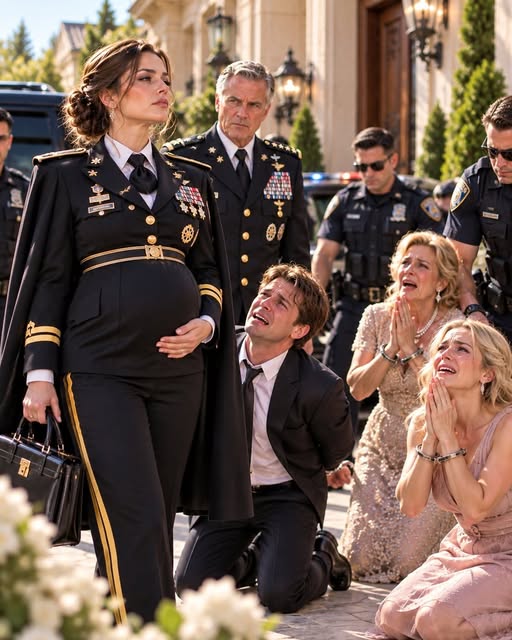
He reached for the case.
And six months of memories came rushing back.
The operation had begun aboard a Navy intelligence vessel in the eastern Mediterranean.
Officially, Samantha had been assigned to a small maritime threat-analysis unit.
In reality, she commanded a compartmented recovery team responsible for intercepting stolen military technology before it could be transferred to hostile buyers.
Her team was small.
Eight people.
No publicity.
No visible unit designation.
No public record tying their names to their missions.
For most assignments, success meant nobody ever heard that anything had happened.
Their final mission was supposed to be routine.
A civilian research ship had transmitted a covert distress signal after a navigation systems engineer discovered that armed smugglers had boarded under forged credentials.
The smugglers were not interested in the ship itself.
They wanted a prototype navigation module being transported under a cooperative Navy research program.
If that module disappeared, it could compromise guidance systems used across multiple naval platforms.
Samantha’s team was ordered to intercept.
They reached the ship shortly before midnight.
And immediately discovered the intelligence had been wrong.
There were not four armed men aboard.
There were eleven.
The crew had been moved below deck.
Two engineers were missing.
And the prototype module had already been removed from its secure container.
Samantha had been ordered to recover the technology.
Then leave.
That changed when one of her operators found blood near a maintenance hatch.
The missing engineers had not escaped.
They had been forced into the machinery spaces to unlock a secondary authentication system.
Samantha had less than nine minutes before the smugglers’ extraction vessel arrived.
Her second-in-command, Lieutenant Aaron Cole, looked at her.
“We can still secure the package.”
Samantha knew what he meant.
Complete the mission.
Protect the classified technology.
Leave before reinforcement arrived.
It was the technically correct decision.
Instead, Samantha said, “We’re getting everyone.”
Aaron stared at her.
“That’s not the order.”
“I know.”
If she failed, her career was over.
If she delayed too long, her entire team could be trapped.
Samantha split the unit.
Four operators secured the prototype.
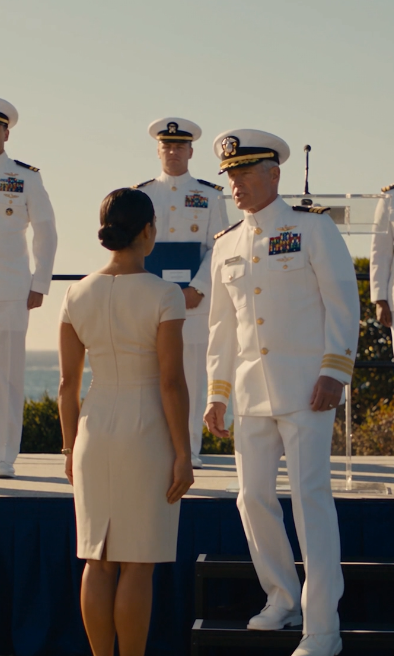
Her Mother Called Her the Family Failure—Then a Rear Admiral Stopped the Navy Graduation and Asked “Commander Hayes” to Stand
Samantha took the remaining three below deck.
They found the engineers locked inside a flooding maintenance compartment.
A ruptured seawater line had filled the space to waist level.
One engineer was unconscious.
The other was trying to keep his head above water.
The hatch had jammed.
The extraction vessel was four minutes away.
Samantha’s team could hear engines approaching outside.
Aaron called over the radio.
“Commander, we have the package. We need to move.”
Samantha looked through the hatch window at the unconscious engineer.
“Negative.”
“Commander—”
“Get the crew to the extraction point.”
“What about you?”
Samantha pulled a rescue tool from the wall bracket.
“I said move.”
For the next ninety seconds, she and Petty Officer Lena Torres forced the warped hatch open while seawater climbed higher.
When the door finally gave way, the pressure knocked Samantha into a bulkhead.
Torres dragged the conscious engineer free.
Samantha went back for the other one.
Then the smugglers returned.
They had discovered that the prototype was gone.
Samantha heard footsteps above.
Torres looked toward the ladder.
“We’re out of time.”
Samantha lifted the unconscious engineer onto her shoulders.
“Then stop wasting it.”
They reached the deck as her team engaged the approaching smugglers from defensive positions.
No one aboard the civilian ship was killed.
Every crew member was evacuated.
Both engineers survived.
The prototype never left American custody.
But that was not what made the mission historic.
It was what happened afterward.
Investigators discovered that the smugglers had not located the research vessel by chance.
Someone inside the procurement system had sold its route.
Someone with access to classified transit schedules.
The compromised route led investigators into a network that had been leaking sensitive logistics information for nearly three years.
Samantha had unknowingly exposed the breach because she refused to abandon the engineers.
One of those engineers, Dr. Robert Chen, had seen a file on a smuggler’s tablet moments before being locked below deck.
He remembered a partial access code.
That code identified the leak.
Three arrests followed.
Then seven more.