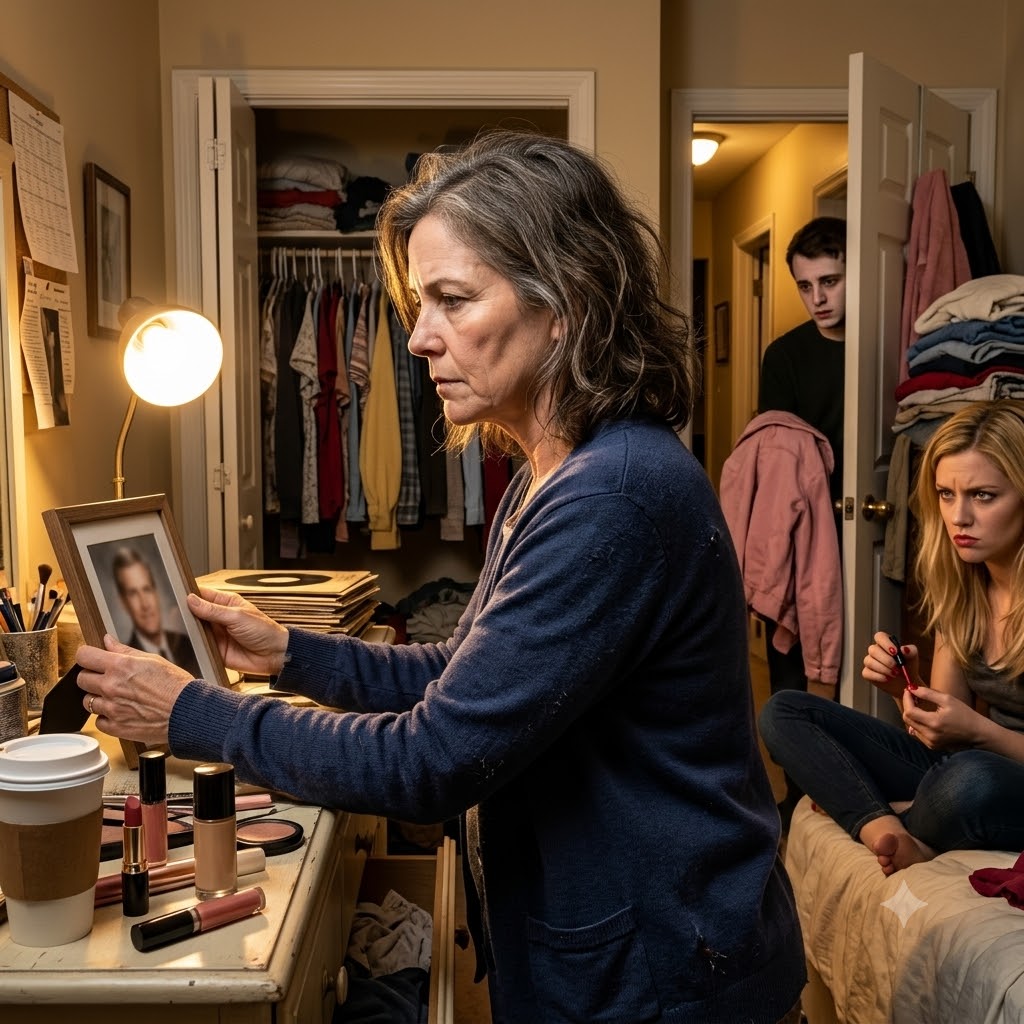
A habit became an expectation.
An expectation became my role.
When I objected, Daniel always had the same answer.
“Don’t take things personally, Mom.”
I began to hate that sentence.
At a dinner party one evening, Claire had invited several friends. I spent most of the afternoon helping her prepare food.
When everyone sat down, she looked around the table.
“Oh.”
“What?” I asked.
“We’re one chair short.”
“I’ll bring the one from the study.”
Claire gave a little laugh.
“There isn’t really space.”
I looked at the table.
There was space.
Daniel looked at me.
“Mom won’t mind, will you?”
I don’t know why I said no.
Perhaps because everybody was watching.
Perhaps because I had spent my whole life believing the person who needed least should ask for least.
I ate my dinner at the kitchen counter.
I was still wearing the apron Claire had handed me earlier.
Behind me came the sound of glasses touching, laughter, knives against plates.
I concentrated on my food.
Then Sophie appeared.
“Nana?”
“Yes, love?”
“Why are you eating here?”
“Oh, there’s no room at the table.”
She looked past me.
Children can be dangerous because they haven’t yet learned which lies adults have agreed to pretend are true.
She frowned.
“There’s loads of room.”
My throat tightened.
“Go finish your dinner.”
“But—”
“Go on.”
Afterward, Daniel found me upstairs.
“Claire gets anxious when she’s entertaining.”
“I know.”
“She didn’t mean anything.”
“I said I know.”
“Then why are you upset?”
That question stayed with me.
Why was I upset?
As though humiliation only counted when the person humiliating you officially declared that humiliation had been their intention.
I told myself none of it would matter once my room was finished.
That room became my answer to everything.
Claire was impatient?
My room would give us space.
I felt like a servant?
My room would give me independence.
I had nowhere to sit alone?
Soon I would have my blue chair by the window.
Except the room never came.
The rest of the house changed.
New flooring appeared.
Then new kitchen fittings.
Then appliances.
Then expensive doors.
Each improvement was explained as something that had to be done as part of the broader renovation.
Whenever I asked about my room, Daniel said, “Soon.”
By Sophie’s thirteenth birthday, I had been living there eleven months.
Sophie loved Victoria sponge.
Robert used to make a terrible version of it every year when Daniel was young. His cakes leaned to one side, and the jam always escaped, but Sophie had inherited his enthusiasm for strawberries and cream.
So the night before her birthday, I made one.
I sliced strawberries carefully.
I whipped the cream.
I dusted the top with icing sugar.
When Sophie saw it the next morning, her whole face changed.
“Nana! Granddad cake!”
I laughed.
“Granddad-inspired. Mine is less structurally dangerous.”
She hugged me.
For an hour, I felt at home.
Then Claire returned carrying a three-tier cake from an expensive bakery.
She put it on the counter beside mine.
Her eyes moved between them.
“Oh.”
“What?”
“Nothing.”
I knew that tone.
“What, Claire?”
She smiled.
“I just didn’t realize you were making one.”
“Sophie asked me weeks ago.”
“Yes, but this is her thirteenth. I thought we’d have something a little more special.”
I looked at my cake.
“She likes it.”
“Of course she does.”
The words sounded polite.
The tone didn’t.
Then she added, “Yours just looks a bit homemade.”
I nearly laughed.
“It is homemade.”
Claire turned away.
Guests began arriving.
I went upstairs to change my blouse.
When I came back, my cake was gone.
At first, I assumed Claire had moved it.
I checked the dining room.
Then the pantry.
Then I saw a strawberry on the floor beside the bin.
I lifted the lid.
For several seconds, I couldn’t understand what I was seeing.
The sponge had split apart.
Cream was smeared across a used coffee filter.
Strawberries lay among vegetable peelings and paper towels.
I reached into the bin.
Claire appeared behind me.
“What are you doing?”
“You threw it away.”
“We don’t need two cakes.”
“You threw Sophie’s cake in the rubbish.”
“It was getting in the way.”
I turned.
“You could have put it in the refrigerator.”
“Maggie—”
“You knew what it meant to her.”
Claire caught my wrist as I reached toward the bin again.
“For God’s sake, Maggie. Have some dignity.”
That was when Daniel walked in.
I looked at him.
Not at Claire.
At my son.
I waited.
I wanted him to say one sentence.
Claire, that was unnecessary.
Mom made that for Sophie.
Anything.
Instead he looked at the guests in the next room, then at me.
His face tightened.
“Mom, please. Don’t ruin Sophie’s birthday.”
Something inside me went very quiet.
Not angry.
Quiet.
I lowered my hand.
“All right.”
Daniel seemed relieved.
That hurt more than the cake.
The party continued.
I smiled when photographs were taken.
I watched Sophie blow out thirteen candles on the bakery cake.
Nobody mentioned the one in the bin.
But the following morning, I did something I should have done months earlier.
I sat across from Daniel and Claire at the kitchen table.
And I asked where my £80,000 had gone.
Daniel rubbed his face.
“Mom, not this again.”
“This isn’t ‘again.’ You’ve never shown me.”
“The money went into the house.”
“Which part?”
“The renovation.”
“Which renovation?”
Claire folded her arms.
“You transferred it voluntarily.”
I turned toward her.
“Yes. For my room.”
“No.”
The word was so clean that for a second I thought I had misheard.
“No?”
“You contributed to the house.”
“I contributed because Daniel promised—”
“You didn’t buy a share in our house, Maggie.”
“I never said I did.”
Claire held my gaze.
“You gave your son a gift.”
I looked at Daniel.
“Is that what you’re saying?”
He stared at the table.
“Daniel.”
“Why are we doing this?”
“Was the £80,000 a gift?”