Du lässt die ganze Hitze raus.”
Ich lächelte trotz mir selbst.
Dann machte ich das Licht an.
Alles lag genau dort, wo er es zurückgelassen hatte.
Die Klammern hingen in sorgfältigen Reihen.
Seine Maßbänder lagen auf einem flachen Holztablett.
Ein halbfertiger Ahornschrank stand an der Rückwand.
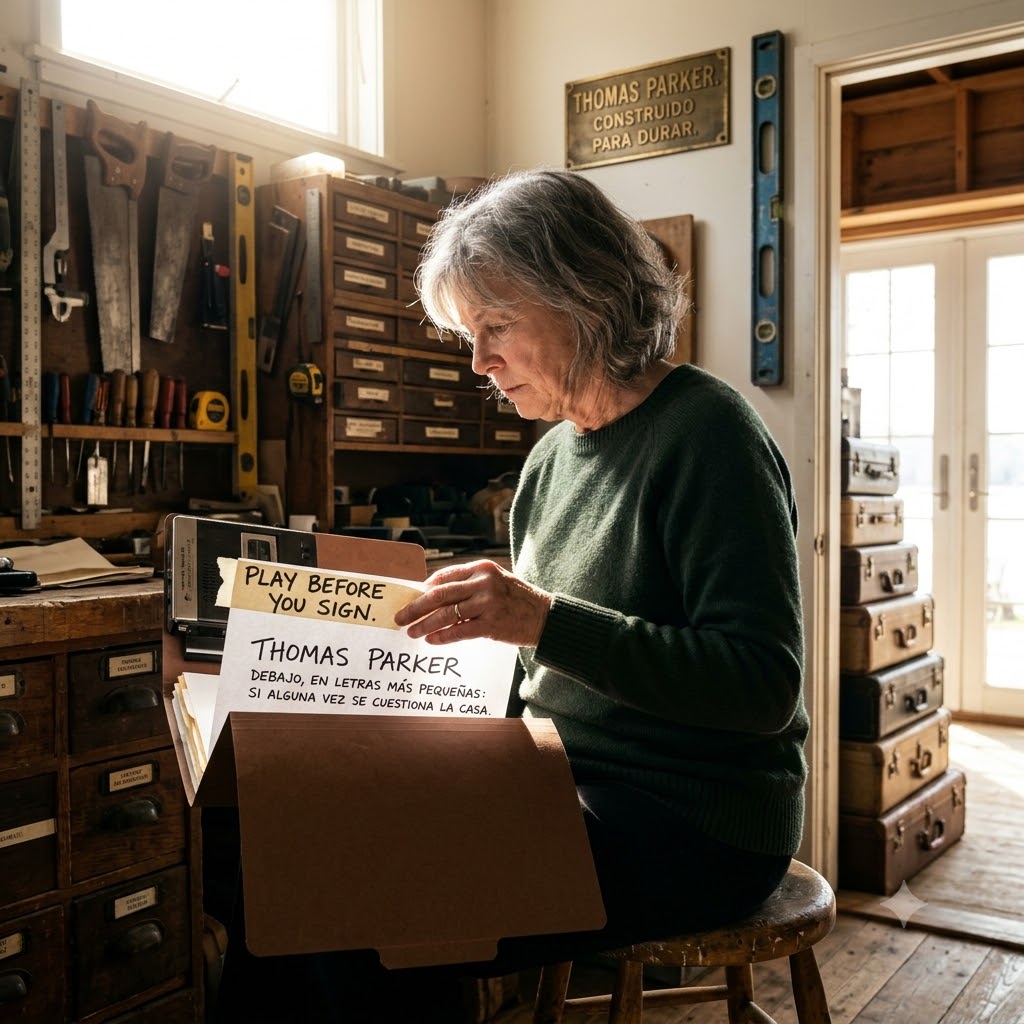
Und über seiner Werkbank hing eine kleine Messingplakette.
THOMAS PARKER.
GEBAUT, UM ZU HALTEN.
Ich berührte die Kante der Bank.
“Na gut, Thomas”, flüsterte ich.
“Was wolltest du mir sagen?”
Der Workshop bot keine Antwort.
Ich durchsuchte die Schubladen, öffnete sie sorgfältig, eine nach der anderen.
Schrauben.
Scharnieren.
Sandpapier.
Bleistifte, mit einem Taschenmesser gespitzt.
Nichts Ungewöhnliches.
Dann erinnerte ich mich an das letzte Mal, als Thomas über die Werkstatt gesprochen hatte.
Es waren drei Wochen vergangen, bis er starb.
Er hatte in seinem Schaukelstuhl am Küchenfenster gesessen, eine Decke über den Knien.
“Daniel ist ein guter Junge”, hatte er gesagt.
Ich hatte leise gelacht.
“He’s forty-two, Thomas.”
“He’ll always be our boy.”
Then his expression had changed.
“Good people can make terrible decisions when they’re afraid of disappointing someone.”
I had assumed he was talking about Daniel’s marriage.
Thomas had never disliked Laurel openly, but he had worried about the way Daniel became smaller whenever she entered a room.
“What are you getting at?”
I had asked.
He had looked toward the workshop.
“I made sure the house can’t be quietly taken away from you.”
I had dismissed the comment.
At the time, I had been more concerned about his breathing than his paperwork.
Now those words returned with painful clarity.
I walked toward the maple cabinet.
It was unfinished only on the outside.
The doors had been sanded but never stained.
Inside were three shelves and a narrow lower compartment.
I opened the first drawer.
Empty.
The second contained old photographs.
The third was locked.
I searched for a key.
There was none in the obvious places.
Then I noticed something written in pencil beneath the cabinet’s upper edge.
Not a sentence.
Just two words.
BLUE LEVEL.
Thomas had owned several spirit levels, but only one was blue.
I found it hanging above the workbench.
It was an old aluminum level with chipped paint, the kind he had refused to replace even after Daniel bought him an expensive new one.
I lifted it from its hooks.
Something rattled inside.
I turned it over.
At one end, a small wooden plug had been fitted into the hollow frame.
My heart began to pound.
I removed the plug.
A brass key slid into my palm.
For a moment, I simply stared.
Thomas had hidden a key inside a tool.
It was exactly the kind of thing he would do.
I crossed the room and unlocked the cabinet drawer.
Inside lay a thick envelope wrapped with a faded blue ribbon.
My name was written across the front.
MARGARET.
BENEATH IT, IN SMALLER LETTERS:
IF THE HOUSE IS EVER QUESTIONED.
I sank onto Thomas’s stool.
My hands shook as I untied the ribbon.
The first thing inside was a letter.
It began with the words:
My dearest Maggie,
If you’re reading this, somebody has made you feel that the home we built together is no longer yours.
I pressed the paper against my chest.
For two years I had wished to hear Thomas’s voice again.
Now, in the middle of a night when I felt more alone than I ever had, his handwriting was waiting for me.
I read slowly.
He told me that the workshop contained copies of our property records, our estate documents, and the instructions he had prepared with our attorney.
He reminded me that the house had been built on land we purchased together, that the deed had been updated after his illness, and that no one—not even Daniel—could make decisions about my ownership merely by claiming to represent me.
Then came the sentence that made me stop.
I have also kept copies of the conversations and documents that made me concerned someone might someday try to pressure you into signing away control.
I looked up.
The workshop suddenly felt different.
Thomas had known something.
Perhaps not everything.
But enough to prepare.
I returned to the envelope.
There was a second letter, addressed to Daniel.
It was sealed.
There was a copy of the deed.
A list of attorney contacts.
A folder of dated notes.
And a small digital recorder.
I stared at it.
Thomas had used that recorder during the final months of his life because writing had become difficult.
He had recorded reminders, measurements, and occasional messages for me.
I had listened to most of them after his funeral.
Apparently, not all.
A piece of masking tape was attached to the recorder.
On it, in Thomas’s uneven handwriting, were four words.
PLAY BEFORE YOU SIGN.
I held the device for a long time.
Then I pressed the button.
There was a faint click.
A breath.
And my husband’s voice filled the workshop.
“Maggie, if you’ve found this, I need you to listen carefully.”
I began to cry.
Not loudly.
Not dramatically.
Just tears slipping down my face as I listened to a voice I had believed was gone forever.
“I hope I’m wrong about what worries me,” Thomas continued.
“I hope Daniel never gives you reason to open this drawer.
But if somebody starts talking about trusts, loans, or putting the house in another person’s name, you need to know what I found.”
The recording crackled.
Then Thomas said:
“Two months ago, Daniel asked me whether the lake house could be used to secure a loan without selling it.”
My breath caught.
“He said Laurel had been looking into arrangements for her parents.
I told him the house wasn’t a bank account.
It was your home.
He didn’t argue, but he didn’t look me in the eye, either.”
I covered my mouth.
Thomas continued.
“I made him a promise.