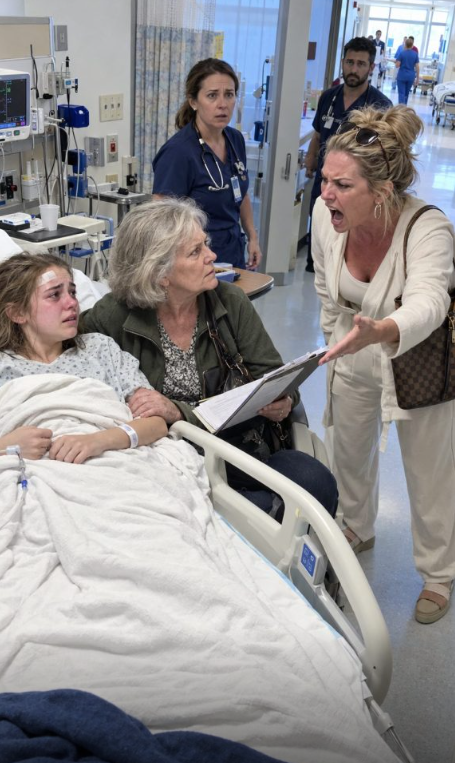
Die Sachbearbeiterin schrieb etwas in ihr Notizbuch.
Mama erkannte, was sie zugegeben hatte, und versuchte sofort, es zu erklären.
“Ich meinte, das Geld hilft, unseren Haushalt zu unterstützen. Offensichtlich liegt mir meine Tochter am Herzen.”
Oma sah sie an.
“Warum bist du dann nicht gekommen, als das Krankenhaus anrief?”
Mama warf einen Blick zu den Maschinen neben meinem Bett.
“Man sagte mir, sie sei stabil.”
“Ihnen wurde gesagt, sie sei nach einem schweren Unfall bewusstlos gewesen.”
“Ich konnte meinen Termin nicht einfach absagen!”
Grandma took off her glasses.
“Vanessa, your daughter could have woken up and found nobody waiting for her.”
I watched Mom’s mouth open.
Nothing came out.
The caseworker asked her to continue the discussion outside. This time, Mom followed.
I turned toward Grandma.
“Is it because of the money?”
She pulled her chair closer.
“No, sweetheart. That isn’t why she’s supposed to love you.”
“But maybe it’s why she kept me.”
Grandma’s eyes filled, and she held my hand until I fell asleep.
Four days later, I turned sixteen in a rehabilitation unit.
There was no elaborate party. My shoulder was immobilized, the hallway lights gave me headaches, and I could barely sit through an entire meal.
Grandma brought a chocolate cupcake from a bakery near the hospital.
She placed one candle in it.
“Make a wish.”
I looked at the flame.
“Can I wish for something that already happened?”
“You can wish for anything.”
I wished Dad were still alive.
Then I blew out the candle.
Grandma didn’t ask what I’d wished for.
She just stayed.
Over the following weeks, the court reviewed the circumstances of my mother’s absences, the accident, the hospital records, and the earlier child welfare concerns. I was interviewed privately about where I felt safe living.
Mom challenged the emergency order at first. She insisted Grandma had exaggerated everything and argued that leaving me alone was reasonable because I was almost sixteen.
But the investigation revealed repeated periods when she’d been unavailable, missed school meetings, and failed to arrange reliable adult supervision.
The survivor benefits became a separate issue. Those payments had been intended for my support, and some had legitimately covered household expenses. However, the agency responsible for the benefits was notified of the custody change and began reviewing who should receive and manage them going forward.
The court didn’t instantly take away every parental right Mom had.
Eventually, after several hearings and negotiations, Grandma received legal custody. Mom retained scheduled contact, subject to conditions designed to protect my welfare.
My recovery took months.
I had physical therapy twice a week, struggled with headaches, and sometimes woke up frightened by the sound of brakes outside.
Grandma drove me to appointments, sat through school meetings, and helped me catch up on the classes I’d missed.
She also made mistakes.
She forgot that teenagers didn’t want their lunches packed in bright pink bags. She worried too much whenever I went somewhere with friends. Once, she tried to help me study algebra and admitted after twenty minutes that she understood absolutely none of it.
We laughed until my shoulder hurt.
Mom visited occasionally.
At first, every conversation ended with her blaming Grandma.
Later, she began talking about herself less and asking about me more.
One afternoon, nearly a year after the accident, she said something I’d waited a long time to hear.
“I should have come to the hospital.”
I looked down at my hands.
“Yes,” I said. “You should have.”
She nodded.
I didn’t hug her.
But I didn’t leave either.
Some relationships take years to rebuild. Some never return to what they were. I learned that forgiveness and trust weren’t the same thing.
On my eighteenth birthday, Grandma took me to dinner at a small restaurant overlooking the river.
When dessert arrived, she handed me an envelope.
Inside was a copy of the first photograph she’d taken after I came home from the hospital.
I was sitting at her kitchen table, wearing oversized pajamas, eating toast.
On the back, she’d written:
The first morning you didn’t have to wonder whether someone would come home.
I traced the words with my thumb.
Two years earlier, I’d woken in a hospital and found a court order beside my bed.
Back then, I thought that piece of paper meant my mother had lost me.
Now I understood what it had really meant.
The hospital needed someone who could sign the forms.
I needed someone who would show up even when no signature was required.