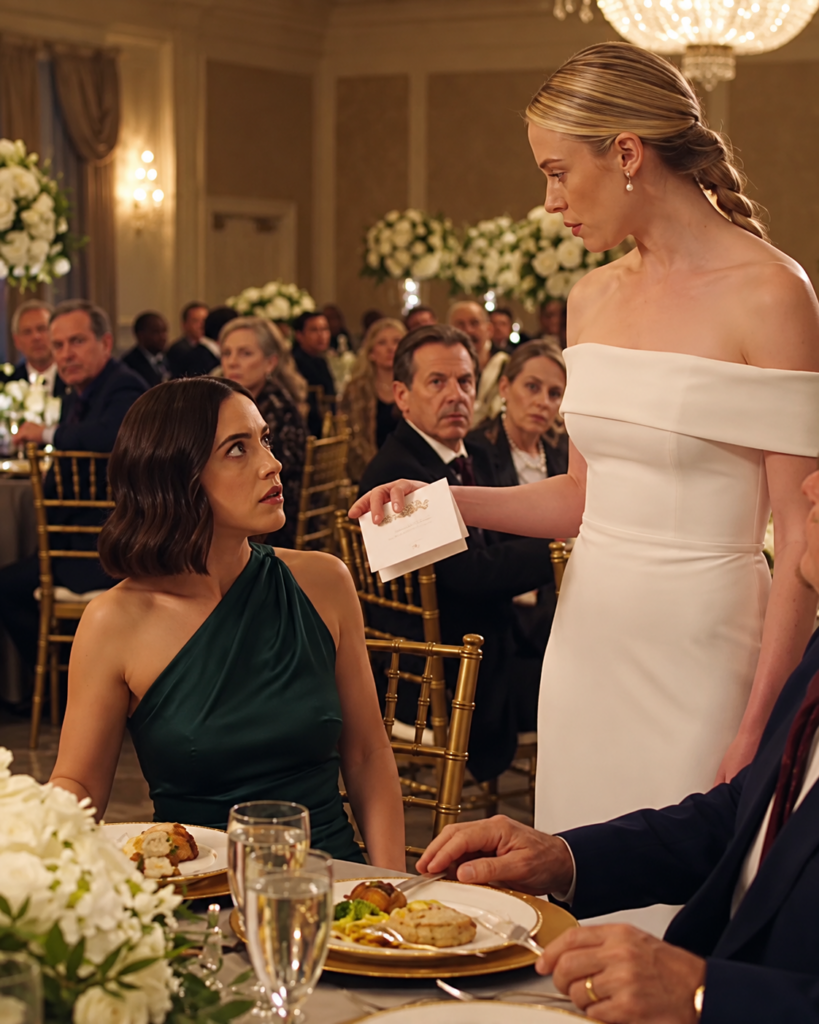
“Why didn’t you tell me any of this?”
Vanessa turned toward him.
“Because it isn’t relevant to us.”
“You excluded your stepmother from our wedding and moved your sister beside the kitchen because of it.”
“I didn’t exclude Rachel.”
“You told her she wasn’t part of your real family.”
Vanessa’s voice rose.
“I never said real.”
“No,” I said quietly.
“You said original.”
She looked at me.
I saw something then.
Not hatred.
Resentment.
Years of it.
And beneath that, grief.
But grief does not become kindness merely because we understand where it came from.
“I would have changed seats if you’d asked me,” I said.
Vanessa’s face crumpled slightly.
“You could have told me you were angry.
You could have told me you resented me.
You could have told me you hated seeing Mom at that table.
I might have been hurt, but at least it would’ve been honest.”
“I don’t hate you.”
“Then why did you need to humiliate me?”
“I didn’t.”
“You took away my chair.”
Her eyes dropped.
That was the first time she looked ashamed.
Only for a second.
Then she said, “You always make everything sound worse.”
I nodded.
There it was again.
The escape hatch.
The thing Vanessa had used for years.
Nothing she did was cruel.
I was simply too sensitive to receive it properly.
Daniel looked exhausted.
“Vanessa, apologize.”
She stared at him.
“Excuse me?”
“To Clara.”
Her face hardened.
“At my wedding?”
“Yes.”
The silence became unbearable.
I stepped backward.
“No.”
Everyone looked at me.
“I don’t want an apology because Daniel ordered her to give me one.”
Vanessa looked almost relieved.
I continued.
“I just want to leave.”
Grandma nodded.
“Then we’re leaving.”
I turned toward the doors.
This time, Vanessa didn’t stop me.
But Daniel did.
“Clara.”
I looked back.
He wasn’t holding the microphone anymore.
He looked embarrassed.
And hurt.
“I didn’t know.”
“I know.”
That was true.
Daniel had always treated me like family.
He was the one who remembered my birthday when Vanessa forgot.
He was the one who brought Mom flowers the first Christmas after Dad died.
Whatever Vanessa had done, I didn’t believe he had planned it with her.
He looked toward the crowd.
“You don’t all have to leave.”
Grandma answered him.
“We know.”
That was the point.
Nobody had been forced.
One by one, people chose.
Some stayed.
Many didn’t.
We walked out through the ballroom doors while Vanessa stood beneath a chandelier in a dress she had spent fourteen months choosing.
I expected triumph.
I felt none.
In the elevator, nobody spoke.
When the doors closed, Grandma Margaret looked at me.
“Your father once made me promise something.”
I frowned.
“What?”
She stared at the glowing floor numbers.
“He told me that if anything ever happened to him, I was to make certain you and Vanessa remembered you were sisters.”
My throat tightened.
Grandma’s expression became sad.
“I kept half that promise.”
“What does that mean?”
The elevator doors opened.
She looked at me.
“I made sure you remembered.”
CHAPTER 3 – PART 3: WHAT MY FATHER LEFT UNSAID
We ended up at a diner three blocks from the hotel.
Twenty-three members of my family, dressed for a black-tie wedding, sitting beneath fluorescent lights while a bewildered waitress poured coffee into thick ceramic mugs.
It should have been funny.
Nobody laughed.
Grandma Margaret ordered apple pie.
I ordered nothing.
My appetite had disappeared somewhere between “half-sister” and “original family.”
Aunt Patricia sat across from me.
“Clara, there are things you don’t know.”
I looked at her.
“I’ve heard enough family secrets for one night.”
“These aren’t secrets.”
Grandma corrected her.
“They became secrets because nobody had the courage to say them.”
I looked between them.
Grandma stirred sugar into her coffee.
“When Diane died, Vanessa was eleven.
Your father fell apart.”
I knew that.
Or thought I did.
Dad had rarely spoken about those years.
“He loved Diane very much,” Grandma continued.
“And grief made him absent when Vanessa needed him most.”
Aunt Patricia nodded.
“She spent a lot of time with us.”
“With me too,” Grandma said.
“Dad told me he raised her alone.”
Grandma gave me a sad smile.
“People remember survival differently.”
That sentence stayed with me.
Grandma explained that Dad had worked constantly after Diane died.
Not because he didn’t love Vanessa.
Because he was terrified.
There had been medical bills.
A mortgage.
A daughter he didn’t know how to comfort.
He coped by doing the one thing he understood.
Working.
By the time he met my mother, years had passed.
He had learned what his absence had cost.
“He tried to repair things with Vanessa,” Grandma said.
“But she was seventeen.
Then eighteen.
She didn’t want repairing.”
I stared into my untouched water.

