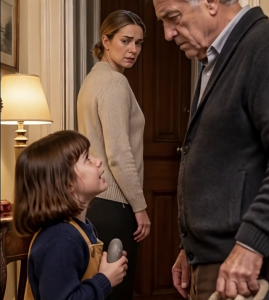
 At five years old, my daughter Léa walked nearly five kilometers barefoot, in the middle of a freezing night, to escape her grandfather. When her school principal called me, Léa’s feet were bleeding, she was no longer speaking, and her own mother was nowhere to be found.
I was in Montreal for a story on press freedom. It was 8 p.m. at my place, 2 a.m. in Bordeaux, when my phone vibrated in the middle of a reception. The name displayed immediately worried me: Ms. Roussel, principal of the Tilleuls school.
“Mr. Lemaire? It’s about Léa. She’s at school.”
I thought I had misheard.
“At this hour? She’s sleeping at her grandfather’s house in Le Bouscat, with Élodie!”
The headmistress took a deep breath. An officer finishing his rounds in the neighboring gymnasium had spotted a small figure knocking against the glass doors. Léa wasn’t wearing a coat or shoes. Her blue sweater was damp, her feet covered in cuts, her lips almost colorless. He had called emergency services, then notified the headmistress, who lived a few streets away.
“She’s with the firefighters now,” she told me. “She refuses to answer. When they gave her a sheet of paper and a pencil, she wrote the same sentence several times.”
“Which sentence?”
Silence.
“Grandpa hurt me.”
I leaned against a column. Around me, the journalists continued to talk, glasses clinked. I couldn’t hear anything anymore.
Léa loved collecting the small grey pebbles near the Garonne River. She always kept one in her pocket, like a lucky charm. That evening, one of those pebbles was found clutched in her fist. I imagined her running through the deserted streets, the wet sidewalks cutting into her feet, not knowing if anyone would eventually open a door.
“Tell her I’m coming home,” I whispered. “And above all, don’t leave her alone.”
I called Elodie, my wife. Once. Four times. Voicemail.
Then I dialed the number of Gérard Valette, his father, a former local elected official whom many people from Bordeaux continued to call “Mr. President”.
“Gérard, Léa has run away from your house. She is injured. She wrote that you hurt her. What happened?”
“That child is talking nonsense,” he replied curtly. “She threw a tantrum because she was sent to bed.”
“She is FIVE YEARS OLD. She walked almost five kilometers barefoot!”
“I will not allow the police into my home because of the lies of some brazen little girl. I will not tarnish my name because of her theatrics.”
He hung up.
I involuntarily relived a family dinner where he had snatched a drawing from Léa’s hands, saying, “Here, children learn to be quiet.” I had protested. Élodie had asked me not to provoke her father. At the time, I had agreed to leave. This time, I couldn’t.
I called my sister Sarah, a pediatric nurse at the Bordeaux University Hospital. She left home immediately. I asked the director to give my contact information to emergency services and the police, and I asked Sarah to inform the medical staff of my concerns about any visits from Gérard or Élodie. Then I booked the first available flight.
During the seven hours spent over the Atlantic, I didn’t sleep a wink. With every turbulence, I saw Léa’s fingers gripping her pebble.
When the plane landed, several messages from Sarah were waiting for me. The last one contained a photo of a second sheet of paper. Under the words “Grandpa hurt me,” Léa had written another sentence in shaky handwriting:
“Mom watched.”
I called Sarah back from the landing platform. She answered immediately, but she didn’t let me speak.
“Mathieu, listen to me. Léa is being treated in the pediatric emergency room. The doctors are monitoring her condition closely after her exposure to the cold. She’s exhausted. Don’t ask her twenty questions when you arrive. She needs to understand that we believe her.”
I asked her what the sentence on the sheet of paper meant. Sarah hesitated.
“I don’t know everything yet. But she drew three people in a room. Her grandfather, her mother, and herself. Next to her mother, she drew a closed door.”
On the way to the hospital, I watched the streets go by through the taxi window. Bordeaux was waking up. A man came out of a bakery with two coffees. A woman ran to catch her tram. The city carried on, indifferent to what had just shattered in our own home.
I found Sarah in the hallway, her hair hastily tied back, still wearing her coat. She took my arm before opening the door for me.
“You might feel like trying to get explanations from them. But right now, your job is Léa.”
