“Mrs. Bernard, before you talk about the owner of this house, you need to know what your husband deposited here in 2016.”
Master Delmas placed the sheet on his desk, between us. The paper was yellowed at the edges, but André’s handwriting remained perfectly recognizable: straight, regular, with his close-set letters that always seemed to lack space.
I ran my fingertip over his name.
” What is this ? “
“A handwritten statement, kept in your husband’s file. He gave it to me a few months before his death. He asked me to give it to you only if you ever encountered difficulties concerning this house.”
I looked up.
“Difficulties with whom?”
Mr. Delmas remained silent for a moment.
“Mainly with your son.”
I felt something loosen in my chest, then tighten immediately. Ever since the kitchen scene, I kept telling myself that maybe I’d misunderstood. That Jasmine had crossed the line, certainly, but that Marc hadn’t really chosen sides. That he was tired, easily influenced, embarrassed.
The sheet of paper trembled in my hands.
I unfolded it.
Ingrid, if you’re reading this, it’s because you’ve probably heard that the house belonged to Marc or someone else. That’s not true. I made sure it belonged entirely to you because you paid for it with me, you maintained it, and you gave up so much for it. I know our son. He can be generous, but he gives in easily when he’s afraid. If he comes asking you to sign, to give him your papers, or to let him “manage” your affairs, don’t do it without consulting Maître Delmas. The house is your sanctuary. Don’t let anyone convince you that you’re a guest there. André.
I remained silent for a long time.
The notary handed me a glass of water.
“He also asked me to keep a copy of certain documents. He was afraid you would be put under pressure.”
“Did he know?”
“He had reason to be concerned. In 2016, your son asked him to sign a document presented as a simple authorization to help him obtain a loan. Your husband refused to sign anything without discussing it with you.”
I remembered that time. Marc often came for dinner. He would talk about a business project, a company he wanted to start, a place to rent. André listened without saying much. After he left, he simply said:
“Your son wants to go too fast.”
I hadn’t insisted.
“What document had he brought?”
Mr. Delmas opened a folder and took out a photocopy.
“An acknowledgment of debt accompanied by a request for a guarantee on the property. Nothing was signed. Your husband wrote at the bottom of the first page: ‘Refused. My wife must never be involved in this matter.’”
I closed my eyes.
Everything fit together: Marc’s talk about his inheritance, his way of saying that “everything would come back anyway”, his sudden interest in my papers, the pressure exerted since Jasmine moved in.
“Why didn’t he tell me anything?”
“He was probably hoping to avoid a conflict. And he thought he had time to explain things to you.”
But André died in 2018, after a short illness. The fatigue had started with shortness of breath, then came a series of tests. He had always refused to talk about his worries in front of me. Even in the hospital, he would ask me if I had eaten properly for lunch.
I folded the letter carefully.
“What should I do now?”
Master Delmas leaned towards me.
“First, don’t sign anything. Then, gather all your documents and change your bank access details, passwords, and locks if you think someone has a key. Finally, you must have what happened on Sunday officially recorded.”
“You mean file a complaint?”
“I advise you, at the very least, to consult a doctor about your hematoma and report the facts. A flare-up is not a family matter.”
I glanced down at my bag. I didn’t want to make Marc an adversary. He was my son. As a child, he used to fall asleep against my shoulder on the tram. At eight, he’d run to the kitchen to show me a tooth he’d lost. At fifteen, he’d bought me a bouquet of daffodils with the money he’d earned washing cars.
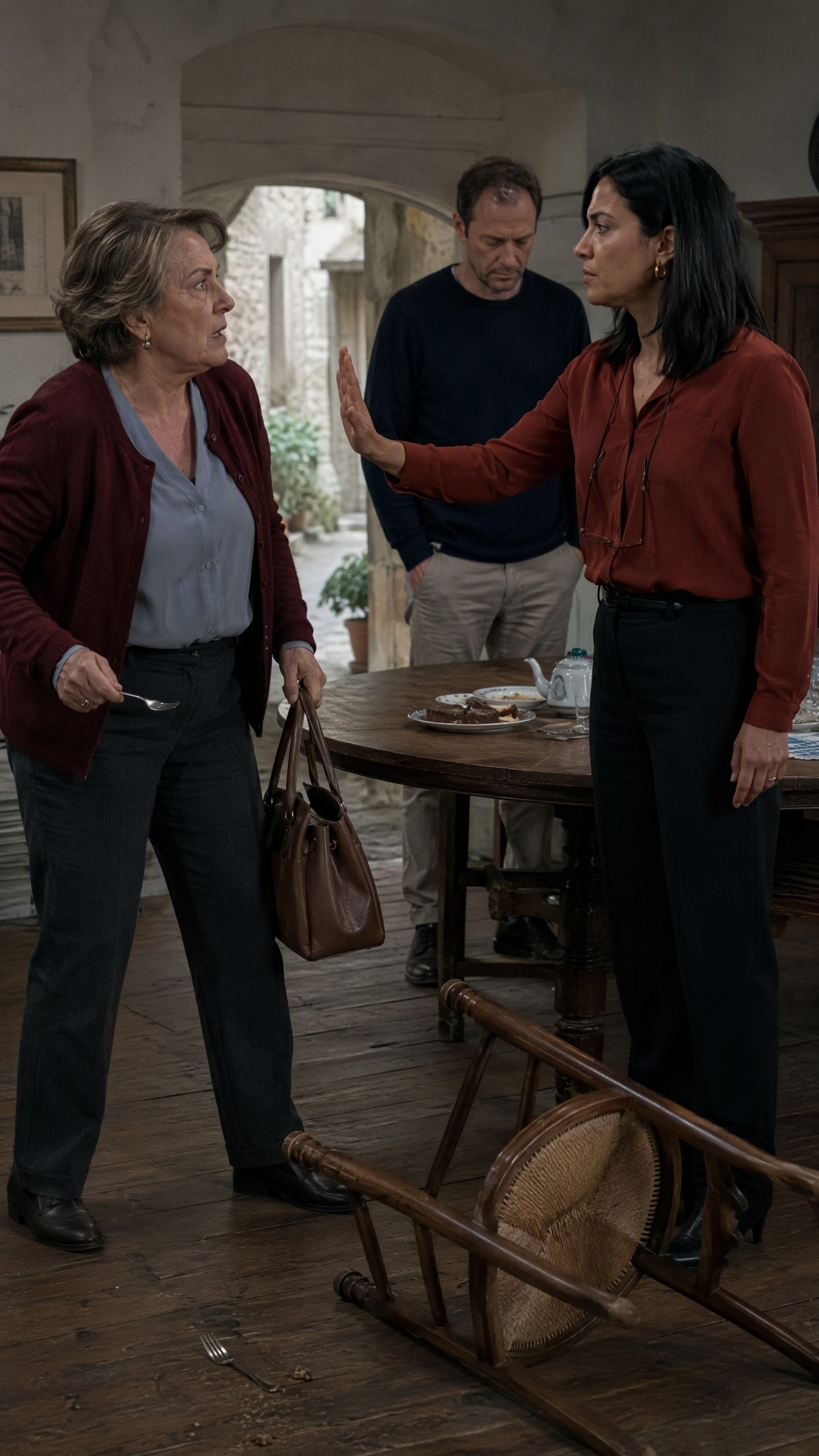
But the man who had watched me pick up a fork without moving was no longer that child.
“And if they do it again?”
“Then you’ll have to ask them to leave. They have no right to move into your room or use your rooms as they please. We can refer you to a lawyer and the appropriate services. But the first decision is yours alone: will you continue to accept living like a stranger in your own home?”
I did not reply immediately.
