Across the ballroom, guests began taking their seats.
And I realized something remarkable.
A year earlier, I’d entered this estate feeling ashamed of everything I didn’t have.
No husband.
No wealth.
No powerful connections.
My sister had mocked my dress.
My mother had hidden me from the family photographs.
I’d believed the evening would simply be another reminder that I was never enough.
Now I stood in the same room knowing something I should have understood long ago.
I had never been the failure in my family.
I had been the one who refused to become like them.
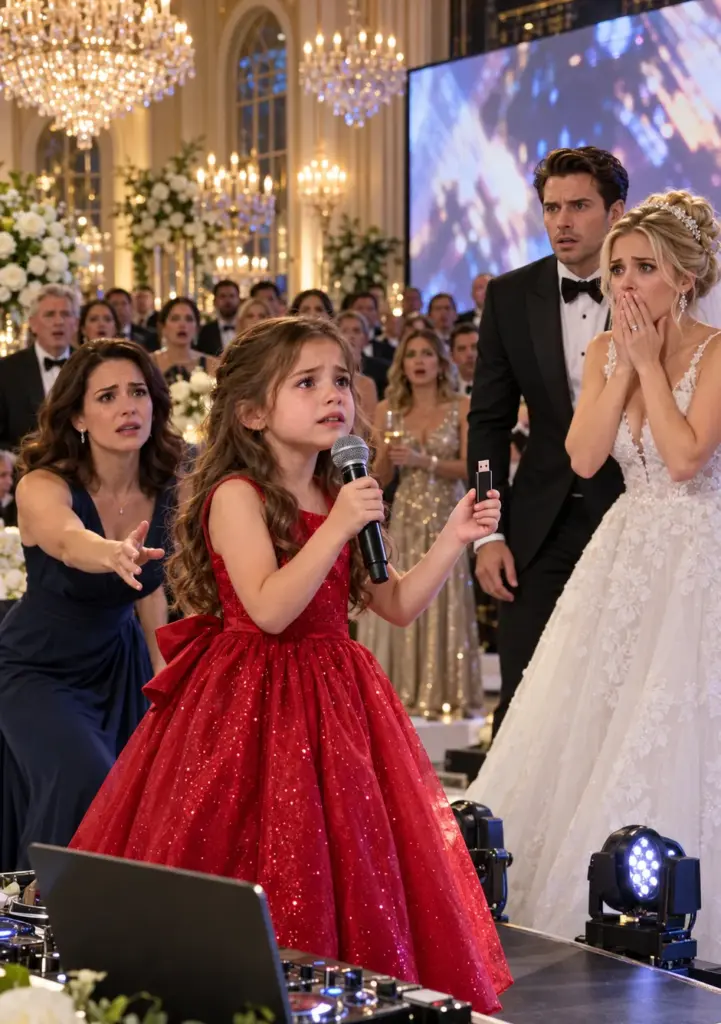
When my name was announced, I stepped onto the stage.
Three hundred faces turned toward me.
I looked at Lily.
Then I looked at Graham.
And finally, I began.
“My father once told me that being honest matters more than being rich.”
The room fell silent.
“He believed that people deserve to feel safe in their homes, secure in their futures, and respected regardless of how much money they have.”
I paused.
“Twenty-four years ago, my father lost his life after trying to expose wrongdoing.”
Tears blurred my vision.
“For a long time, I believed his story ended there.”
I glanced toward Lily.
“But I was wrong.”
She smiled at me.
“Because truth doesn’t always disappear when someone tries to bury it.
Sometimes it waits in an old wooden boat.
Sometimes it survives in a forgotten letter.”
I took a breath.
“And sometimes, it comes from an eight-year-old girl brave enough to stand in front of three hundred strangers and say something nobody wants to hear.”
The room erupted in applause.
Lily blushed.
Graham stood.
Others followed.
I looked at the little girl who had once worried that asking for cereal at dinner might be too much trouble.
And I understood that no amount of money could ever equal what she had given me.
The courage to stop accepting cruelty as love.
The strength to walk away from people who used family as an excuse to control me.
And the certainty that our future belonged to us.
Later that evening, after the speeches, Graham found me standing near the garden doors.
“Beautiful speech,” he said.
“Thank you.”
We watched Lily dancing with her school friends.
Then Graham took a small velvet box from his jacket.
My heart skipped.
“Graham…”
He laughed.
“Relax.
It’s not what you think.”
He opened it.
Inside was a delicate silver necklace.
A tiny sailboat hung from the chain.
I covered my mouth.
“My father left me that charm,” Graham said.
“He said it reminded him of an old friend who taught him what integrity looked like.”
I touched the little boat.
“Andrew?”
Graham nodded.
“I had it restored.
I thought you should have it.”
Tears spilled down my cheeks.
I didn’t know what to say.
So I hugged him.
For a long moment, we stood together in the soft light.
Then Lily appeared beside us.
“Mommy, are you crying?”
I laughed through my tears.
“Happy tears.”
She looked at Graham.
“Did you make my mommy happy?”
He smiled.
“I hope so.”
Lily nodded approvingly.
“Good.
Because she deserves it.”
Graham looked at me.
“Yes,” he said softly.
“She does.”
A few months later, the three of us spent our first summer weekend at Harbor House under the new occupancy arrangement.
Lily learned to sail a tiny boat in the sheltered cove.
I planted white roses beside the porch.
And Graham repaired the weathered bench where my father used to sit.
We didn’t pretend the past had never happened.
Vanessa still had to face the consequences of her choices.
Daniel’s relationship with Lily remained subject to appropriate legal and therapeutic safeguards, based on her welfare rather than his demands.
My mother never offered the apology I once wanted.
But I had stopped waiting for it.
Some people never become the family you deserved. That doesn’t mean you have to spend your life begging them to change.
One evening, as the sun sank over Newport Harbor, Lily climbed into my lap.
“Mommy?”
“Yes, sweetheart?”
“Do you think Grandpa Andrew can see us?”
I looked out across the water.
The boats rocked gently in the evening breeze.
“I don’t know, baby.”
She rested her head against my shoulder.
“I hope he can.”
“Me too.”
She thought for a moment.
“Do you think he’s proud?”
I kissed her forehead.
“I think he’d be very proud.”
Then she smiled.
“Of you?”
I held her close.
“Of both of us.”
We sat together until the last light disappeared.
And for the first time in twenty-four years, I felt the past loosen its grip.
My father had left me something far greater than a letter, a house, or a hidden fortune.
He had left me an example.