“I’ll need to review the original loan file,” he said. “A photocopy alone won’t establish whether the transaction was valid, but it gives us a direction.”
“What if the bank tries to seize the building?”
“That is one of the risks we need to evaluate. Your attorney should contact the lender through the appropriate legal channels and notify them that ownership is disputed. We should not assume the bank’s rights or your position until the documents are reviewed.”
I appreciated his caution.
For the first time, someone was refusing to promise me an easy answer just because I was frightened.
After we hung up, I began cooking dinner.
Mason came through the door at four fifteen, dropped his backpack beside the couch, and ran toward me.
“Mom!”
I caught him in my arms.
“Hey, sweetheart.”
He hugged me tightly.
“Nobody at school knows about the wedding, right?”
I pulled back.
“Why would they?”
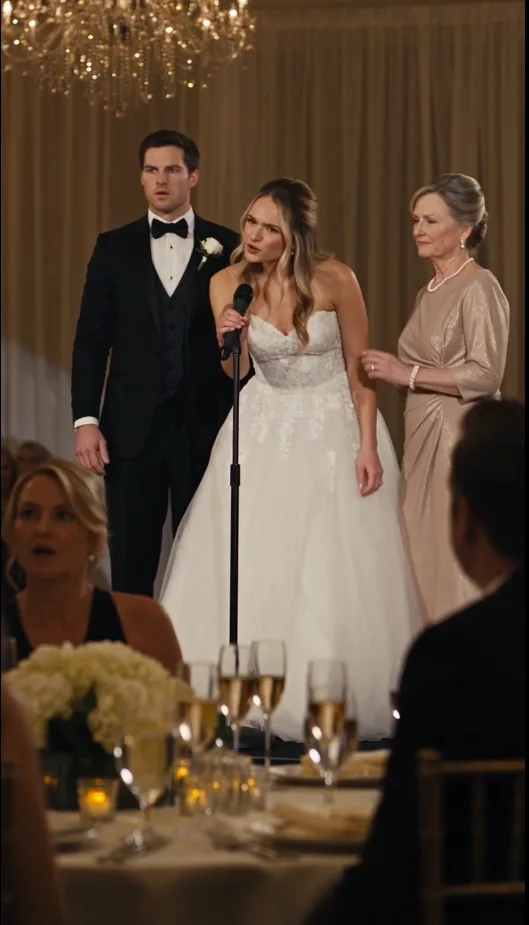
“Because I talked into the microphone. What if someone posted it online?”
I hadn’t thought about that.
In the age of phones and social media, two hundred witnesses could become thousands of spectators in minutes.
“I don’t know if anyone recorded it,” I admitted. “But if they did, you haven’t done anything wrong.”
He nodded uncertainly.
Then he asked the question I had been dreading.
“Are Grandma and Grandpa bad people?”
I put the spoon down.
Children want simple answers.
They want heroes and villains, good people and bad people, promises that everything will be all right.
But life rarely offers such clean divisions.
“I think Grandma and Grandpa have made choices that hurt us,” I said carefully. “And I think they need to take responsibility for those choices.”
“Does that mean we can’t see them anymore?”
“It means we’ll decide what is safe and healthy for us. You don’t have to decide anything today.”
He studied my face.
“Uncle Jake said he was sorry.”
“He did.”
“Do you forgive him?”
I considered the question.
“Not yet.”
Mason nodded as though that made sense.
Then he said something that made my throat tighten.
“That’s okay. You don’t have to forgive someone just because they want you to stop being sad.”
I stared at him.
He was nine years old.
He should have been thinking about soccer practice, comic books, and whether he could have dessert before dinner.
Instead, he was trying to make sense of betrayal.
I pulled him close.
“You are a very wise boy.”
He rested his head against my shoulder.
“Grandpa used to say that.”
I smiled through my tears.
“Yes, he did.”
That evening, after Mason went to bed, I received an email from Brittany.
The subject line read: We need to talk.
I almost deleted it.
Then I opened it.
Sarah,
I know you have every reason to hate me after what happened at the wedding. I am not going to pretend that I didn’t know the speech was meant to embarrass you. I did.
Linda told me that if the guests saw you as unstable and jealous, it would protect Jake’s reputation if the property dispute became public. I agreed because I was afraid the business would collapse and I would lose the future I had planned.
That doesn’t excuse what I did.
But there is something I need you to know. The documents I found at the bank were not the only documents connected to your grandfather’s estate.
I found a second set of records showing that the original trust was changed after his death. The signature on the amendment is yours.
I know you say you never signed it. I believe you.
And I think someone in your family forged it.
I read the email twice.
Then I scrolled to the bottom.
Brittany had attached a photograph of a document.
The page was slightly blurred, but I could clearly see my name at the bottom.
Sarah Mitchell.
The signature looked like mine.
Almost.
But there was something wrong with the final stroke of the letter h.
I had always written my surname with a small upward curve.
This signature ended with a sharp downward line.
I enlarged the photograph.
A date appeared near the top.
Six years earlier.
The same year my mother told me the estate had been settled.
The same year Jake’s business moved into the Franklin Road building.
And beneath the signature was a sentence that made my blood run cold.
I hereby relinquish all present and future beneficial interest in the Mitchell Family Trust.
I had never signed those words.
I had never seen that document.
But someone had used my name to make it appear that I had willingly surrendered my inheritance.
I forwarded the email and photograph to Robert.
His reply arrived less than five minutes later.
Do not confront anyone about this document yet. We need the original.
A second message followed.
Sarah, there is a serious issue here. If this amendment was used to transfer trust assets, we need to establish who created it, who witnessed it, and who presented it to the bank.
Then he called me.
His voice was unusually grave.
“Sarah, I’ve examined the image.”
“What does it mean?”
“Si el documento es auténtico en apariencia pero no en origen, puede ser prueba de falsificación. Pero necesito el original y los registros completos de la ejecución antes de poder llegar a una conclusión.”
“¿Quién habría tenido acceso a mi firma?”
Guardó silencio un momento.
“Varias personas, posiblemente. Pero hay un detalle que quiero que consideres.”
“¿Qué?”
“La enmienda enumera dos testigos.”
Esperé.
“Uno es tu madre.”
Se me encogió el estómago.
“¿Y el otro?”
Robert hizo una pausa.
“Tu padre.”