“I hope so.”
The foundation would offer advice to elderly people who are victims of property abuse.
It would also fund counselling, legal guidance and programmes to combat loneliness.
It did not aim to replace public services or to solve all problems.
His objective was more precise.
To prevent vulnerable people from being forced to face painful situations without information or support.
Carmen listened, moved.
“And why do you want to do that now?” she asked.
Don Ernesto took a few seconds before answering.
“Because for months, I was afraid to ask for help. And if I, with my resources and the people who could have listened to me, have come to feel defenseless, I don’t dare to imagine what someone who has nothing feels. »
Javier approached his father.
“I want to help you.”
The old man smiled.
“You’re already doing it.”
“No, Dad. I want to really participate. I can dedicate time and resources to this project. »
Ernesto he closes the main.
“So let’s do it together.”
For the first time in a long time, the mansion is once again filled with joyful conversations.
Carmen prepared a special meal.
Rosa was invited.
Elena brought flowers.
And Javier made a personal decision.
He would reduce his business trips.
He would delegate part of his responsibilities in the company.
Not because he wanted to give up his job.
But because he understood that no amount of professional success could repay the time he had neglected to spend with his father.
That afternoon they sat together in the garden.
Don Ernesto looked at the rose-bushes that Mercedes had planted.
“Your mother always said that these flowers were too delicate for our climate.”
Javier smiled.
“And they’re still there.”
“Because she learned to take care of it.”
The old man gently brushed against a rose.
“Important things need attention, too, son.”
Javier didn’t answer.
It wasn’t necessary.
CHAPTER 21. ONE YEAR LATER
A year after the day Javier discovered his father kneeling in the kitchen, the mansion had become a completely different place.
The windows remained open in the morning.
The music was once again resounding in the living room.
Don Ernesto ate breakfast with his son every day when they were both at home.
Sometimes they would discuss politics, football or professional decisions.
Other times, they were content to read the newspaper in silence.
But there was no more fear.
The foundation had launched its first programs.
Elena coordinated the legal advice service.
A team of professionals received the elderly who needed information and guidance.
Carmen was involved in some community activities.
Rosa also helped when her work allowed it.
Don Ernesto visited the premises whenever his health permitted.
He did not present himself as a great benefactor.
He preferred to sit among the participants and listen to their stories.
One morning, he met a woman named Pilar.
She was eighty-one years old.
Her nephew had tried to pressure her to entrust him with the management of his bank accounts.
Pilar had gone to the foundation to get information.
At the end of the meeting, she approached Ernesto.
“I was told that you were the one who created all this.”
The old man smiled.
“With the help of a lot of people.”
“Thank you. I thought no one would believe me. »
Don Ernesto felt a twinge of sadness.
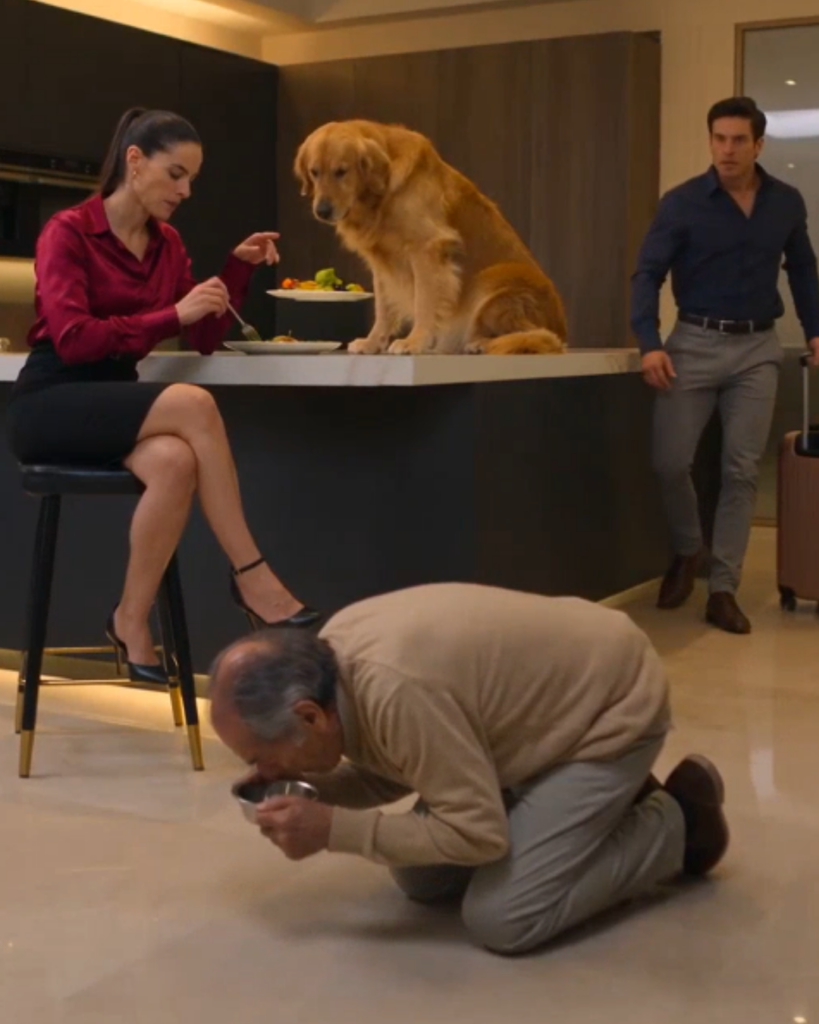
He remembered the kitchen.
Cold marble.
Metal bowl.
And from this impression that his own voice no longer mattered.
He took Pilar’s hands.
“Your word counts. Don’t let anyone convince you otherwise. »
The woman began to cry.
Ernesto accompanied him to the exit.
When he returned to the office, Javier was waiting for him.
“Are you okay, Dad?”
The old man nodded.
“Yes.”
“You look emotional.”
Don Ernesto looked out of the window.
“Today, I understood why I had to do all this.”
Javier smiled.
“Because of Pilar?”
“For her. And for all those who have not yet dared to ask for help. »
That afternoon they returned to the manor house together.
The golden-coated dog came out to greet them.
Don Ernesto stooped with difficulty and stroked his head.
The animal wagged its tail.
Javier watched the scene.
“You know, I thought that after what happened, you wouldn’t want to see him again.”
The old man smiled.
“The dog was never responsible for anything.”
Javier remains pensive.
It was true.
The animal had been used in a humiliation that he could never have understood.
Don Ernesto slowly straightened up.
“What was cruel was not that he had food. It was that a person could believe that I deserved less respect. »
Javier looked down.
He would never forget those words.
CHAPTER 22. THE LAST LETTER
One autumn morning, a letter addressed personally to Don Ernesto arrived at the manor.