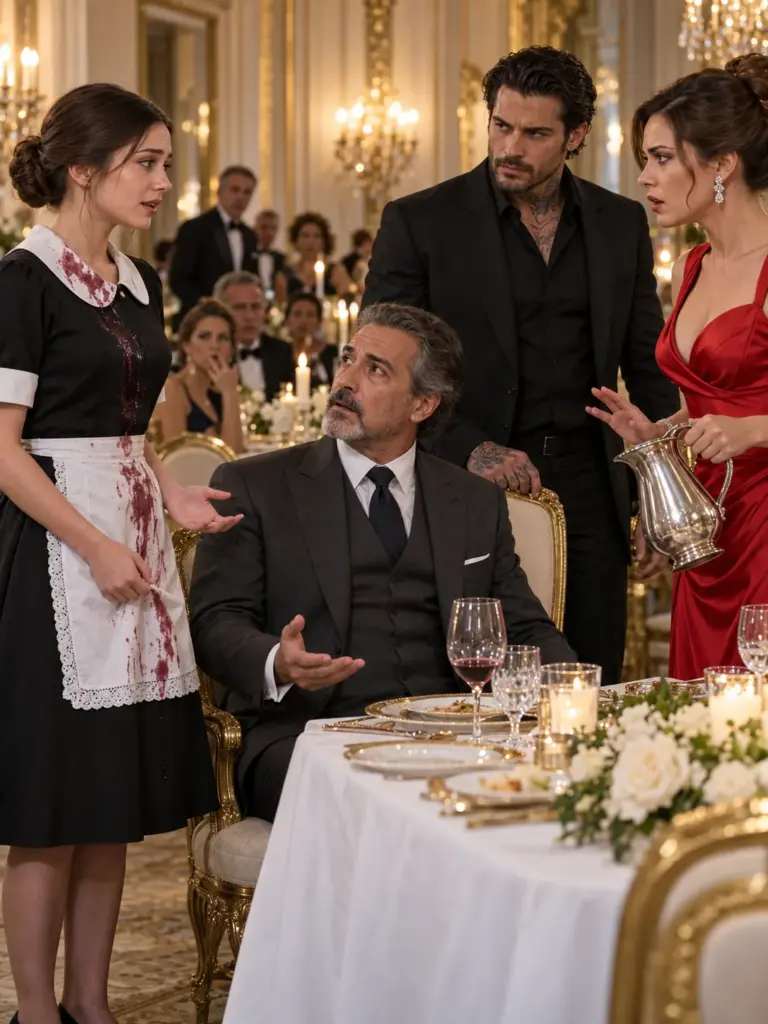
I remember Luca’s hand closing around my wrist in the hallway, not to stop me, but to keep me from falling down the stairs.
I remember him saying my name twice.
I remember answering with the only words I had.
“They are at my mother’s house.”
Chapter 5 – The Woman Coming Friday
The side gate was hanging open when we reached my mother’s street.
One of Luca’s cars arrived thirty seconds before us, which is a sentence I never expected to say about my life.
Two of his men were already on the porch.
A third stood in the yard beside a dark sedan with its engine running and its driver showing both hands through the open window.
A Chicago police cruiser turned the corner with its lights on and its siren mercifully off.
My mother hates sirens.
She says they make her heart try to leave her body before the rest of her is ready.
Rosa opened the front door a crack, saw me, and began to cry with relief.
Behind her, my mother sat in her wheelchair by the window, fully dressed, with her coat on her lap and her father’s Bible in her hands.
She had been preparing to be taken somewhere.
She had chosen what to carry.
“Mama.”
I knelt in front of her chair and took her strong hand.
“The gate,” she said.
“A man came over the fence.”
“He had a key for the side door, Emily.”
“Not a key.”
She searched for the word and found it with disgust.
“A copy.”
One of Luca’s men, a quiet giant named Frank whom I had only ever seen holding doors, came in from the kitchen carrying a clear bag.
Inside it lay a folded black glove and a syringe case of the kind hospitals stamp with warnings.
He did not let me look at it for long.
“The sedan driver says he was hired to drive a nurse.”
“He says the nurse was supposed to sedate Mrs. Carter for a private evaluation.”
“Evaluation,” my mother repeated, in a voice like a slap.
The police officer took statements on our porch while the light went gold and ordinary around us.
A neighbor watered her roses.
A child rode a bicycle in a slow circle at the end of the block.
Fear looks very strange in daylight.
It looks almost rude.
Luca did not enter my mother’s house until she invited him.
He stood on the sloped porch in his black suit, with his tattooed hands visible and empty, and he waited.
My mother studied him for a long moment.
“You are Luca.”
“Yes, ma’am.”
“You look like the photographs she cried over.”
Luca’s face did something I had never seen it do.
It lost its armor in front of a witness and did not reach for it again.
“Mrs. Carter, I owe you an apology I cannot make large enough.”
“You kept a piece of my wife when everyone else was throwing her away.”
My mother shook her head, impatient with ceremony.
“I kept a wristband.”
“Sofia kept herself.”
“Do not make the rest of us into her rescuers, young man.”
“She survived that place.”
“We only refused to help bury her.”
Luca bowed his head.
It was not theater.
It was a man accepting correction from a woman in a wheelchair in a house his money could have bought fifty times over.
“Will you let me move you somewhere safer tonight, ma’am?”
“Not a hospital.”
“No, ma’am.”
“The guest wing of my house.”
“It has a garden door, a nurse on staff, and no stairs between you and a bed.”
My mother looked at me.
I nodded.
I hated nodding.
I hated that Vanessa Bellini had made my mother’s own house unsafe.
But I loved my mother more than I hated any of it, so I nodded.
By seven that evening, while Enrico Bellini was dressing for a signing in the dining room below, my mother was installed in the mansion’s guest wing with Rosa beside her and a Moretti nurse named Angela checking her blood pressure.
Rosa kept touching the wallpaper like a woman in a museum.
My mother told her to stop admiring the enemy’s castle.
It was the first thing she had said all day that sounded like a joke, and I nearly cried from gratitude.
The merger signing happened without signatures.
Enrico arrived with bank counsel, two Bellini lawyers, and a smile that never reached his eyes.
Luca let him sit.
Luca let him pour his own water.
Then Luca placed three things on the dining table, in a row, like place cards for the truth.
A certified clinic admission record for Anna Ricci.
A forensic comparison of a forged divorce signature.
A photograph of my mother’s hospital wristband, taken that morning by Ms. Adler’s investigator.
Enrico looked at each item exactly once.
“You are being manipulated by servants and a sick brother.”
“Perhaps,” Luca said.
“But no bank at this table will sign a merger that begins with a living wife.”
The bank counsel closed his folder.

