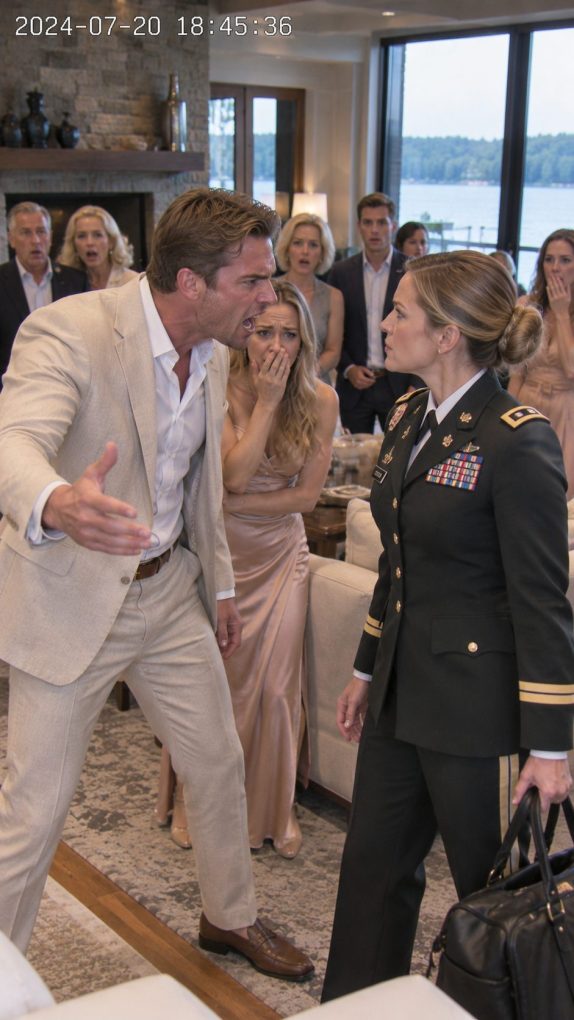
¡Fuera de aquí, parásito inútil! —gritó mi cuñado a centímetros de mi cara durante nuestra celebración familiar. Amenazó con que la seguridad me sacaría a rastras de la propiedad ante la mirada de veinte parientes. Tomé mi bolsa militar en silencio y me marché. Diez minutos después, estaba hablando con un oficial superior del Ejército sobre algo que mi cuñado quería ocultar a toda costa.
Mi nombre es Coronel Emily Carter. Tengo cuarenta y cinco años y he servido veintitrés años en el Ejército de los Estados Unidos. Había regresado al norte de Virginia después de una misión en el extranjero, con la esperanza de celebrar el septuagésimo cumpleaños de mi padre en la casa del lago que había comprado seis años antes.
Mi hermana menor, Rachel, y su esposo, Ryan Mitchell, se habían estado quedando allí temporalmente mientras renovaban su casa. Lo permití porque Rachel era de la familia. Desafortunadamente, Ryan empezó a comportarse como si la propiedad fuera suya, organizando fiestas, cambiando las cerraduras y diciéndoles a los familiares que yo era simplemente un soldado desempleado que vivía de las ayudas del gobierno.
Esa tarde de sábado llegué con mi bolsa de lona militar negra. Casi veinte familiares estaban reunidos en el comedor cuando Ryan me bloqueó la entrada. Exigió saber por qué había aparecido sin permiso. Con calma le recordé que mi nombre figuraba en la escritura.
Ryan soltó una carcajada. Agarró mi bolsa de lona y la arrojó hacia la puerta, esparciendo varias de mis pertenencias. Rachel se quedó detrás de él, evitando mi mirada. Mi padre intentó intervenir, pero Ryan golpeó la mesa del comedor con la palma de la mano y ordenó a todos que se mantuvieran alejados.
¿Crees que llevar uniforme te hace importante? —gritó Ryan—. ¡No eres más que un parásito que espera que todos te respeten! Se acercó y amenazó con llamar a sus contactos de seguridad para que me echaran. Varios familiares miraban al suelo mientras otros grababan nerviosamente la confrontación.
Tomé mi bolso sin responder. Antes de irme, vi varios vehículos desconocidos estacionados junto al garaje. Dos hombres con chaquetas bordadas con el logo de Sentinel Defense Solutions estaban descargando cajas de equipo selladas. Ryan se interpuso inmediatamente entre yo y las ventanas al darse cuenta de hacia dónde miraba.
Afuera, llamé al general de división Thomas Whitaker, un oficial superior que supervisa una revisión del cumplimiento de los contratos de defensa que involucra a varias instalaciones del Ejército. A principios de esa semana, me había pedido que informara sobre cualquier inquietud creíble relacionada con Sentinel, un contratista que actualmente está siendo investigado por registros de equipos restringidos.
I explained what I had witnessed, carefully separating facts from suspicions. Whitaker instructed me not to confront anyone or handle the equipment. He said he would refer the information to the appropriate investigative authorities because my brother-in-law had previously worked as a subcontractor for Sentinel.
As I ended the call, my father hurried onto the porch, looking terrified. He whispered that Ryan had been using my garage for months and had forbidden anyone from entering it. Then he handed me an envelope Ryan had accidentally left inside. Across its front were three words that made my stomach tighten: Restricted Inventory Transfer.
I opened the envelope only far enough to recognize the document heading, then stopped. I knew better than to examine materials that might belong to a sensitive investigation. I photographed the envelope’s exterior, placed it in a clean folder, and called the investigator whose contact information General Whitaker had provided.
Within an hour, a representative from the Army Criminal Investigation Division contacted me. He explained that investigators would need to establish whether the equipment had any connection to government property before taking further action. I gave him Ryan’s employment details, the vehicle descriptions, and my father’s account of the garage activity.
Meanwhile, Ryan called me repeatedly. When I finally answered, he demanded that I return immediately and apologize in front of the family. He claimed I had embarrassed him during an important business gathering. I told him the discussion was over and that he needed to remove his unauthorized equipment from my property.
Ryan’s tone changed. He suddenly offered to pay me $20,000 if I allowed him to continue using the garage for another month. When I refused, he threatened to sue me for interfering with his business. I ended the conversation and preserved the messages for investigators.
That evening, Rachel arrived at my temporary apartment crying. She confessed that Ryan had told her he was storing surplus communications equipment purchased through legitimate government auctions. But she had recently discovered invoices showing serial numbers that didn’t match the inventory descriptions. Whenever she questioned him, he became furious.
Rachel also revealed that Ryan had been using my address as the registered storage location for his subcontracting company without my permission. She had discovered the paperwork while searching for mortgage records. Worse, Ryan had instructed her to sign documents confirming that I had authorized the arrangement.
I asked whether she had signed anything. Rachel shook her head, explaining that she had refused and secretly photographed the forms. When she showed me the pictures, I saw a supposed authorization letter bearing my printed name and a signature that resembled mine. I had never signed it.
The following morning, investigators obtained the appropriate legal authorization to examine the garage. I cooperated as the property owner but remained outside while trained personnel documented the contents. They recovered equipment and records that required further verification against government inventory databases. No one suggested that my military rank gave me special authority over the investigation.
Ryan arrived while the examination was underway. His confident expression disappeared when he saw the investigators. He demanded to know who had reported him, then pointed at me and accused me of destroying his career because of a family argument. I remained silent as an investigator directed him away from the garage.