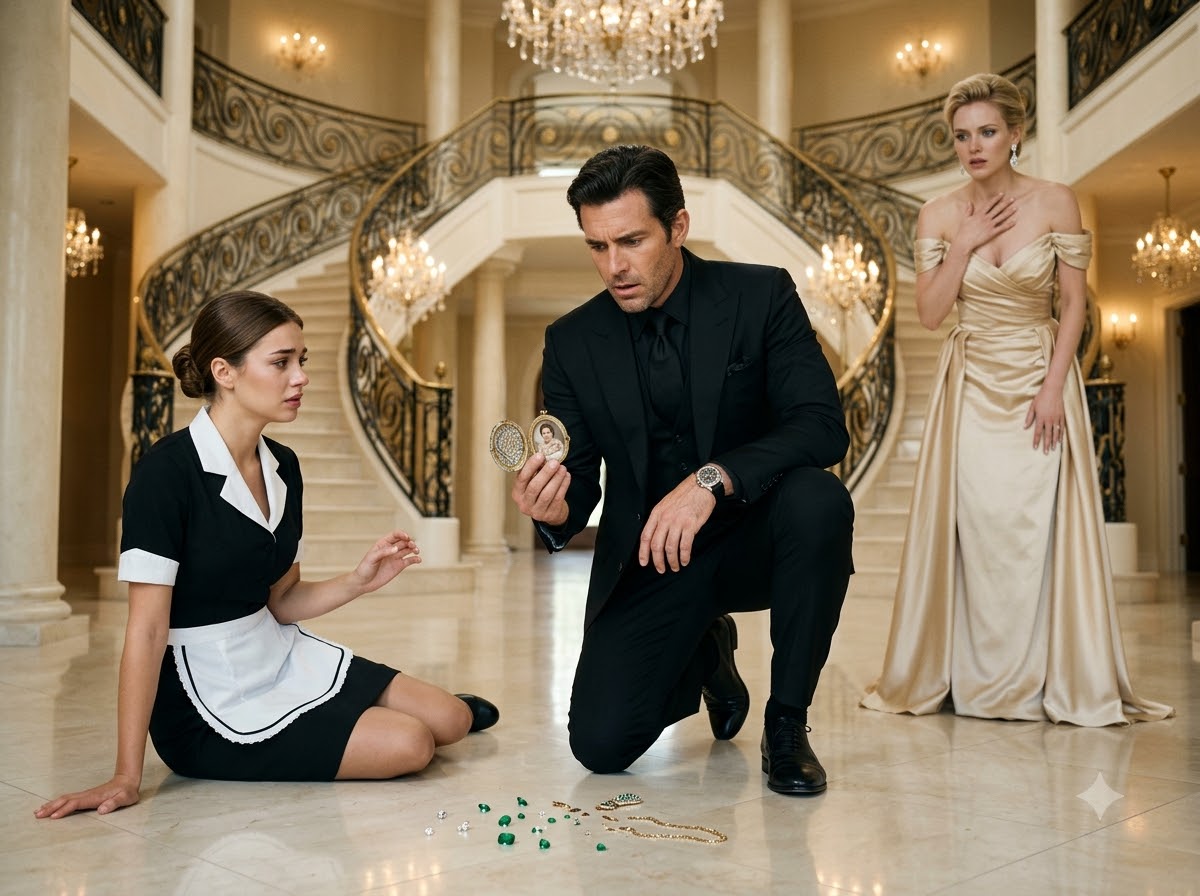
The first thing Sofia heard was the sound of a diamond striking marble. It made a delicate, ridiculous noise, like a spoon tapping a champagne flute. Then another stone hit the floor, and another, until the foyer of the Whitmore estate glittered with scattered wealth. Sofia had been helping Victoria Laurent remove the emerald necklace after a charity dinner. She had held the clasp carefully between two fingers, aware that a month’s wages would not pay for a single link. The old gold had snapped anyway. For one breath Victoria stared at the broken chain. Then she slapped Sofia hard enough to send her stumbling into a console table. ‘You stupid little maid,’ she shouted. ‘Do you know what you’ve done?’ Sofia touched her cheek. She knew only that she had tried to help, and that the necklace had seemed strangely brittle beneath her fingers.
Alexander Whitmore entered from the library with his jacket over one arm. At thirty-eight, he had built a fortune from shipping software, private hospitals, and investments that newspapers discussed with equal measures of admiration and suspicion. He was not accustomed to people speaking when he entered a room. Yet he stopped when he saw Sofia on the floor, one hand braced against the marble, and Victoria towering above her. ‘Don’t touch her again,’ he said. Victoria’s expression changed at once. ‘Baby, she destroyed your mother’s necklace.’ Alexander looked at the central emerald. A thin seam ran across its setting. He had seen that seam before, although he could not immediately remember where. He knelt, picked up the stone, and pressed the concealed catch. The setting opened like a tiny book. Inside was a miniature photograph of his late mother holding a newborn. On the reverse, engraved in the gold, was one word: SOFIA.
Alexander forgot the guests still talking in the dining room. He forgot the calls waiting on his phone. He remembered being eleven, standing outside his mother’s bedroom while adults whispered about a baby who had died before she could come home. His mother, Eleanor Whitmore, had refused to let anyone pack away the nursery. His father had ordered it locked. For twenty-seven years Alexander had accepted the family story because children cannot investigate the people who feed them. Now he stared at the photograph, and his hands shook. ‘Where did you get this?’ he asked Victoria. ‘Your mother gave it to me,’ she answered. ‘My mother died before we met.’ He turned toward Sofia. Her eyes were dark, her hair pulled into a practical knot, and a faint crescent-shaped birthmark sat just below her left ear. He had seen the same mark in the photograph. ‘Why,’ he asked slowly, ‘are you wearing the necklace my mother left my sister?’
Sofia had grown up being told that her name was the only thing her birth mother had given her. Her foster mother, a retired school cafeteria worker named Ruth Alvarez, had found that name on a hospital bracelet when Sofia arrived at her home at six months old. Ruth had never pretended to know more. She had raised Sofia in a narrow brick house in Queens, taught her to stretch soup across three dinners, and told her that the circumstances of her birth did not define the value of her life. Ruth had died two winters earlier, leaving Sofia with a small collection of photographs and an envelope marked FOR WHEN YOU FEEL READY. Sofia had not opened it. She had been afraid it would contain a name she could never find.
‘Your sister?’ Sofia repeated. Victoria laughed too sharply. ‘Alexander, you’re letting a servant manipulate you.’ He rose and called his security director, Caleb Shaw. ‘Nobody leaves with that necklace. Have the guests escorted out respectfully. And get Dr. Miriam Hale on the phone.’ Victoria took a step toward him. ‘You’re embarrassing me.’ ‘You struck an employee in my home,’ Alexander replied. ‘Embarrassment is the least of your concerns.’ He offered Sofia his hand. She stood without taking it. The gesture was small, but he noticed. ‘I don’t need rescuing from the floor,’ she said. ‘I need you to believe what happened.’ Alexander looked at the reddening mark on her face. ‘I do.’
When the last guest had gone, Alexander brought the necklace into the study. Sofia remained near the door. She was certain he would ask her to sign a confidentiality agreement and disappear. Instead he laid the photograph beneath a reading lamp and brought out an old leather album. He turned pages slowly until he found a picture of Eleanor beside the hospital window, her arms wrapped around a pink blanket. ‘This was taken the day my sister was born,’ he said. Sofia leaned closer. In the corner of the photograph was a nurse wearing a blue enamel pin shaped like a swallow. Sofia recognized the pin from a picture in Ruth’s kitchen. It had belonged to a woman Ruth called Aunt June, although June was not related to either of them.

