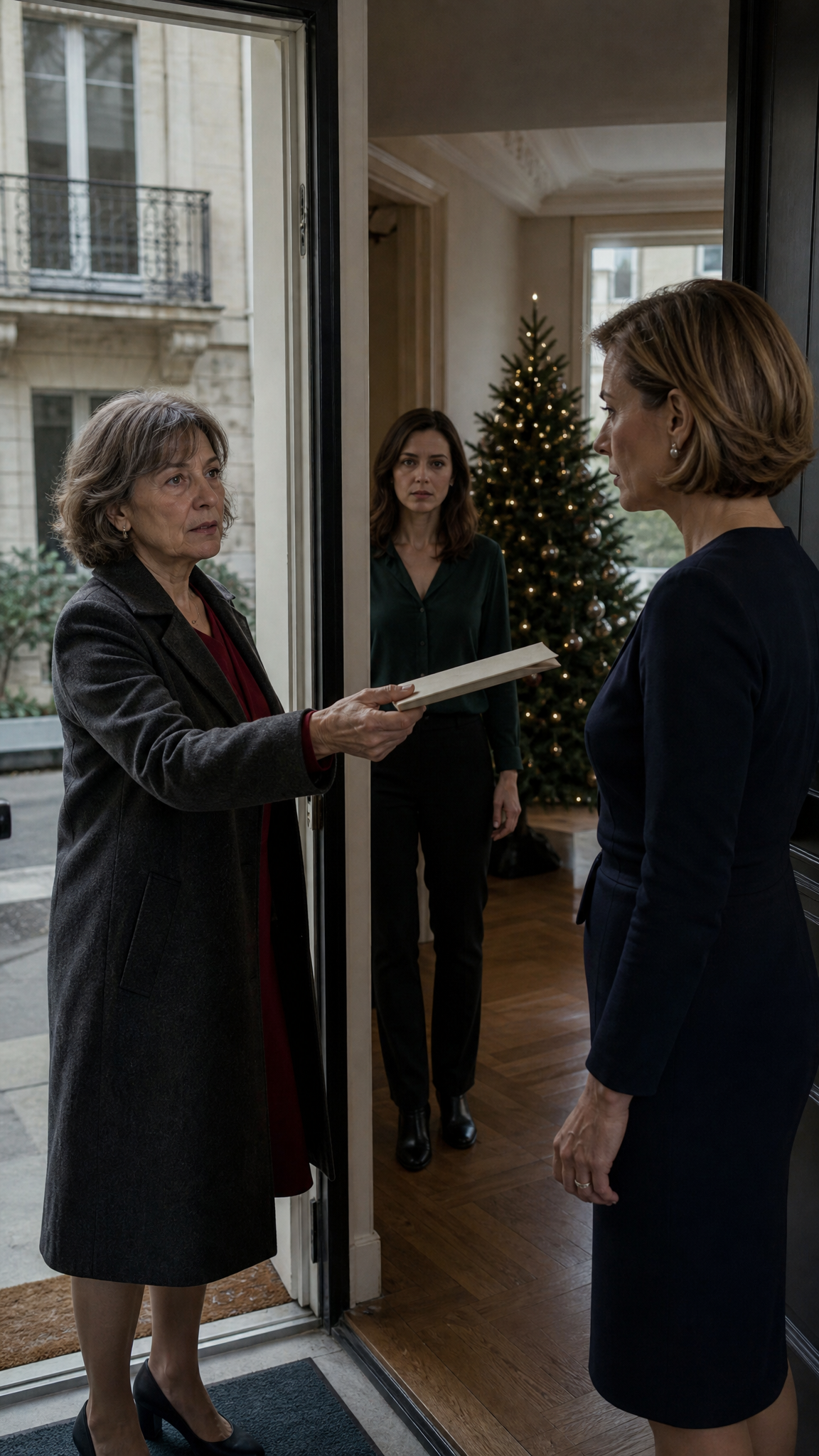
At 3:14 a.m., my daughter wrote to me that I wasn’t “family enough” to sit at the Christmas table, in the house my savings had paid for.
I replied with a single word: “Understood.”
My name is Jeanne Vignal. I am sixty-two years old, a widow, and I worked for thirty-five years as a librarian. Until that night, I mistook silence for dignity.
Outside, the rain was beating against the tall windows of my apartment in Saint-Cloud. I had placed my book on my lap and was about to turn off the lamp when my cell phone vibrated on the coffee table. I didn’t immediately recognize Elise’s number. Then I saw her name appear on the screen, and I smiled.
That smile didn’t last long.
“Mom, I know you’ve helped around the house, but Agnes thinks Christmas Eve should be just for close family. I hope you understand. I love you.”
I reread the message. Once. Twice. I stopped at the word “helped”.
There were words that were used out of delicacy. Others out of ignorance. And some, like that one, served to diminish what one owed someone.
I hadn’t simply helped Elise and Julien buy their house. When the bank rejected their application, I provided most of the remaining funds. Then, when Julien’s business ran into difficulties, I covered several monthly payments. I paid the taxes, the insurance, the urgent repairs, and even the water leak that no one mentioned afterward, while guests admired the hardwood floors and the garden.
I had done all this without keeping score at the dinner table. Without asking for thanks after each transfer. I believed that a mother didn’t need to turn love into a bill.
But in that house, I had become a nuisance.
First, I was a mother. Then a guest. Next, “too sensitive.” Finally, the problem that had to be avoided.
Agnès, Julien’s mother, hadn’t participated in the purchase. Yet she moved around the house as if she’d always had the keys. She wore discreet jewelry and expensive perfume, and spoke of my profession with a condescending smile.
“That was charming, librarian,” she had told me one day, as she put down her cup.
I replied that I had loved my job. I didn’t explain to him that you don’t need a prestigious job to know your worth.
Another day, she had my favorite armchair removed from the living room because it didn’t match the decor. Elise called me afterwards to tell me it had been put in the garage.
“We’ll keep it, Mom. It just looks neater without it.”
The armchair ended up behind crates of books and cans of paint. Then the guest room that Elise had promised me was turned into a storage room. It was piled full of boxes, garment bags, and an exercise bike still in its packaging.
When I asked a question, my daughter would squeeze my hand.
“It’s temporary, Mom.”
Provisional: the word we use when we hope you will stop asking for your place.
The November lunch had already been cancelled. Agnès said the house would be too full. Elise had assured me that Christmas would be different. I wanted to believe her. I even offered to bring dessert, as I did every year.
Now I understood what “different” meant.
I didn’t call Elise in the middle of the night. I didn’t list the payments, remind her of the years of work, or ask why she called keeping her distance “preserving the peace.” I simply wrote: “Understood.”
Then I put down my phone and sat in silence.
It wasn’t the silence of dignity. Not quite. It was the silence that comes when you finally stop negotiating with yourself.
The next morning, I called Maître Delmas.
He had been my husband Marc’s lawyer for years. After Marc’s death four years earlier, he had helped me settle the estate. I hadn’t seen him since. He received me in his office in central Paris, in a room where the files were arranged with a precision that would have pleased Marc.
I told him about Elise’s message. Then I talked to him about the house. Not just the money paid, but also how things had unfolded: the renovations, the bills, the decisions made without me. I finally pulled out a folder from my bag where I’d kept the bank correspondence and the receipts for the recent work.
Mr. Delmas made no comment. He opened a trunk, took out a thick file, and read through several pages. At one point, he stopped. He reread a passage, then pushed his glasses back up his nose.
I twisted my wedding ring around my finger.
“Is there a problem?”
He looked up at me.
“Jeanne, they’ve forgotten who holds the legal authority over this property.”
