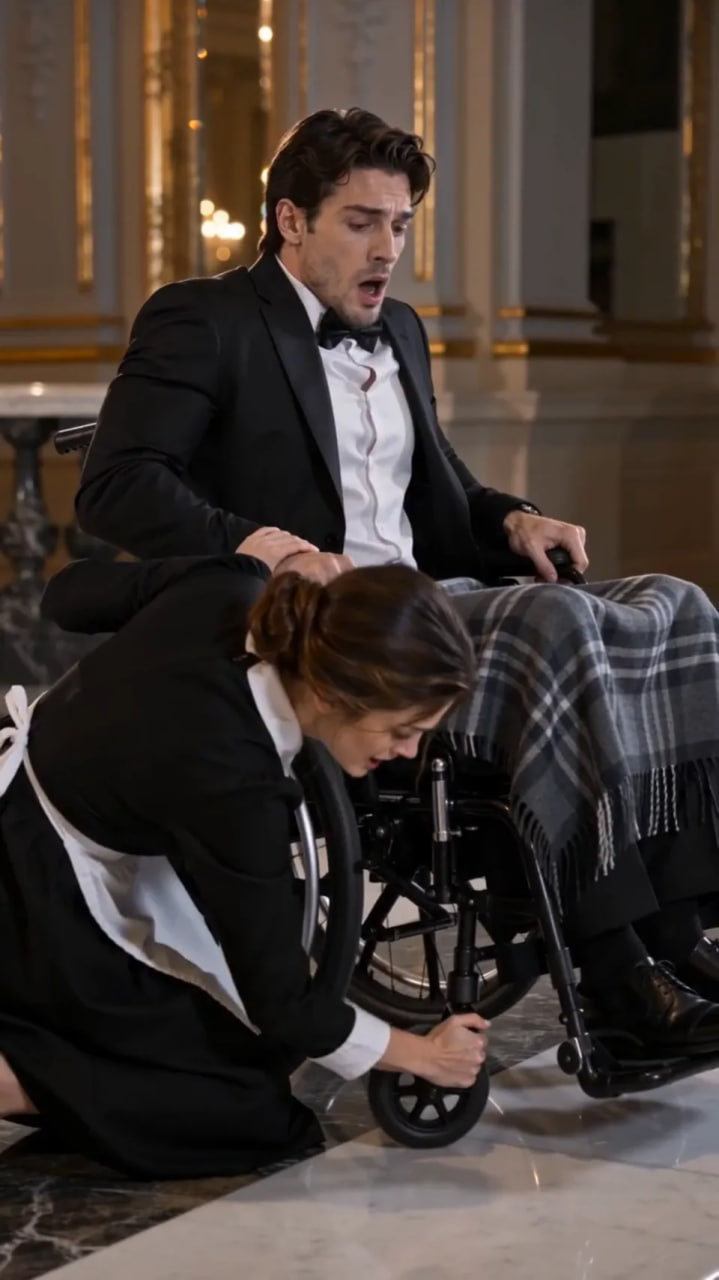
The wheelchair began moving before I understood what I was seeing.
One moment, Julian Ashford sat beneath the ballroom chandeliers while his wife smiled for a photographer.
The next, his chair rolled backward toward the open staircase.
There were six steps between the ballroom terrace and the lower reception hall.
Six polished marble steps.
Enough.
“Watch out!”
I dropped the tray.
Champagne glasses struck the floor behind me as I ran.
My knees hit the marble beside the chair. I caught the wheel with both hands and felt it drag against my palms.
For a terrible second, I could not stop it.
Then a waiter reached the other side.
Together, we held the chair inches from the edge.
Julian gripped the armrests.
His face had gone still.
Not peaceful.
The kind of stillness people mistake for calm when they have never been close enough to recognize terror.
“Don’t move,” I whispered.
A foolish instruction.
A necessary one.
Around us, the ballroom had fallen silent.
Two hundred guests watched from beneath flowers and crystal lights while my hands shook against the wheel.
Victoria Ashford stepped closer.
She still held her champagne.
I expected her to kneel.
To touch her husband.
To ask whether he was hurt.
Instead, she looked at me.
“Clara, stop making a spectacle.”
I stared.
The waiter beside me, Daniel, did too.
Julian turned his head toward her.
“Victoria.”
She exhaled as though he had become inconvenient at a particularly expensive moment.
“He’s a cripple now,” she said quietly.
Quietly enough, perhaps, that she thought the room would let the words disappear.
It did not.
“He has nothing left. You don’t need to cling to the chair like he’s still someone important.”
Something hot rose behind my eyes.
Not only anger.
Recognition.
I had heard people speak about the injured as though losing ease of movement erased a person’s place in the world.
My mother spent her last years using a wheelchair.
She remained stubborn, funny, and capable of noticing an insult from three rooms away.
I looked up at Victoria.
“I don’t care what he has.”
My voice broke.
“I’m not leaving him at the top of a staircase.”
For a moment, no one breathed.
Then Julian spoke.
“Daniel. Bring the chair forward.”
We moved carefully.
Another staff member cleared broken glass.
Someone finally asked for medical help.
Once the wheelchair stood safely away from the steps, Julian placed his feet beneath him.
He leaned forward.
I thought he was uncomfortable.
Then he stood.
Not with a miraculous leap.
Slowly.
Deliberately.
One hand briefly steadied him against the chair.
Then he released it.
His shoulders straightened inside his dark dinner jacket.
Victoria’s glass trembled.
I sat on the floor, staring.
For eight months, I had cleaned his room, brought coffee, and watched people speak over him as though sitting lower meant understanding less.
I had never seen him stand without assistance.
“Julian?”
His wife’s voice had become very small.
He looked at her.
“I began walking again three months ago.”
The ballroom changed.
A ripple of movement.
A sharp breath.
Someone whispered his name.
Victoria shook her head.
“No.”
He remained still.
“I still use the chair when I need it. Recovery isn’t a performance, Victoria.”
His eyes moved toward the stairs.
“But what happened just now was.”
My name is Clara Bennett.
I was twenty-nine, employed by the estate’s housekeeping contractor, and earning enough to keep my daughter in after-school care if nothing unexpected happened.
Unexpected things happened regularly.
That evening, I had been assigned to the Ashford Foundation’s annual gala.
A white blouse.
Black skirt.
An apron somebody decided looked more elegant than the practical uniform we normally wore.
My job was to clear glasses and remain invisible.
I had become good at that.
Invisible people heard things.
They noticed whose voice changed when doors closed.
They knew which guests thanked staff and which ones used a hand movement instead of a name.
They also saw moments nobody important expected them to remember.
Twenty seconds before Julian’s chair moved, Victoria had been standing behind him.
Her hand was not on his shoulder.
I knew that much.
I had looked away only when a guest asked for water.
Now Julian turned toward the ballroom.
“Please give the staff room.”
The words were directed at people who had begun moving closer with their phones.
His attention returned to me.
“Clara. Are you hurt?”
I looked down.
There was blood on one knee where broken glass had caught my stocking.
My palms burned.
“I’m fine.”
He shook his head.
“That wasn’t the question.”
Before I could answer, a woman in a navy suit approached from the private dining room.
I recognized her as his attorney.
Beside her walked the head of venue security.
Victoria saw them.
